
 Gaby
Gaby
The states where he was born and died (the Holy Roman and Austrian Empires) no longer exist, yet Beethoven’s name in the 21st century carries as much weight as it did in the 18th. Despite losing his hearing, the genius masterfully played several instruments, composed symphonies, and conducted orchestras. Fate may have taken his physical hearing, but it left him with a musical ear—more than enough to create immortal masterpieces across many genres.
Not a second, but the first
He did not become the “second Mozart” as his parents had hoped; instead, he became the “first Beethoven.” Mozart, upon hearing this distinctive young talent in Vienna, reportedly predicted that the world would come to know him. And so it happened during Beethoven’s own lifetime. Tragically, he lived only 56 years, about 30 of which he spent in complete silence, alone with his inner metronome. Paradoxically, those silent years proved pivotal for his unparalleled creativity, during which he gave humanity his greatest symphonies, operas, choral works, theater music, sonatas, overtures, quartets, and concertos.
One of the most intriguing composers of all time, he gave the piano its own “voice,” allowing it to stand apart from the harpsichord. This legendary German composer forged a signature piano style marked by dramatic contrasts between extreme registers (the harpsichord had been limited mostly to the middle range), by expressive use of dynamics and pedal, and by powerful chordal harmonies.
The son of a tenor, the grandson of a bass
The phenomenal child was born on December 16, 1770, in Bonn, into a family of court musicians. Ludwig was named after his grandfather, a native of the Southern Netherlands who rose to become conductor of the court chapel. His father was a tenor in that chapel, and his grandfather had been a bass; his mother was the daughter of the court chef.
From a young age, Ludwig learned the violin, organ, and harpsichord, and by age 8 he gave his first public performance in Cologne. His teachers encouraged him to study well-tempered keyboard works, so the young Beethoven grew up on the music of Bach, Mozart, and Haydn. At 12, he composed his first original piece, a variation on a popular march that entered the repertoire of the assistant court organist. As a child, Ludwig van Beethoven wrote three sonatas and a number of songs, one of which—”The Little Raven”—is still taught to children in schools today.

Beethoven’s parents: Johann and Maria Magdalena
After his grandfather’s death the family’s finances worsened, and Beethoven left school early to educate himself. Beyond music, he loved literature, languages, and philosophy: he read in German, French, Italian, and Latin, striving from a young age, as he put it, to understand the core ideas of the great thinkers. He tackled works by Homer, Plutarch, Shakespeare, Goethe, and Schiller.
A title is not an achievement
Beethoven never had the chance to study with Mozart. After reportedly impressing Mozart with an improvisation—”This young man will be talked about by everyone!”—17-year-old Ludwig left Vienna when his mother died. With the responsibility of caring for his younger brothers, Beethoven had little time for formal study: he took a position singing as an alto in the court ensemble, where he performed works by Mozart, the very person who might have been his teacher. Two years later, he was able to resume his studies.
He attended lectures at the university in Bonn while Europe trembled under the French Revolution. Progressive professors there supported radical ideas, and after reading a collection of revolutionary poetry from one of his teachers, Beethoven wrote a piece about social justice. In his “Song of the Free Man” he wrote, “He is free who does not consider birth and title an advantage.”

Young Beethoven (1801), painting by Karl T. Riedel
In that sense, Beethoven considered himself free. He allowed himself an informal hairstyle and careless clothing, sharp judgments, and independent behavior. He would stop performing if people in the hall talked: “It’s not worth throwing pearls before swine.” He refused to entertain guests if he himself was a guest. When Prince Lichnowsky announced Beethoven’s performance in his salon, the unyielding composer left the parlor and locked himself in a room. The prince ordered the lock broken; Beethoven slammed the door and immediately left the aristocrat’s palace that had offended him. The next morning he sent Lichnowsky a note: “I owe my name to myself. There are many princes, but there is only one Beethoven.”
There is no harmony in the world
When he encountered Emperor Franz in the street, Beethoven did not bow deeply; he pushed through the crowd of attendants and barely touched his hat. Disillusioned by Napoleon’s betrayal of revolutionary ideals, the 34-year-old Beethoven refused to dedicate his Third Symphony to the French emperor. He crossed out the dedication on the title page of the “Eroica” and wrote beside it a stinging accusation: “Now this mediocre creature will trample on civil rights and become a tyrant.”

Title page of the “Eroica” Symphony, edited by the author
Because of his outspoken remarks about the emperor, the heir apparent, and other rulers, colleagues sometimes had to destroy portions of the “conversation notebooks” that helped them communicate with the deaf Beethoven. He constantly criticized actions by authorities that he saw as unjust and laws and decrees harmful to the people. “You will end up on the scaffold,” his friends warned, urging caution and sometimes pointing out suspected spies. Beethoven’s bleak view of human affairs shaped his public image and his music and sometimes alienated others. Haydn, for example, called his student talented but “gloomy and strange” and declined to continue working with him because of his radical views.
Who killed the genius?
Despite his outward severity, Beethoven never turned away relatives and friends in need. He struggled with suicidal thoughts after his hearing began to fail (the composer started losing his hearing at 26), and a 2007 study of his remains suggested that lead treatments given during efforts to drain bodily fluids may have worsened his condition. He kept living for the purpose he saw in making music and for the sake of those he supported.
After his brother’s death, Beethoven took on the care of his nephew. Managing the boy’s upbringing and finances took a toll on Beethoven’s health. The nephew’s education at top boarding schools and with fine music teachers proved futile: he preferred billiards and cards to art, fell into debt, and attempted suicide. The gunshot left a scar on the nephew’s head; Beethoven’s health, already fragile, suffered from the stress. Beethoven died in March 1827 at the age of 56. His funeral drew some 20,000 mourners who came to honor the composer and his immortal music.
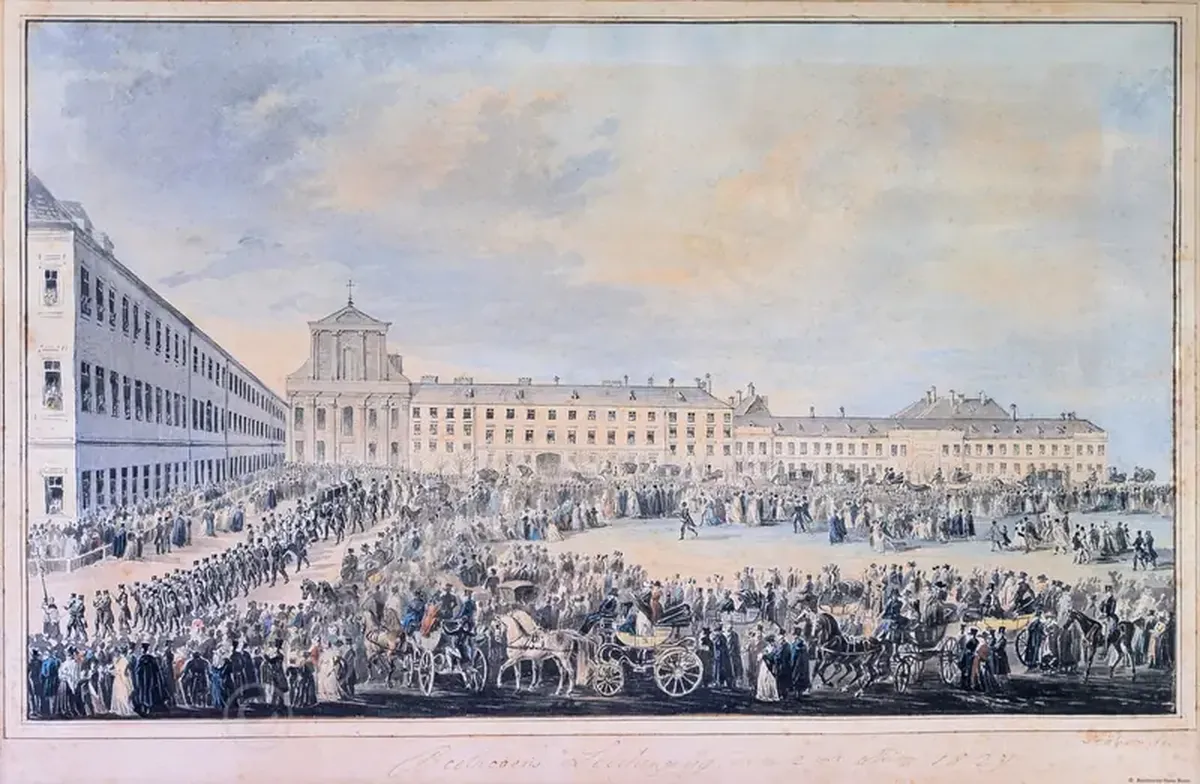
Beethoven’s funeral procession: watercolor by FX Stoeber
