
 Carlos Solis
AI services from OpenAI, Meta, Google, and others can translate dozens of languages almost instantly and keep getting better. But there’s a difference between using a tool to extend what you can do and giving up on doing something yourself. That difference doesn’t just change a skill — it changes how we engage cognitively and culturally.
Effort Is Its Own Reward
Psychologists talk about “desirable difficulties” — challenging tasks that feel inefficient at first but lead to stronger, longer-lasting learning. Battling grammar, searching for the right word, and building a sentence in another language activate brain networks that support attention, memory, and cognitive flexibility. Exercises like these consolidate knowledge far more deeply than passively “consuming” translations.
Sustained mental engagement contributes to what scientists call cognitive resilience — the brain’s ability to maintain function with age. Using multiple languages requires suppressing competing alternatives, monitoring context, and dynamically adapting. Those demands aren’t trivial, and passive reliance on a translator — resolving someone else’s phrase with a single button press — won’t produce them.

What Studies Show
A recent study evaluated cognitive measures in 94 adults aged 18 to 83 using visuospatial and auditory tasks that covered working memory, attention, and the ability to ignore distractions. The researchers examined how people process information they see, hear, or imagine in space.
On most tasks, multilingual and monolingual participants performed similarly. But one clear pattern emerged: people with richer and more varied multilingual experience showed better working memory. This effect was strongest among older participants.
So multilingualism is unlikely to universally improve all cognitive functions, as headlines sometimes suggest. Instead, it may help preserve specific abilities over the years.
Other population-level studies also link multilingualism to a later onset of dementia and generally better cognitive health, although experts still debate the mechanisms.
Bottom line: long-term, active use of multiple languages is a form of mental exercise whose effects accumulate across a lifetime.
What AI Won’t Replace
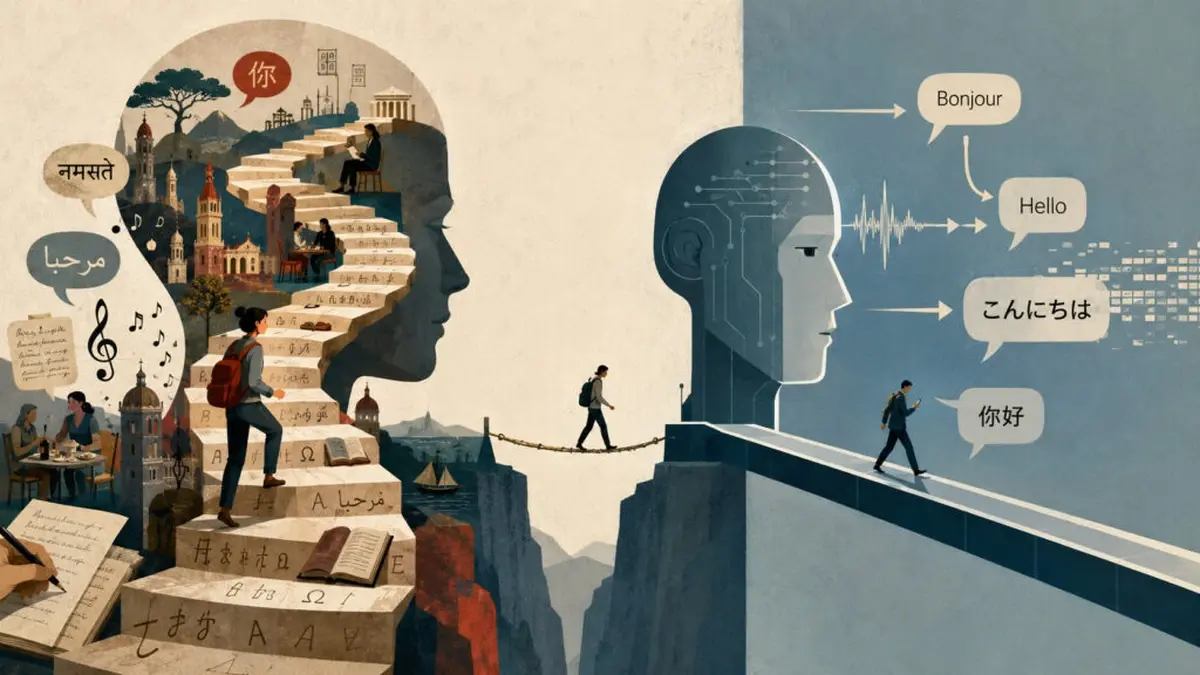
For many practical situations, AI-powered translators handle the job impressively. But they work by spotting patterns, not by offering a lived understanding. AI can miss cultural context, humor, speaking style, and emotionally embedded meaning — especially for languages that are underrepresented in training data. At best, AI conveys the literal aspects of language but skips the social ones.
Cultural literacy means understanding how people think, what they value, and how meaning forms through context and history. You gain that cultural literacy through interaction and experience; you cannot fully delegate it to an on-demand translation system.
AI is already changing how people learn languages: it can personalize lessons, lower access barriers, and provide massive feedback. Used wisely, it amplifies learning and makes it more accessible.
But AI won’t replace the cognitive and cultural work that language learning produces — the work that builds deeper ties to how others see the world and how you express yourself. That difference still matters.
Based on reporting from ZME Science, The Conversation
Photo: Unsplash
