
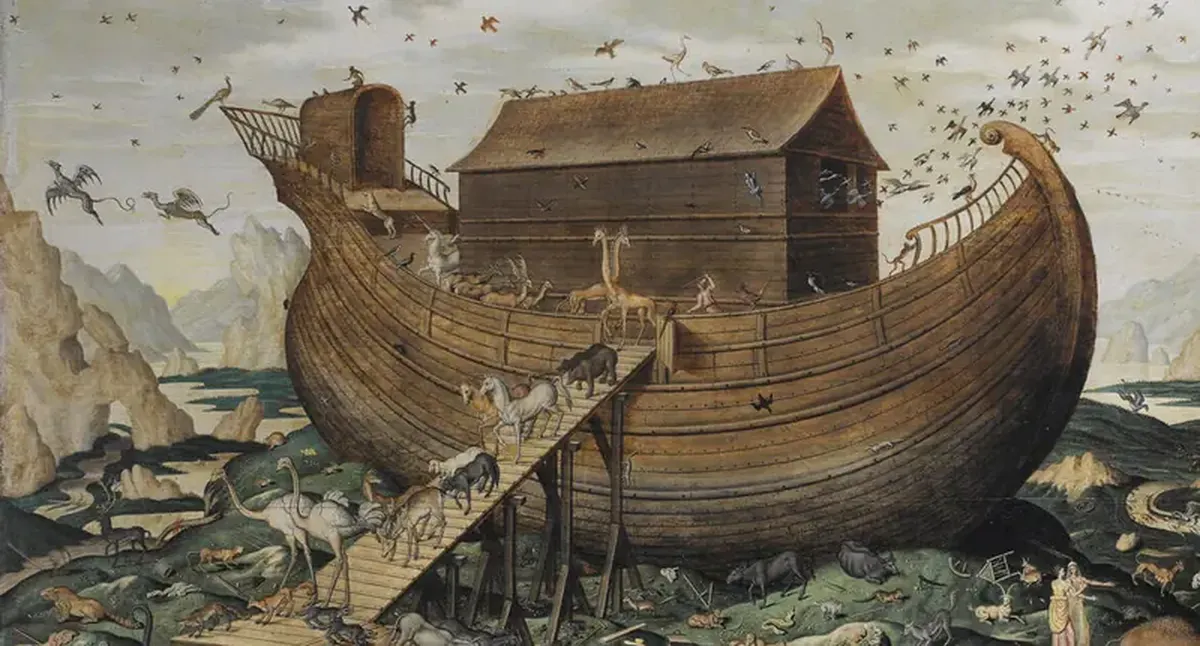
Researchers at the British Museum in London have deciphered a map etched on a clay tablet dating to roughly 3,000 years ago. The scientists discovered that the cuneiform symbols indicate the geographical location of Noah’s Ark.
This Babylonian artifact, known as Imago Mundi, was unearthed in the Middle East in 1882 and later acquired by the British Museum. For years the museum’s researchers worked to decode the cuneiform on this rare object. They concluded that the clay tablet, dated to about the 9th century BCE, is a map of Mesopotamia.

What Did the Scientists Discover?
But that was just the start of their findings. A deeper analysis revealed references to a well-known story mentioned in the Bible.
The reverse side of the tablet served as a sort of guide for ancient travelers. The engraved symbols explained how to reach various landmarks. For instance, it mentions that one must walk “seven leagues to see something as thick as a vessel of parsikhtu.”
The term “parsikhtu” has also been found on other ancient Babylonian tablets. It was used to denote the size of the vessel that helped save lives during the Great Flood: namely, the biblical Noah’s Ark.
The researchers decoded the instructions on the ancient map and found a route to Urartu (Mount Ararat). According to ancient sources, this is where the rescued family disembarked from the ark that had saved their lives.

In addition to these astonishing details, the scholars identified the Euphrates River, Babylon, and other cities on the clay map. They also discovered the so-called “bitter river,” which encircles the landmarks known to the ancient Babylonians over three thousand years ago. Beyond the river, they depicted unknown lands.
Dr. Irving Finkel, curator at the British Museum and a renowned Assyriologist, noted, “This describes the Ark, which, theoretically, was built by the Babylonian version of Noah.” That figure is Utnapishtim.
In the Babylonian version of this story, the god Ea sent a flood that destroyed all of humanity except for Utnapishtim and his family. He built an ark and saved his family along with many animals.
This story appears on a cuneiform tablet roughly 3,000 years old, while the biblical flood is often dated to around 5,000 years ago. The Bible recounts that the ark came to rest on Ararat after a 150-day flood, during which the Earth and all living things not aboard the wooden vessel were submerged. The spot on the mountain where the ark supposedly came to rest roughly matches the ark’s bottom in shape and size.
Dr. Finkel said anyone who follows the route to Urartu might find wooden ribs of a vessel similar to those described in the Bible.

A mountain formation resembling a boat on Mount Ararat
Any Scientific Theory Is Open to Debate
The idea that the ark landed on Ararat has long sparked debate, the Daily Mail reports.
A team of researchers from Istanbul Technical University has been excavating the mountain for many years. In 2023, scientists uncovered clay and seafood remains, indicating that people were present here 5,000 to 3,000 years ago.
However, Dr. Andrew Snelling of the University of Sydney argued that Mount Ararat couldn’t be the ark’s resting place because the mountain formed after the floodwaters receded.
While the story of Noah’s Ark is culturally significant, most scientists do not accept it as a literal historical event.
