
 Gaby
Gaby
The story of a former stockbroker who swapped the city’s hustle for the imagined tranquility of tropical islands foreshadows downshifting—a conscious rejection of imposed values and a simplification of life in search of inner harmony. But choosing risk over compromise came with costs, and he might have done well to remember the old warning: “the grass is always greener on the other side.”
In Search of Paradise
Paul Gauguin was born on June 7, 1848, in Paris, and by the age of one he had lost both his father and his homeland. In 1849 Clovis Gauguin, a political journalist, was forced to flee Paris with his family for safety. A radical Republican shaken by the failure of an anti-monarchist coup and unafraid to voice his opinions in the magazine National, he set sail with his infant son and wife, Aline-Marie (whose mother, Flora Tristan, shared utopian socialist ideals), for Aline’s Creole homeland in Peru. The 35-year-old head of the family never reached South America; he died of a heart attack aboard ship on the way to a new life.

Portrait of Paul Gauguin’s mother
Until he was seven, Gauguin lived in Peru, raised by wealthy maternal relatives. Life on his uncle’s estate in Lima left a lasting impression: vivid local costumes, year-round sun, and an exotic southern landscape he would long to return to. His childhood memories of a “paradise on earth without problems” fueled a consuming love for the tropics and an insatiable thirst for travel. In 1855 he returned to France with his mother to claim an inheritance from his father’s side, settled in his grandfather’s house in Orléans, and began preparing for a maritime academy. Unable to pass the entrance exam, the 15-year-old took a job as an apprentice pilot. For seven years he sailed the seas, visiting the northern oceans, the Mediterranean, South America, and India.
The Law of Survival
The adventurer came home only to learn of his mother’s death during his travels. In her will Aline-Marie urged him to build a career so he would not be helpless without outside support. Paul did have a patron: thanks to a recommendation from his mother’s friend Gustave Arosa—a stock trader, photographer, and art collector—Gauguin landed a job as a stockbroker in Paris in 1872 and, within a year, married a young Danish woman he had met through the same mentor.

“The Garden in Vahine” (The Artist’s Family in the Garden on Carcel Street), 1881
Over the next decade Mette-Sophie Gad bore Gauguin five children, while he, encouraged by Arosa, discovered a passion for visual art and developed a long-hidden talent for painting. The broker set up an art studio, and his income as a financier was supplemented by sales of his paintings.
Everything worked as long as he could support a large family and pay for comfortable housing. But when he lost his lucrative job, Gauguin faced a hard reality: creativity and talent alone could not sustain his former standard of living. Outside his artist friends—Édouard Manet, Edgar Degas, and Camille Pissarro—his early works attracted little interest. In 1884 the family had to leave Paris for the equally expensive Copenhagen. Expecting support from his wife’s relatives proved a mistake. Mette’s Danish family began pressuring her to divorce him. “I know what cold and hunger are,” Gauguin later recalled. “You get used to poverty. But the worst part is that it hinders your work. The constant struggle for a piece of bread in the capital cities drains your energy and leaves your mind with no room to maneuver.”

Gauguin with his wife Mette in Copenhagen, Denmark, 1885
Not for Fame
Disturbed by family discord, in 1885 the artist fled the scandals and accusations—first to Paris, then in the following years to Brittany (Pont-Aven), Martinique, Panama, and Arles. A violent quarrel in Arles with Vincent van Gogh—an episode that culminated in Van Gogh severing part of his ear and being hospitalized—helped convince Gauguin that “civilization is a disease” and pushed him toward the tropics. At the time France’s colonial reach had expanded into Oceania, and the government was covering travel costs to the Pacific. When Gauguin learned this, and that European demand existed for Polynesian pearls, he decided to make a radical change.

Vincent van Gogh, 1888
The myth of carefree tropical peoples—who supposedly did not have to work for food, clothing, or shelter—lured the easygoing traveler. To Europeans, eternal summer seemed to remove many needs; breadfruit and bananas appeared to fall effortlessly from the trees. He was also drawn by the prospect of new models: Tahitian women, whom he imagined as beautiful, carefree, and more accessible than European models.
“I intend to forget my miserable past and go where I can live without money,” Gauguin told the Danish artist Wilhelm. “I will paint at will, not on commission and not for fame.” In his quest to “merge with nature,” Gauguin sailed to Tahiti in 1891 and settled in Papeete, where he produced some 80 works over the course of a year.
Who, Where, and With Whom
After a brief return to France because of illness and lack of funds, Gauguin left for Oceania for good in 1895. He had no intention of returning; his wife and children stayed in Europe. In Tahiti he fathered a child with a young model named Tehura. That relationship was not unique: Gauguin formed and dissolved affairs with several young women who became his models. He also painted port prostitutes waving medical certificates like fans when ships arrived (Gauguin’s painting “Tématete” translates to “Market”). He built a house on the quiet islands he called Maison du Jouir (figuratively, the “Palace of Ecstasy”). The residence was guarded by a dog named Penis.
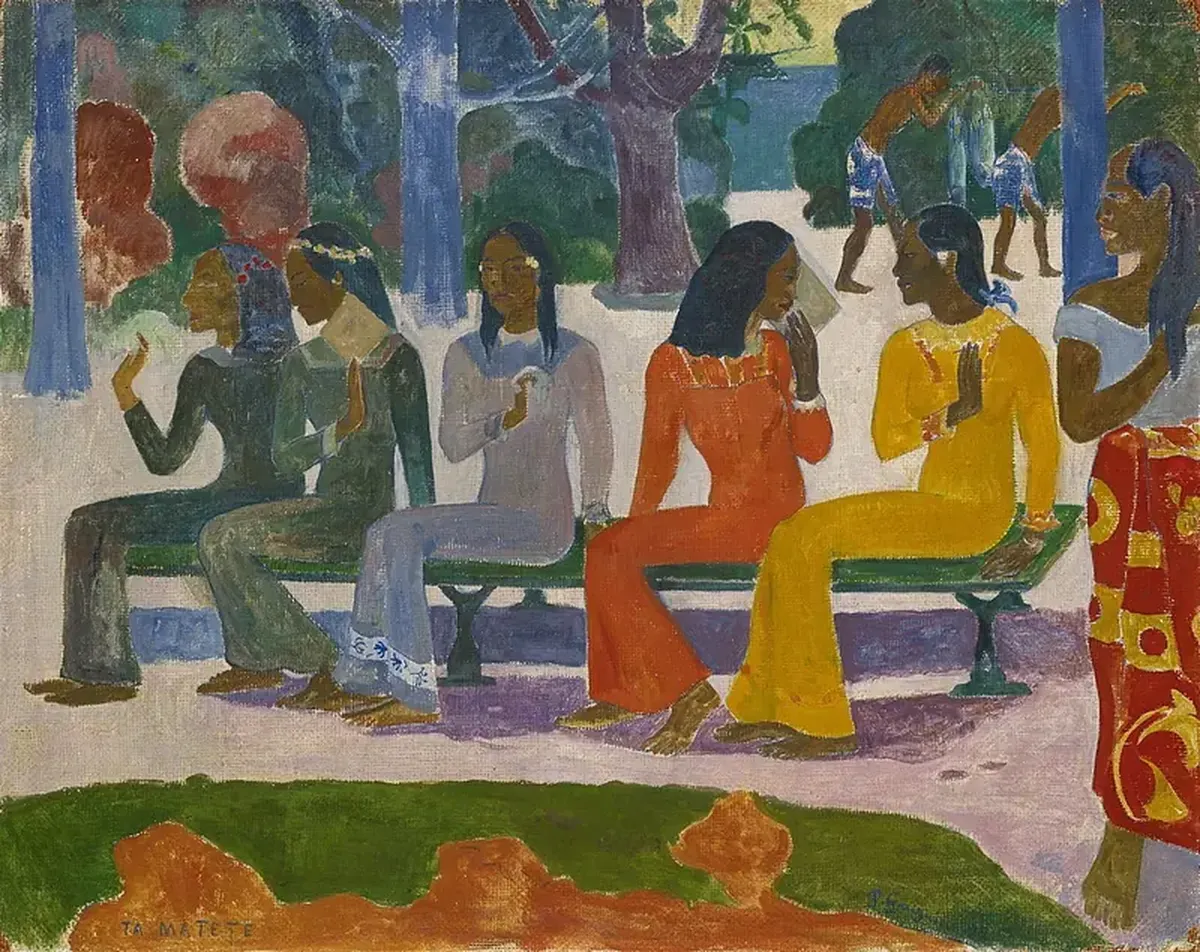
“Tématete” (“Market”), 1892
As a European expatriate, Gauguin supported native social protests and defended local people’s rights in conflicts with colonial authorities. He was taken to court, fined, and at one point threatened with three months in prison. In 1901 he moved alone to the island of Hiva Oa in the Marquesas, where, following in his father’s footsteps, he worked as a journalist, wrote stories, and painted striking canvases. Despite poverty, depression, and illnesses—syphilis among them, which caused painful sores he numbed with morphine—he produced some of his greatest work there. After completing “Where Do We Come From? What Are We? What Are We Going?” Gauguin tried to take his own life by ingesting arsenic; the attempt failed when he vomited the poison.
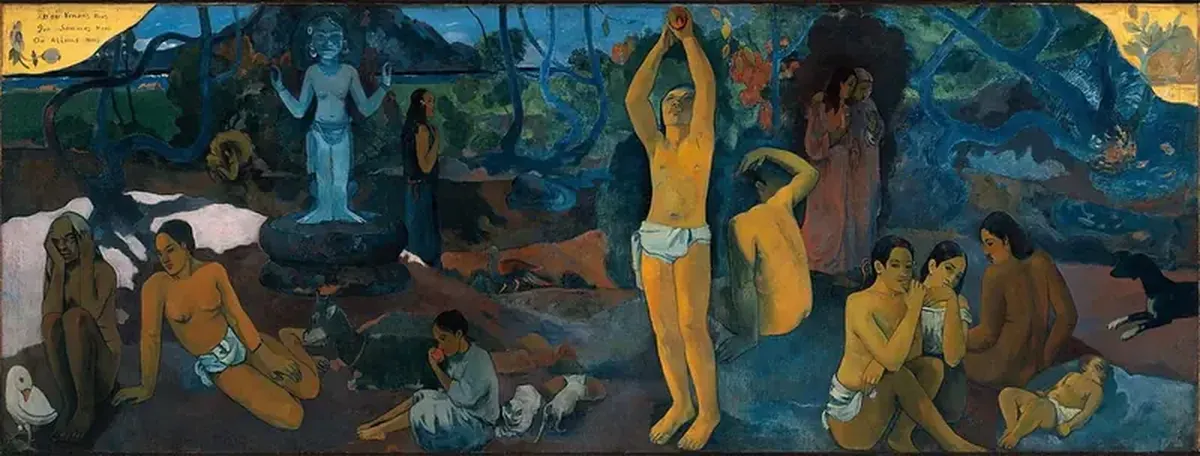
“Where Do We Come From? What Are We? What Are We Going?”, 1897
Posthumous Fame
The poisoning and his long illness shortened Gauguin’s life. He died in Atuona on May 8, 1903, at the age of 55. A heart attack triggered by another dose of morphine ended his life; an empty ampoule lay beside his bed. His grave remained in Polynesia while his works made their way to Europe, helping open the door to Symbolism and modernism for his contemporaries. A 1906 Paris exhibition of 227 paintings secured his posthumous fame. He left behind some 517 works in total.

Gauguin’s grave in Atuona
Gauguin’s life inspired Somerset Maugham’s novel “The Moon and Sixpence,” and filmmakers have made movies about him, such as “The Found Paradise” and “The Savage” (“Journey to Tahiti”). Although his most famous move from Paris to Tahiti did not bring him health or wealth, those extraordinary experiences later increased appreciation for his work. One Tahitian-period painting, “When Is the Wedding?”, was sold by Swiss collector Rudolf Staehelin to a Qatari buyer for nearly $300 million.
