
 Gaby
GabyIn Tim Burton’s popular youth series Wednesday, there’s an episode where the main character, Wednesday Addams, plays the melody of The Rolling Stones’ Paint It Black on a cello from the balcony of her room at Nevermore Academy. That instrumental motif fits the show’s mood and the character’s image perfectly, just as the cello and other equally atmospheric instruments have in other performances of the song.
The song—a musical riddle whose meaning is still debated—was recorded in spring 1966, and since then more than a hundred diverse versions have been documented.
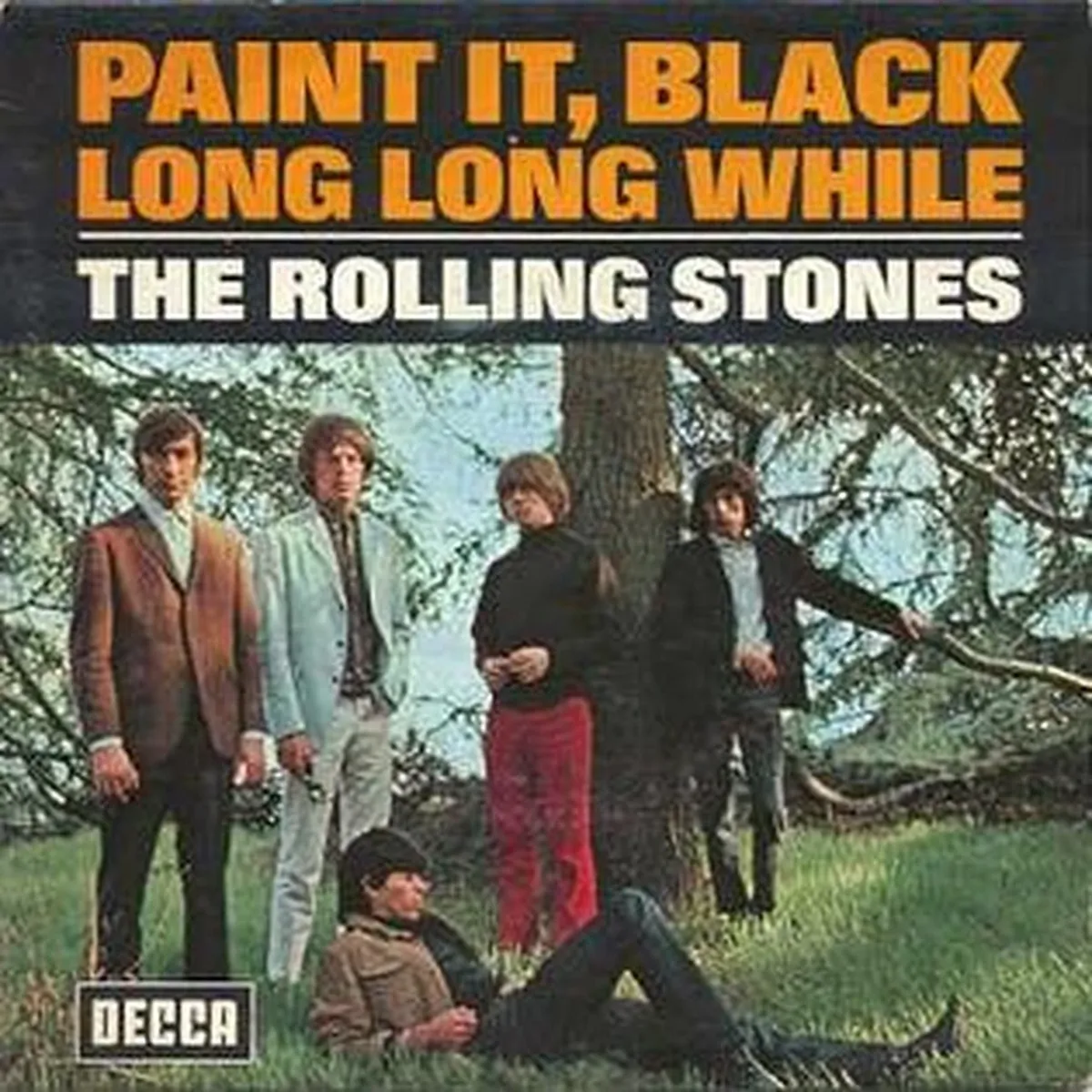
The cover of the single Paint It Black, whose title was mistakenly printed with a comma by the releasing label Decca.
Let’s break down its components.
“Paint It Black” performed by Wednesday Addams

Sitar
The classical Indian plucked instrument was popular among 1960s rock musicians who, eager to follow the era’s fascination with Eastern culture, added exotic flair to their work and boosted their psychedelic sound.
A key popularizer of the sitar and Indian culture in rock was The Beatles’ guitarist George Harrison, who later embraced Hinduism. He became the first rock musician to use the instrument in popular music—most famously on The Beatles’ 1965 song Norwegian Wood (This Bird Has Flown). Given the competitive, sometimes rivalrous, relationship between the bands, the Indian sitar sooner or later also appeared in The Rolling Stones’ music.

North American Tour, 1965
According to one account, the main sitar theme that set the tone for the future hit was born after George Harrison met Rolling Stones guitarist Brian Jones. As early as the early ’60s, Jones studied sitar under Harihar Rao, a disciple of Ravi Shankar, the most renowned master of the instrument.
Rao also played a role in the song’s story: one version says he walked into the studio with his instrument just as the track was being mixed.
This video shows Brian Jones performing the song on sitar:

Vietnam
Stanley Kubrick’s penultimate film, Full Metal Jacket (1987), like Francis Ford Coppola’s Apocalypse Now, remains one of cinema’s most powerful depictions of the horrors of war—specifically the Vietnam War. The film argues that military training doesn’t so much toughen young men as transform them into cold-blooded killers sent to a foreign land. The Rolling Stones’ Paint It Black plays through the end credits and to the film’s conclusion, and from that point the song has often been associated with both the movie and the Vietnam War.
There’s a logic to the link: the song was written in 1966, when America’s active phase in Vietnam was intensifying and anti-war sentiments were spreading worldwide. Rock musicians were cultural leaders at the time, and The Rolling Stones’ popularity in the U.S. was growing quickly. The main riff of Paint It Black was written in a Los Angeles studio. Even if the song’s meaning wasn’t directly about those events, many Vietnam War veterans have said it supported them during those years and captured the fighting spirit they needed.
Official lyric video for the song:

World Literature
Another Rolling Stones song, Sympathy for the Devil, released two years later, drew on Baudelaire’s poems and Bulgakov’s novel The Master and Margarita. Which literary works influenced Paint It Black is less certain: Mick Jagger and Keith Richards never explicitly named their influences.
Some listeners point to British occult writer Dennis Wheatley; others mention Edgar Allan Poe, Bob Dylan, or avant-garde artist Ed Reinhardt. Other sources claim Mick Jagger drew inspiration from James Joyce’s modernist novel Ulysses, specifically a passage with the line “I must turn away before my darkness goes away.” That phrase resembles the moment in the song when the protagonist turns away from girls in summer dresses.

The Rolling Stones Concert, 1981. Photo: Michael Conen
Gypsies and Weddings
In one interview, Mick Jagger joked that Paint It Black was “a song for Jewish weddings.” In another, he compared it to some Turkish songs. So which influences dominate the track—Middle Eastern, Indian (thanks to the sitar), or Romani, as some members of that community claim?
American musicologist James Perone pointed out that despite the sitar intro played in an Indian style, the song’s rhythmic and melodic feel is closer to the Middle East. The search for the right form reportedly led Rolling Stones member Bill Wyman to pound the Hammond organ with his fists during recording, holding it on his lap. That approach pushed the band toward a faster tempo and an Eastern pentatonic flavor.
The song presents a paradox: its lyrics deal with hopelessness, depression, and despair—making it one of rock’s darkest works—yet its accelerated tempo makes it easy to imagine at a private Middle Eastern party, where it would invite dancing.
Perone suggests the protagonist’s depressive state pushed him to a point of “to hell with it all” surrender. The mention of Gypsies fits because Romani cultural contrasts—combining desperate suffering with relentless joy—mirror the song’s emotional mix.
Still, the “Gypsy parallels” in Paint It Black also show up in melody: some listeners have identified motifs from Djelem Djelem, considered the Romani anthem (adopted in 1971 at their World Congress). If you imagine Paint It Black played at twice the speed, the similarity becomes clearer. Listen for yourself:

Color Palette of Emotions
At its core, Paint It Black is about how someone who has just lost a loved one sees the world: inner grief drives them to turn away from girls in light dresses, to notice black cars with unfestive flowers, and to feel an overwhelming urge to paint everything black—even the shining sun.
The song has generated an astonishing number of conspiracy theories, speculations, and wildly different readings of its metaphors.
For example, the line “I see my red door, I must have it painted black” produced surprising interpretations: in the UK, Anglican church doors were traditionally painted red, so some argued the protagonist was turning away from God. Others saw red as a symbol of the communist threat; some thought it referred to the entrance to brothels.
Lines and color references from the song remain hot topics on internet forums and fan sites. One of the stranger theories is that the song was dedicated to Jacqueline Kennedy, since the tragedy surrounding the American president shortly before was a global shock.
Most likely, though, the young Jagger and Richards did not intend any specific hidden meanings in the lyrics. They have spent the decades since watching the cascade of interpretations and flights of fancy the song inspired.

The Rolling Stones Concert in London, 2018. Photo: Raph_PH
Versions
This truly popular song has been performed in many languages around the world—from Finnish to Japanese. Each rendition brings something different. Here is a version by French singer Marie Laforêt:

And here is an eccentric, candid performance by Italian singer Caterina Caselli:

However, many consider Czech singer Karel Gott’s rendition the most successful: he performed the song in German with an orchestral arrangement that blends Romani melancholy and lively dance rhythms.

