
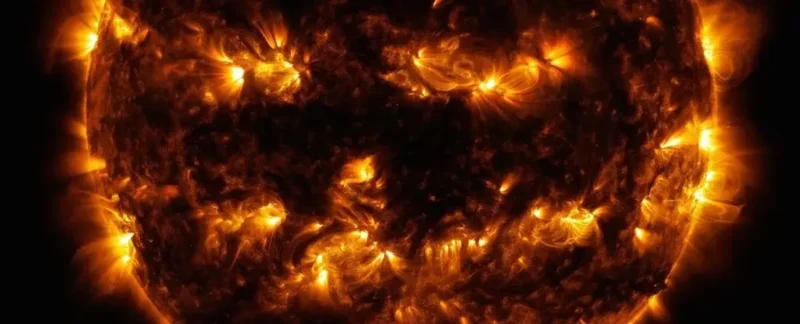
The star that makes life on Earth possible will die in about 5–5.5 billion years.
Researchers estimate the Sun, now about 4.6 billion years old, will die when it’s roughly 10 billion years old.
Its surface temperature is about 5,500 degrees Celsius, and inside the star temperatures reach roughly 20 million °C. Over the years, researchers have proposed many theories about the Sun’s demise. By analyzing observations of Sun-like stars, astronomers have made predictions about its final stages.
One thing is certain: we won’t be around by then. Astronomers estimate Earth will remain habitable for roughly another billion years.
Every billion years, the Sun’s brightness and temperature increase by about 10 percent. Eventually the oceans will evaporate and the planet’s surface will become too hot to support life, ScienceAlert reported.
Using computer models, astronomers analyzed stars similar to the Sun — comparable in age and key properties. In about 5 billion years, the Sun is expected to expand into a red giant. Its core will contract while its outer layers swell to roughly Mars’s orbit, potentially engulfing Earth.
After the red-giant phase, the Sun will shed its outer layers to form a planetary nebula and leave behind a hot core that will cool into a white dwarf. The nebula will shine for about 10,000 years.
Astrophysicist Albert Zijlstra of the University of Manchester says when a star dies it ejects a shell of gas and dust into space. By that stage the star’s core has run out of hydrogen; fusion stops and the core ceases to produce energy, signifying the star’s end.
