
Eco-friendly technologies for commercial aviation are increasingly showing up in everyday life. Developers from NASA and Boeing have presented a concept for an eco-friendly aircraft that will transport passengers in the 2030s. The first flight is expected to take place in five years.
The aircraft’s eco credentials come from an estimated 30% fuel savings, and therefore lower emissions compared with the most efficient modern airliners.
This will be another serious step toward “green” aviation.
The National Aeronautics and Space Administration (NASA) and Boeing are collaborating on the Sustainable Flight Demonstrator project. The partnership aims to develop a low-emissions narrow-body aircraft.
NASA administrator Bill Nelson said the airliner will be more economical and will benefit the environment, the commercial aviation industry, and passengers worldwide. He added that the aircraft will cover about 50 percent of the market for short- and medium-haul commercial flights.
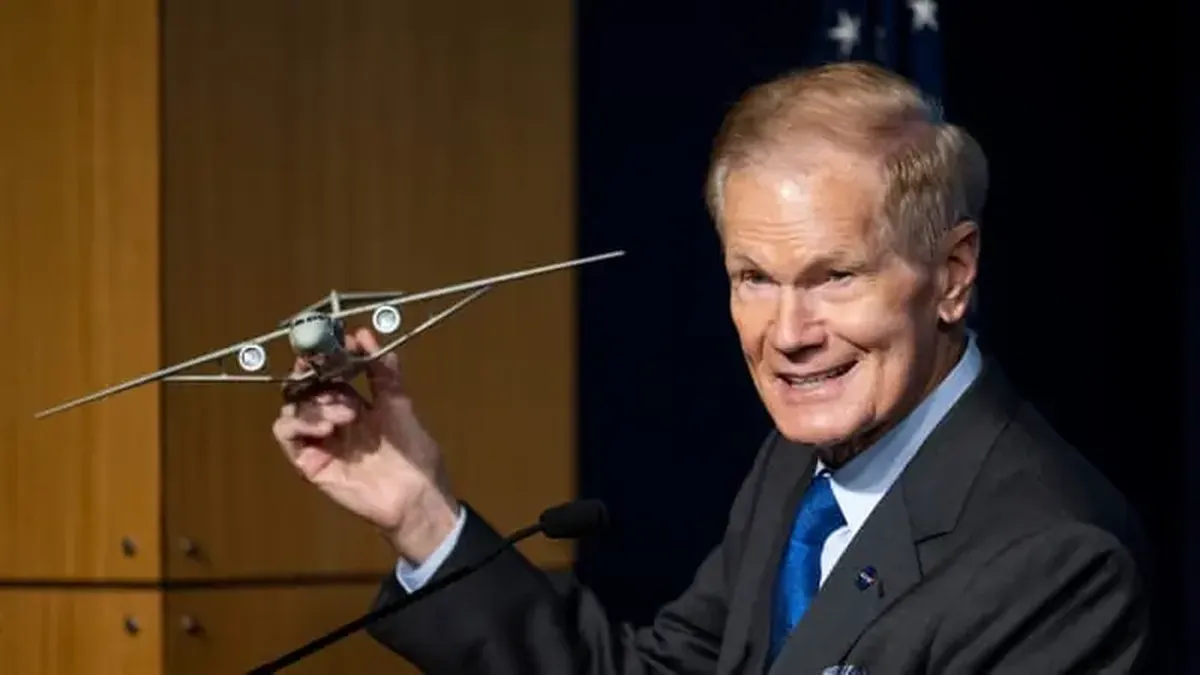
NASA Administrator Bill Nelson is holding a model of the new aircraft.
According to NASA, airlines primarily rely on narrow-body aircraft (fuselage diameters up to four meters). However, these aircraft account for nearly half of aviation emissions worldwide, reports CNN. The development of new technologies to reduce fuel consumption could fundamentally change that balance.
NASA and Boeing’s eco aircraft will meet the requirements of “green” aviation. Its design centers on a new wing concept—the Transonic Truss-Braced Wing. These long, relatively narrow wings are stabilized by diagonal struts and sit high on the fuselage. The configuration reduces drag, which in turn lowers fuel consumption.
According to preliminary estimates from Boeing experts, demand for new narrow-body aircraft is expected to grow by 40,000 units between 2035 and 2050.
The development of revolutionary fuel-efficiency technologies brings the aviation community closer to its goal of achieving net-zero carbon emissions by 2050. Bob Pearce, NASA’s deputy administrator for aeronautics, emphasized that point.
NASA will invest $425 million in the project over seven years. Boeing and its partners will provide the remaining $725 million.
