
 Gaby
GabyIt’s rare to find a plant encased in amber, and even rarer to find a dinosaur fragment. Imagine paleontologists’ surprise when what looked like a delicate flower turned out to be part of the tail of a young theropod dinosaur called a coelurosaur. Coelurosaurs were a diverse group of theropod dinosaurs, closely related to birds, that lived roughly 167 to 65.5 million years ago.
It wasn’t a plant but an animal that caught the eye of Lida Sin, a paleontologist at the China University of Geosciences in Beijing, when she came across this case of mistaken identity in 2015. While walking through a market in Myanmar, she encountered a polished amber ornament that had been prepared for sale. Inside the hardened resin was something that resembled a plant, but Sin suspected something was off. She proposed buying the piece for a scientific institution, according to IFLScience.
Upon closer examination, it became clear that the 99-million-year-old amber contained not a plant but a fragment of a young coelurosaur’s tail. Sin even pinpointed the amber’s origin to Kachin State in Myanmar and tracked down the miner who first discovered the fossil.
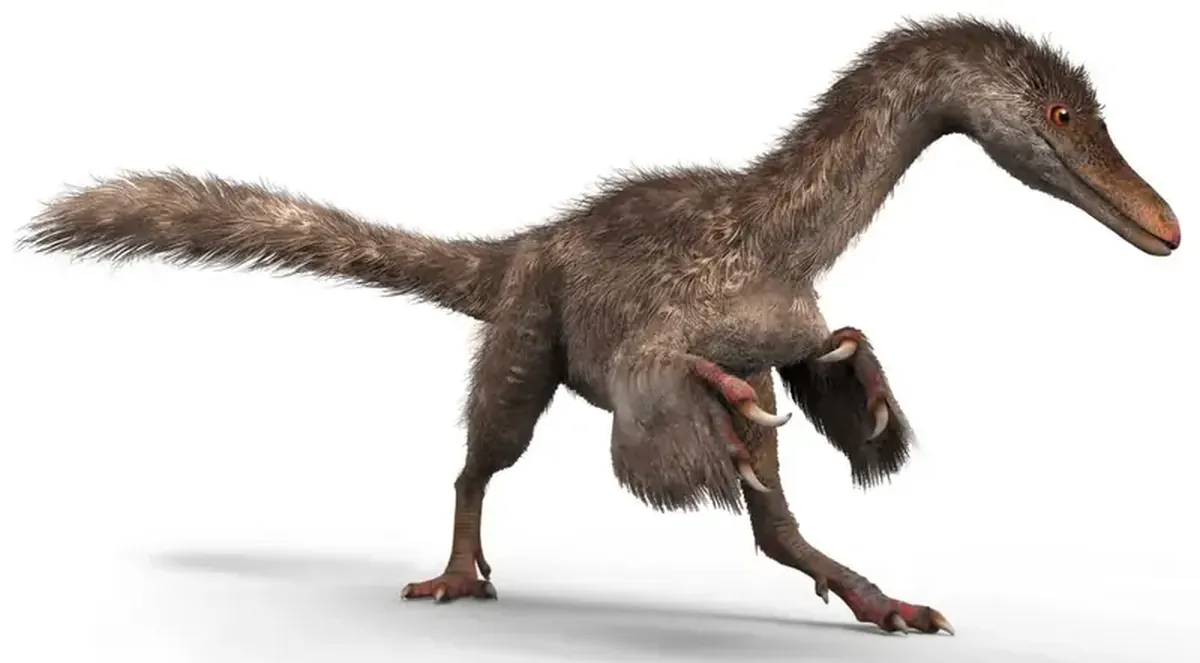
Using computed tomography and microscopic observations, Sin and her colleagues peered inside the amber. As co-author Ryan McKellar explained, the team found a portion of a long, flexible tail from a juvenile: eight vertebrae surrounded by feathers preserved in microscopic detail. McKellar said this is the first instance of dinosaur remains preserved in amber.
A closer study of the tail’s soft tissues revealed traces of divalent iron—a component of hemoglobin—preserved in the tissue layer around the bones. The authors suggested the dinosaur may have become trapped in the resin while still alive and died as a result. “It’s astonishing to see all the details of a dinosaur’s tail—bones, flesh, skin, and feathers—and to imagine how this little one got ensnared by its tail in the resin and likely perished because it couldn’t free itself,” said Professor Mike Benton.
