
 Gaby
Gaby
Alexander the Great is one of history’s most remarkable military leaders, famous for toppling powerful states like the Persian Empire and conquering Egypt. He became known for never losing a battle and for building the largest empire of his time—the Macedonian Empire. But that empire was not destined to outlive its creator. Let’s explore why.

Alexander enters Babylon. Lebrun, (1664)
The Great and Noble
Alexander the Great, as he is often called, took the throne at age 20. Early in his reign he removed political rivals and consolidated power in his own hands. Over the next decade he led campaign after campaign, extending his reach from Greece to India. He died at 32 under mysterious circumstances, leaving behind the largest and most influential empire of his era. Who would inherit it in the power vacuum that followed? Did Alexander have any children? In short—yes.

Aristotle teaches young Alexander, 19th-century engraving.
The great commander did have one, and possibly two, heirs — both boys. The first, known as Alexander IV, was his son with his wife Roxana. Roxana was the daughter of a Bactrian chieftain from a historical region in Central Asia that corresponds to parts of modern-day Tajikistan, Uzbekistan, and Afghanistan.
Alexander met Roxana during one of his campaigns. His army captured her in that region, and Alexander fell in love with the young captive; they married in 327 BC. This episode appears in the book ‘Alexander the Great: A Reader’ by Ian Worthington, a professor of ancient history at Macquarie University in Sydney.
Some historical sources, including Plutarch, suggest the young king could have taken Roxana by force, but instead he asked for her hand in marriage. Alexander did not live to see the birth of their son—he died in Babylon in 323 BC while Roxana was pregnant.

The marriage of Alexander and Roxana, Sodom (1517)
Secret Connections
The other son, Heracles of Macedon, was born around 327 BC, making him roughly four years older than Alexander IV. Heracles was an illegitimate child by Barsine, a noblewoman of Persian descent. Barsine reportedly attracted the young prince with both her education and her character; their relationship lasted about five years and ended when Alexander married Roxana.
Some modern scholars question whether Alexander was truly Heracles’ father, since the commander never formally acknowledged him. Still, many academics accept that Heracles was Alexander’s biological son.
‘Several historians are skeptical about Alexander’s paternity, but I do not share their viewpoint,’ Joseph Roisman, a professor of classics at Colby College in Maine, told Live Science.
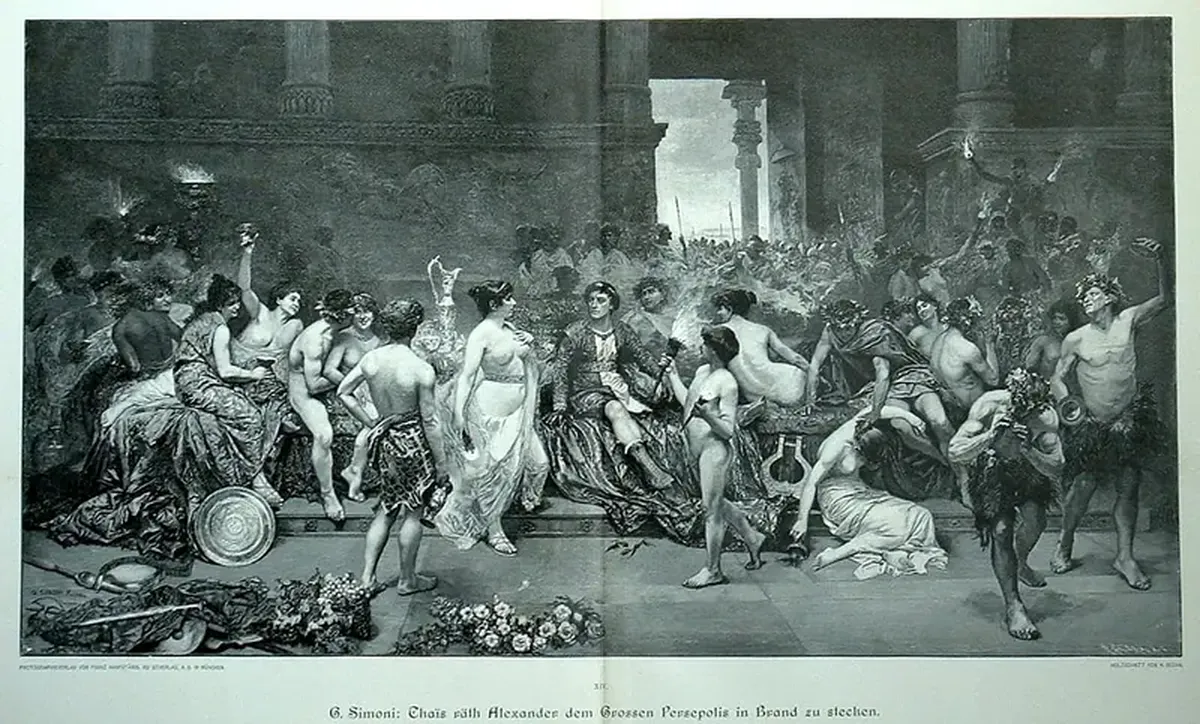
Macedonian feasting with courtesans in the captured Persepolis, painting by G. Simoni, 19th century.
Why They Didn’t Become Kings
When Alexander died, the question of succession was chaotic. His empire stretched from the Balkans to what is now Pakistan, but there was no clear plan for who should take over.
Roxana was pregnant when Alexander died; it was still unknown whether she was carrying a girl or a boy. At the same time, Alexander already had a four-year-old son, albeit an illegitimate one. That made Heracles’ claim to the throne politically awkward. Worthington notes that Heracles never pressed his claim because he was aware of his ‘low’ status.
The situation grew more complicated because both Roxana and Barsine had Asian backgrounds, which bothered many of Alexander’s soldiers.
‘According to the ancient Roman historian Quintus Curtius, both sons were proposed as potential heirs at a council of generals and cavalry. However, the common soldiers, particularly the infantry, rejected both candidates because their mothers were Asian,’ Carol King, an associate professor of classics at Memorial University of Newfoundland, told Live Science.

The Death of Alexander the Great. Karl Theodor von Piloty (1885)
“And the King is Not Real!”
There was another figure who entered the succession fight: Philip III Arrhidaeus, Alexander’s half-brother. Alexander had spared Arrhidaeus early in his reign because he did not view him as a rival. Arrhidaeus was an illegitimate son of King Philip II by a dancer, and he had a mental disability.

Philip III Arrhidaeus, depicted on a coin
After Alexander’s death, many Macedonians rallied behind Arrhidaeus because they preferred a native ruler to a foreign one. Nominally, Arrhidaeus became king, and Alexander IV was set to be his co-regent once he was born. But as Carol King points out, neither could effectively rule: Arrhidaeus because of his condition, and Alexander IV because he was an infant.
As a result, ‘they all became pawns in the wars of the successors, the powerful generals of Alexander, as they fought each other for control of the empire; and all were killed,’ King said.
Blood for Blood
That turbulent political landscape deeply unsettled Olympias, Alexander’s mother. She had never forgiven her husband for his infidelities and held a grudge against his illegitimate son.
In 317 BC Olympias became the guardian of the legitimate heir, Alexander IV. With an army led by the general Polyperchon, she captured Arrhidaeus and his wife and soon had them killed. She put her six-year-old grandson on the Macedonian throne and ruled in his name.

Roxana with Alexander IV, son of Alexander the Great, by Alessandro Varotari, 17th century.
That arrangement did not last. The next year the general Cassander seized power and had Olympias executed by stoning. Roxana and her young son were taken captive. Although Cassander controlled the empire in practice, he feared rivals. To eliminate any future claim, Cassander ordered the execution of Alexander IV and his mother Roxana in 309 BC.
Heracles, Alexander’s illegitimate son, fared no better. Polyperchon captured him and, in agreement with Cassander, had the young man killed shortly after Alexander IV’s death, a sequence recounted in Robin Waterfield’s book ‘Dividing the Spoils: The War for Alexander the Great’s Empire.’
The generals’ ambitions and the lack of a single strong leader to hold the realm together sparked continuous infighting and the rapid unraveling of the empire Alexander had created. And, to be frank, he bears some of the blame.
