
 Carlos Solis
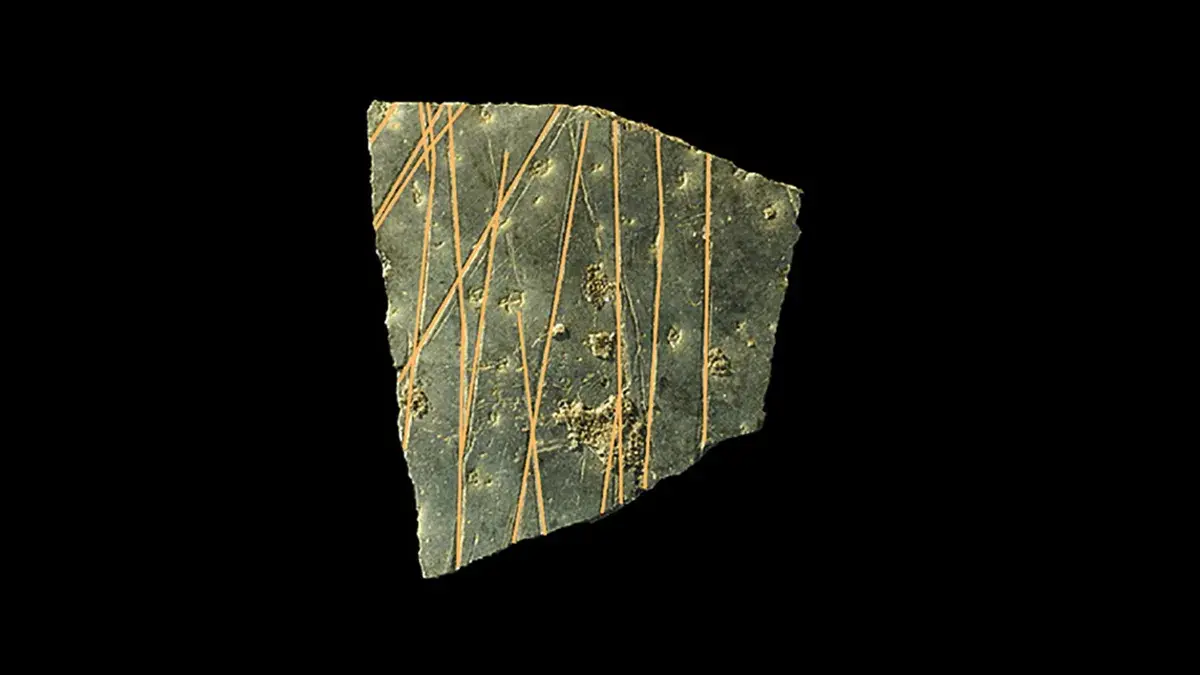 A study published in PLOS ONE by researchers from the University of Bologna (Italy) presents evidence of the oldest geometric thinking in Homo sapiens, found on fragments of eggshells from South Africa and Namibia. Archaeologists found prehistoric people used ostrich eggshells as water containers about 60,000 years ago and decorated them with intricate geometric patterns—repeating parallel lines and right angles. These findings confirm our ancestors’ ability for abstract planning and complex forms of communication long before the advent of writing.
“We’re talking about people who didn’t just draw lines; they organized them according to repeating principles—parallelism, grids, rotations: this is visual grammar in its infancy,” said Silvia Ferrara, a co-author of the study. She said these marks reveal an astonishingly structured, geometric way of thinking.
“Geometric Grammar” and Portable Water Containers
To learn more about the unusual engravings, the team examined more than a hundred fragments of ostrich eggshells recovered from three archaeological sites in South Africa and Namibia. In total, the fragments contained 1,275 engraved lines, IFLScience reported.
Using statistical and geometric analyses, the researchers found that 83.4 percent of the lines formed parallel pairs, and about a third of all line intersections were right angles. The team reported that more than 80 percent of the fragments showed consistent spatial relationships among the elements, which indicates the engravers had a solid grasp of geometric organization.
“This is not just about repeating signs: it’s genuine visual-spatial planning, as if the authors had a clear idea of the figure before they engraved it,” Ferrara said. The engravers also employed cognitive operations such as rotation, repetition, movement, and hierarchical layering of signs to create more complex elements like shaded stripes, grids, and diamond-shaped motifs.
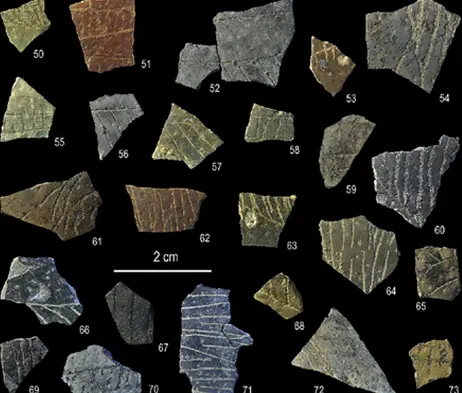
By tracking the marking patterns, researchers were able to gather data on their geometric properties.
“The results show that late Homo sapiens mastered precise, pre-planned schemes based on specific geometric principles: orthogonality [i.e., the use of right angles] and parallelism,” the researchers wrote in their report. “As a result, geometric grammar emerges,” they added.
Valentina Dechembri, another co-author of the study, said the ability to create visual configurations that follow a set of geometric principles points to an innate capacity for abstract thought.
“Transforming simple forms into complex systems through specific rules is a deeply human trait that has characterized our history for millennia, from creating ornaments to developing symbolic systems and, ultimately, writing,” Dechembri said.
