
 Gaby
Gaby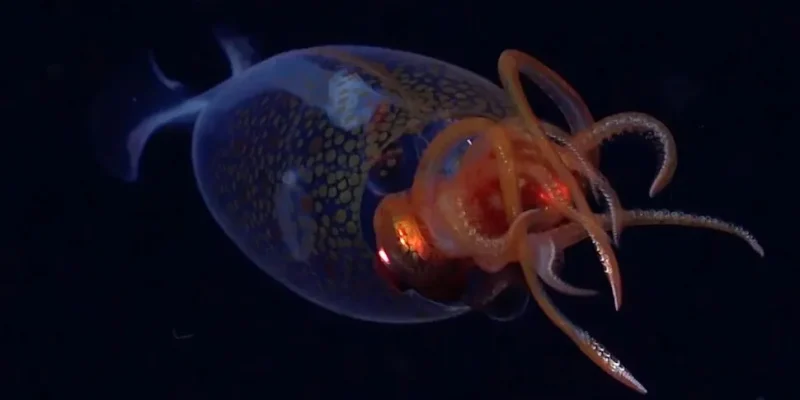
An international team announced a discovery made during an expedition aboard the research vessel Falkor, operated by the Schmidt Ocean Institute (USA). Near the South Sandwich Islands, they filmed a giant squid in its natural habitat at a depth of 600 meters — the first time anyone has captured such footage. It’s a stunning sight.
The species Mesonychoteuthis hamiltoni, often called the Antarctic kraken or giant squid, belongs to the glass squid family Cranchiidae. Individuals can reach 10–14 meters in length and weigh 500–700 kilograms, making them the heaviest invertebrates on Earth, Sci.news reports. Little is known about their life cycle, but adults lose the transparent appearance typical of juveniles.
“These unique images are incredibly moving, and it’s a bit unsettling to think that these creatures have no idea humans exist,” said researcher Kat Bolstad from Auckland University of Technology (New Zealand).

For the past century since the species was discovered, scientists mostly knew giant squids from remains found in the stomachs of whales and seabirds, Bolstad said. The team struck gold on March 9, 2025, when the remotely operated vehicle SuBastian filmed a 30 cm juvenile giant squid. Earlier, on January 25, 2025, during a previous expedition aboard the Falkor, the same team filmed a glacial glass squid (Galiteuthis glacialis) in the Southern Ocean — another species never before recorded alive in its natural environment.
The Southern Ocean, also called the Antarctic Ocean, is the fourth-largest ocean and surrounds Antarctica. “One of the most distinctive features of giant squids is the presence of hooks on the middle of their eight arms, which helps differentiate them from glacial glass squids,” explained independent expert Aaron Evans. Juveniles of the two species look similar: they have transparent bodies and sharp hooks at the tips of their two long tentacles, Evans noted.
“Finding two different squid species across consecutive expeditions highlights how little we know about the Southern Ocean’s inhabitants,” said Jotika Veermani, executive director of the Schmidt Ocean Institute. “We captured high-resolution images that allowed experts who were not on the vessel to confirm both species,” she added.
