
 Carlos Solis
“Aging is sad, but growing up is pleasant,” said the iconic French actress who was often labeled a “carefree girl.” The shy daughter of a strict Catholic family was destined in the mid-20th century to become one of the most alluring women in European cinema, a style icon, and a symbol of rebellion. Her name became synonymous with free thought, sexual liberation, and emancipation. Although she didn’t personally take part in the women’s movement, she became a public voice of it in post-war conservative France and helped liberalize cinema by being among the first actresses to appear naked on screen, earning condemnation from clerics and conservatives.

A Guiding Light for a Generation
The sexuality, spontaneity, and apparent innocence of Brigitte Bardot’s on-screen persona made her, for some, “the embodiment of sin and debauchery,” while for others she was an object of adoration. Her success in romantic comedies did not keep her from dramatic work like And God Created Woman, The Truth, and Contempt. For her role in Viva Maria! she was nominated for a British BAFTA. To the wider world, though, the beauty whom Empire ranked among the 100 sexiest movie stars of all time is best known as a daredevil who popularized the bikini, often showcasing that seemingly “frivolous” attire in her roles and even at the Cannes Film Festival.
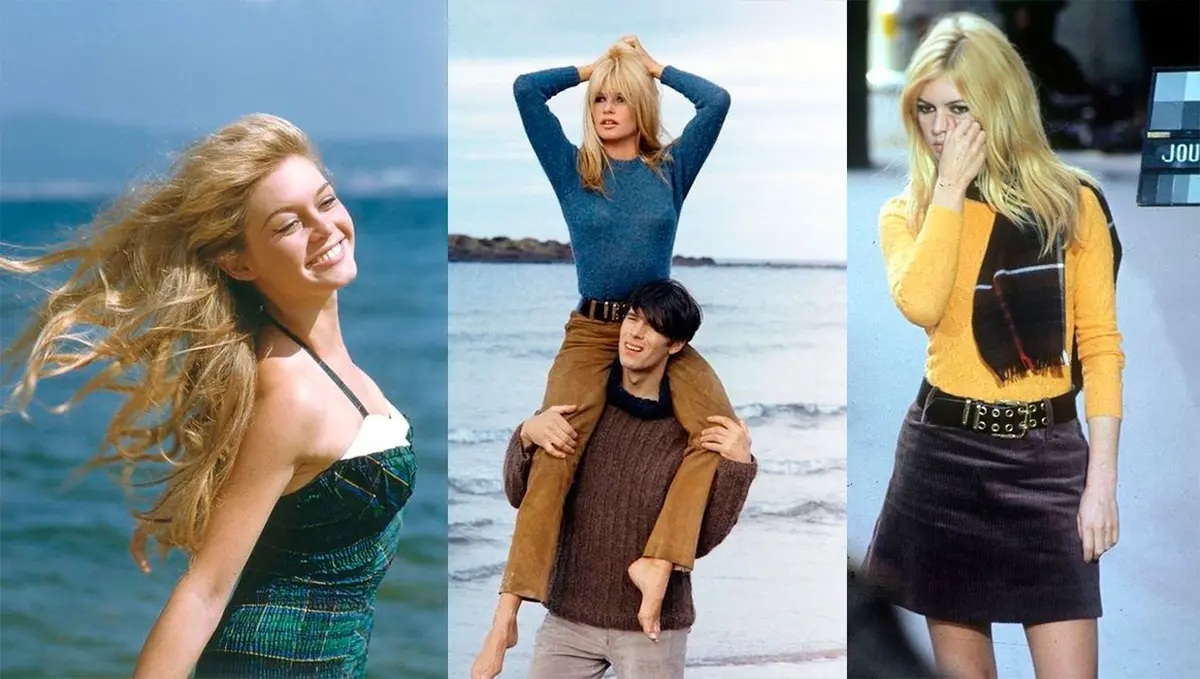
Critics and style writers argue that Bardot’s influence came from pioneering a new way of life for her generation—becoming a role model people wanted to imitate. Girls around the world copied her checkered dresses, faded denim, black eyeliner, curtain bangs on tousled hair, the “babette” hairstyle, and the habit of lounging on the beaches of Saint-Tropez. She also helped normalize the idea that women could enjoy life’s pleasures on the same terms as men. Having started adult relationships at 15, the alluring star went on to have many romances, four marriages, and the painful experience of giving up custody of her son during a divorce because she felt she wasn’t ready to care for him.
Staying True to Herself
The actress, who starred in 48 films, and the singer, who recorded 80 songs, had no illusions about all-around theatrical skill: Bardot realized while young that she couldn’t—or didn’t want to—completely transform herself. She also chose not to change her looks surgically and remained one of the few stars of her era who avoided plastic surgery. A former ballet student, she became an aesthetic ideal for young musicians, including members of The Beatles. In 1970 Bardot was chosen as the model for the first official bust of Marianne, the symbol of France. Standing about 5’7″, Bardot kept her weight around 137 pounds for much of her life and followed a vegetarian diet.

Maintaining that figure through the end of her screen career, she concluded a 20-year run on film at 39. As founder, leader, and activist of the Brigitte Bardot Foundation, she later devoted a troubled heart to animal protection. Although she stopped acting after 1973 and hasn’t taken on new film projects for more than half a century, her name has remained in the headlines—sometimes for court cases in which she was fined for comments that many viewed as inciting hatred against LGBT people, migrants, and Islam in France. In her nineties, Bardot continued to criticize the president, back the right-wing opposition, deny accusations of “misanthropy,” and insist she remains a “carefree girl.”
Ballet: A Ticket to Fame
Brigitte Anne-Marie Bardot was born in Paris on September 28, 1934. Her parents, both Parisians, raised their two daughters in strict Catholic traditions. Along with her younger sister, Brigitte attended a Catholic school. Her father, an engineer, could afford nannies and governesses, one of whom was Italian and taught Brigitte the language. Unlike her sister, Brigitte was considered the “ugly duckling” by her parents; her mother would often say, “Brigitte is a little monster, and she’s not even pretty.” The girl suffered from allergic rashes, wore braces and glasses for nearsightedness, and spent many years ashamed of her appearance. Bardot later recalled growing up gloomy and withdrawn.
Her mother did one important thing for her: she enrolled the sisters in ballet classes. The girls began studying at seven with a former Grand Opera star, Marcel Burga, and those lessons helped shy Brigitte gain confidence. Her natural grace helped her excel in choreography, and in 1947 she was accepted into the National Conservatory of Music and Dance. Three years of ballet training with leading choreographers in Paris paid off: she developed a shapely figure and a graceful walk. Her mother then used her new appearance to promote a fashion store, where Brigitte took part in fashion shows as a model.

The Naked Truth
A friend of her mother’s who worked as an editor at Jardin des Modes published several runway photos of Bardot. Those pictures caught the attention of an editor at Elle, who invited the young model to shoot for the magazine—her father insisted her name be withheld. A year later a second Elle shoot produced a cover that was seen by Roger Vadim, then an assistant director. He showed the photos to his boss and got an invitation for the girl to audition. Although her first audition didn’t lead to a role, Vadim noticed her and would later have a major impact on her career. Their acquaintance turned into a romance, and controversy followed.
Brigitte announced to her parents at 15 that she intended to marry Vadim. The news shocked them. They refused to accept a relationship between a schoolgirl and an adult man, and Brigitte responded by skipping classes and meeting Vadim in secret. When her parents tried to stop the relationship, Bardot attempted suicide by gas poisoning. Eventually her parents relented on the condition that Vadim wait until she turned 18 to marry. In the meantime, thanks to Vadim, she was offered the lead in Manina, the Girl in a Bikini. On the Nice set Bardot spent most scenes in a revealing swimsuit.
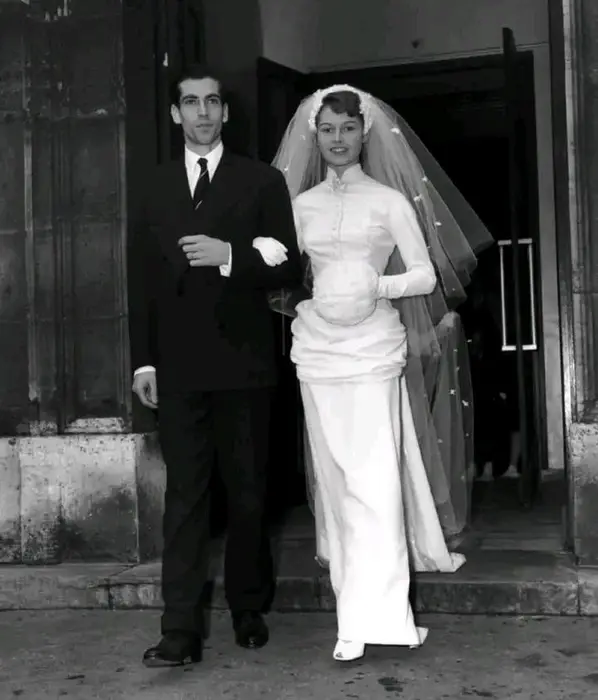
Brigitte Bardot and Roger Vadim’s wedding
The Bride of Paris Match
At the end of 1952, Bardot and Vadim married. He worked as a journalist and also wrote scripts; whenever his stunning wife visited the office, his colleagues abandoned their urgent tasks. Reporters nicknamed her “the bride of Paris Match.” Vadim found a producer for his young wife and acted as her press agent. Bardot’s career took off after a sensational appearance on an American aircraft carrier in front of 3,500 sailors during the 1953 Cannes Film Festival. She was even offered a contract by Universal, but the young actress ultimately turned it down.
British producer Betty Box had more luck and secured Bardot for Ralph Thomas’s comedy Doctor at Sea. In a brief shower scene—where Bardot appears naked—she took part in what became the first risqué scene in British sound cinema. Contrary to expectations, public morality guardians were largely silent, and critics called her a “sex kitten” and “a breath of fresh air.” After the 1955 film The Light of the Street, a series of projects with director Jacques Gauthier was planned, but Gauthier died during a botched operation and an administrator finished the work. The administrator and Bardot later bonded over their shared dislike of filming and the film process in general.

A Tender Creature
Bardot’s subsequent films cemented her status as a French sex symbol. Some of those films were scripted by her husband, but the marriage was strained by the growing allure he had helped cultivate. In 1956 Vadim set out to film his wife in a part that would expose her “natural, unmasked sexuality”—a project he envisioned as “revolutionary cinema” that challenged rigid moral norms. That film became And God Created Woman, starring Bardot and Jean-Louis Trintignant. The Catholic Church condemned the heroine’s provocative behavior. A real-life on-set romance during filming eventually led to Vadim’s divorce from his wife.

Brigitte Bardot with Jean-Louis Trintignant
The marriage was dissolved in December 1957. “We divorced without scandals, civilly and amicably,” Vadim later recalled. “But it wasn’t without a few sad and poignant moments. When it was all over, and we were left alone in the courthouse hallway, I embraced Brigitte, and we kissed.” The divorce didn’t prevent them from remaining close friends or from continuing to collaborate. Her co-star in the 1958 film In Case of Misfortune said he saw in Bardot “a tender creature who cannot live without love and affection,” a description that applied to both the character and the actress.
Fame: A Path to Underground Life
Bardot’s new romance with Jean-Louis Trintignant made tabloid headlines, but two years later they split when he was drafted into the army. She briefly dated married musician Gilbert Bécaud before starting a relationship with Sacha Distel. During the filming of Babette Goes to War she grew close to young actor Jacques Charrier and became pregnant. They married in June 1959 amid intense media attention. In the last months of her pregnancy the paparazzi kept her house under constant surveillance. Their son, Nicolas-Jacques Charrier, was born in January 1960.

Brigitte with Jacques Charrier and newborn son
The stress took a toll on the marriage. Charrier was drafted and later discharged after a diagnosis of a mental disorder. Pressure and nervous exhaustion followed. Both partners at times showed suicidal tendencies. During the filming of The Truth, Bardot fell for her co-star Sami Frey; when her husband caught them in a car, a fight broke out and the paparazzi published scandalous photos. Charrier demanded a divorce and custody of their child. Bardot later regretted agreeing to give up her son, but at the time she felt unable to care for herself. She said fame had turned her life into an underground existence.
Trying Everything
That existence became unbearable: she repeatedly attempted suicide. On her 26th birthday, Bardot overdosed on barbiturates and cut her wrists; neighbors found her in critical condition and rushed her to the hospital. The emotional emptiness of sudden loneliness—when yet another lover was drafted into the army—was the immediate trigger for that attempt. She didn’t stay alone for long. Her subsequent partners included Brazilian musician and dancer Bob Zagury and French singer-songwriter Serge Gainsbourg, both of whom contributed to her musical career. Her third husband was the extravagant German multimillionaire Gunter Sachs.

After that divorce—also reportedly tied to mutual infidelity—the now-mature Bardot had romances with a 20-year-old political science student, a bartender, a budding actor, and a sculptor. In the early 1980s she was diagnosed with breast cancer; after surgery and therapy, she recovered. Her son Nicolas later studied economics at the University of Paris, learned piano, made music, arranged songs, modeled for couturier Pierre Cardin, and worked as a computer specialist. He married the daughter of a Norwegian diplomat and became a father of two; the family lives in Oslo. As an adult, Nicolas let go of his grievances toward his mother, who married politician Bernard d’Ormale as her fourth husband.
A New Life
“I was reborn when I started working with animals,” the actress wrote in her memoirs. “When I look at myself on screen, I see someone else, someone I don’t even want to know. Only now have I become a person who has found meaning in life.”

During her final shoots, Bardot bought a goat from a local farmer to save it from slaughter, and when a hotel banned her from bringing the animal inside, she realized what she needed to do. “I realized that I was a prisoner, alienated from true life values,” she wrote in Initials B.B. “I have only one life, and I must live it my way!” In the final scene of her last film she appears with a bird perched on her hand, a small symbol of the life she would dedicate to animal rights.
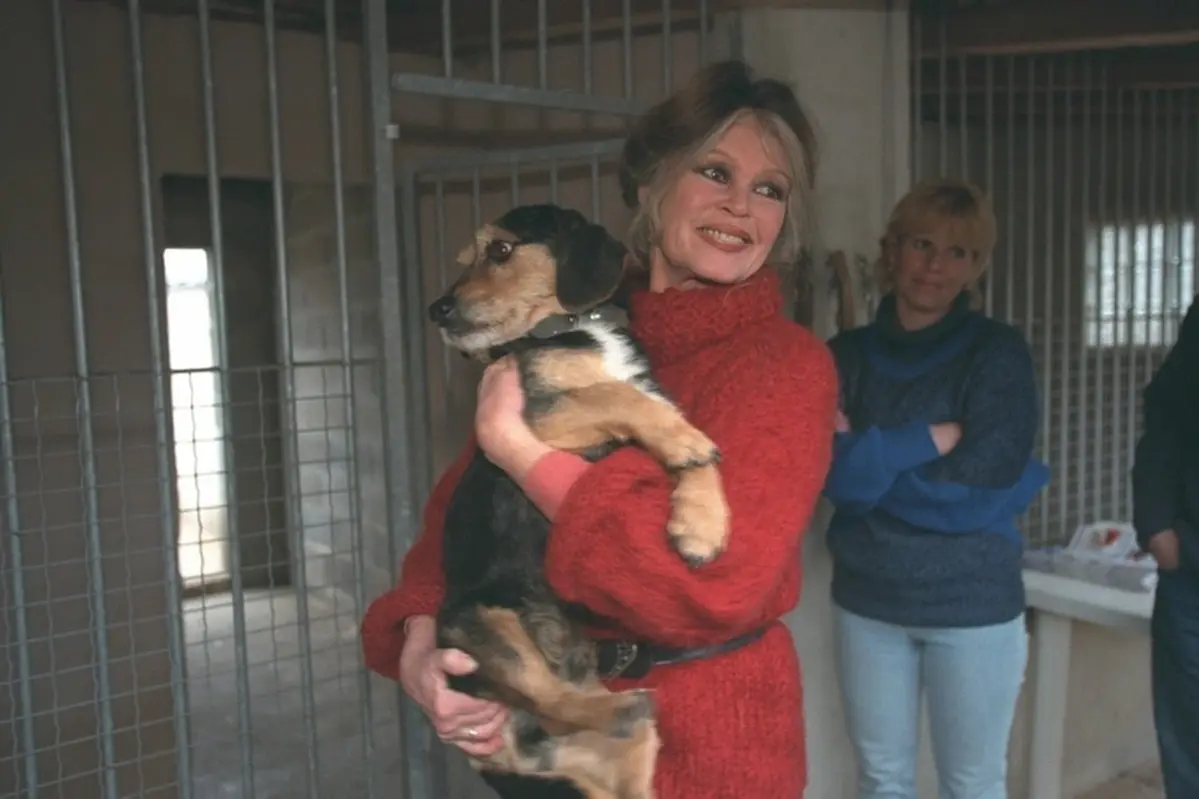
In 1977 she launched a campaign against the slaughter of seals in Eastern Canada. She later opposed seal and whale hunting, game hunting, cockfighting, dog fighting, bullfighting, fur trading, and the consumption of horse meat. She spoke out against using animals in medical and industrial experiments, fought for more humane treatment in zoos, and raised funds to create shelters for koalas in Australia, primates and elephants in Africa, and bears in Bulgaria. By 1997 the Brigitte Bardot Foundation had 27,000 members in 42 countries; within two decades it grew to 75,000 activists. Bardot never regretted saying goodbye to cinema.
Photos from open sources
