
 Carlos Solis
 Rita Hayworth, America’s original sex symbol, was born Margarita Carmen Cansino; her father was a Spanish dancer of Romani descent. She adopted her mother’s surname, Hayworth, for her acting career and became a sensation after starring in the romantic drama “Gilda.” American troops even nicknamed a 1946 nuclear test after her iconic role, calling it “Gilda.” The Hollywood star, later recognized by the American Film Institute as one of the greatest movie stars of all time, was early labeled a “sex bomb.” As we mark her birthday, let’s look back at the life and films of Rita Hayworth — a gifted dancer and captivating woman who had wealth, admirers, and five marriages, yet never seemed to find lasting love.

Dance School
The future star was born on October 17, 1918, in New York City, the home of American musical theater. Her Brooklyn family included two sons, but her father’s attention was focused on his daughter; Eduardo Cansino, a flamenco dancer from Seville, immediately saw her as a future dance partner. From the age of three he taught her to move gracefully on stage, while her mother, Volga Hayworth, a chorus girl of half-Irish and half-English descent, dreamed of an acting career for her. Rita managed to fulfill both expectations. Although Margarita Carmen disliked the dance exercises that stole her childhood, the dance school provided her education and set her on a path to the film industry by the age of eight.

Little Rita with her brothers
The young performer made her film debut in 1926 in “La Fiesta,” and the following year the family moved to Hollywood. There her father opened a dance studio where he taught chorus girls and future stars like Jean Harlow and James Cagney. During the Great Depression that business closed, and the family earned a living by performing together. After her early film debut, the underage performer danced the habanera in Mexican nightclubs for another ten years, enhancing her “Latin” appeal by dyeing her hair at her impresario’s suggestion. Audiences believed she was of Mexican descent, and it was as an exotic dancer that 17-year-old Rita landed her first films under contract with Fox.
Labeled a “Failure”
It wasn’t until her fourth film that the Spanish-American actress spoke on screen — and she had none of the expected Latin accent. Soon after, the studio, which had become 20th Century Fox, came under new head Darryl Zanuck, who ordered all her scenes cut from the newly edited 1936 film “The Garcia Letter,” calling her a “failure.” Critics continued to deny her acting talent, praising only her feminine allure, which was enough to make her films successful. She also had a knack for attracting resourceful men who helped her in life and career.
Rita Hayworth’s first husband, a year after her setback with 20th Century Fox, was Edward Charles Judson, a car salesman with a reputation as Hollywood’s Monte Cristo. Rumor held that his legitimate business was a front and no one knew how he had really amassed his fortune. He helped transform Margarita Carmen Cansino into Rita Hayworth, convincing her to use her mother’s maiden name and promising to open doors for her at Columbia Pictures. To realize that plan, Ed Judson paid for acting lessons, had her dye and lighten her hair, remove excess hair from her forehead via electrolysis, and even alter the shape of her nose for the new image.
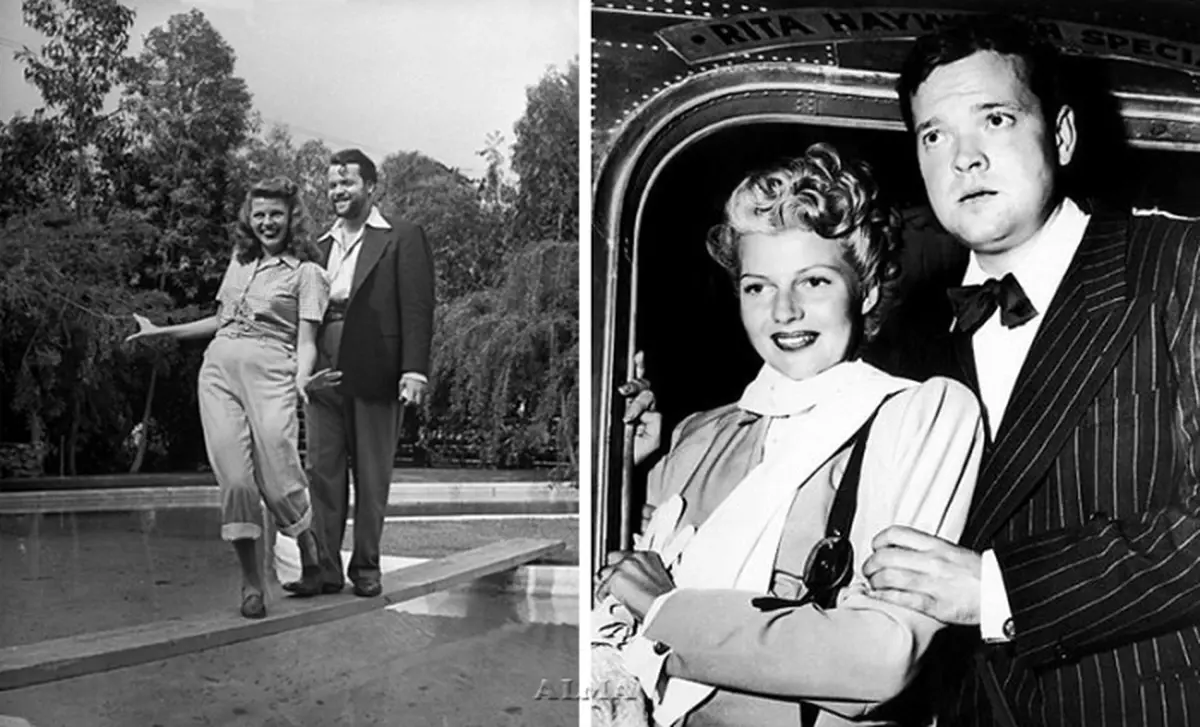
Eddie Judson and Rita Hayworth
The Birth of a Star
The aesthetic transformations took more than a year and involved plastic surgeon Joel Pressman. The golden‑haired Rita Hayworth emerged after weekly procedures that raised her hairline nearly two centimeters and refined her forehead. The facial changes increased her chances of getting roles, but at first they were low‑budget films in which Rita appeared three to four times a year and made little impression on critics. The name Hayworth first appeared in the credits of the modest detective film “The Shadow” in 1937, after which director Howard Hawks cast her in “Only Angels Have Wings.”

Scene from the film ‘Only Angels Have Wings’
Her role as “the other woman” in the 1939 film about mail pilots in South America, along with her work in “Angels Over Broadway” and “Music in My Heart,” convinced Columbia Pictures president Harry Cohn to promote her to “A” projects and to loan her out to other studios, as was customary in Hollywood. Her next employers included Metro‑Goldwyn‑Mayer, where she starred in “Susan and God” (1940), and 20th Century Fox, where positive reviews for the 1941 color melodrama “Blood and Sand” made Darryl Zanuck reassess the actress.
The Cover Girl
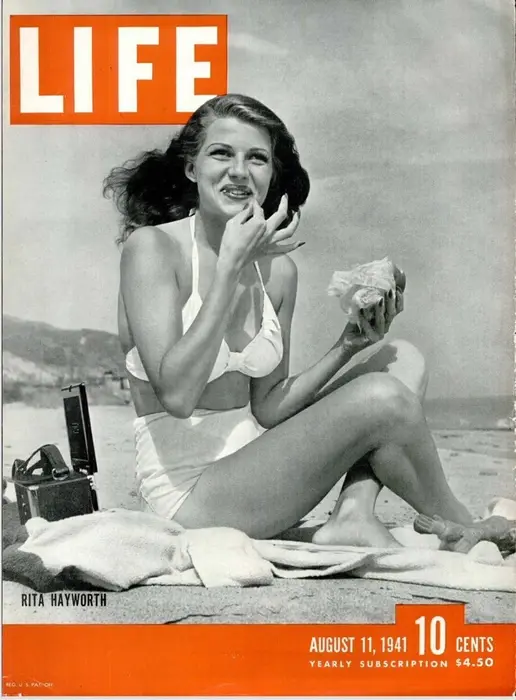
The newly minted star returned to 20th Century Fox as a favorite. In 1941 a semi‑nude photo of Rita Hayworth graced the cover of Life magazine and set a new publishing trend. Fred Astaire chose Hayworth as his partner for the musicals “You Were Never Lovelier” and “You’ll Never Get Rich” (1941–1942). Astaire called her an unparalleled dancer and an incomparable seductress, but Hayworth did not see herself as a femme fatale and was upset that she couldn’t sing — her vocal numbers were secretly dubbed by other actresses.
The studio rushed to mount new productions for the rising star — the costume musical “My Gal Sal” and the epic drama “Legends of Manhattan.” Those projects affected Hayworth’s personal life: in 1942 she divorced Ed Judson to marry her “My Gal Sal” co‑star Victor Mature. Her plans changed when Orson Welles, the groundbreaking director, actor, and producer, saw her in “Blood and Sand” and declared his love for her immediately.
“First-Class Trash”
The gamble paid off: in 1943 Hayworth married Orson Welles, and a year later her second color musical, “Cover Girl,” was released with Gene Kelly as her partner. Her next film, “Tonight and Every Night,” set in a London music hall that kept performing through the Blitz, was another milestone. Then came the melodrama “Gilda,” which secured her place in American cinema — even though critics dismissed the movie’s flimsy script as “first‑class trash.”

Rita Hayworth in the melodrama ‘Gilda’
Even in what some called “trash,” audiences found gold: nobody forgot the scene in which Hayworth sensually removes her glove. That moment, dubbed a “striptease,” made her a household sex symbol, and American troops later nicknamed a bomb after her character. Hayworth was not thrilled with that unofficial association and considered protesting, but her husband at the time dissuaded her from taking any step that might look unpatriotic. She and Welles had a daughter, Rebecca, and the couple divorced after five years of marriage. Ironically, they later reunited on screen.
Gave Birth to a Princess
The pair first appeared together in the 1948 film “The Lady from Shanghai.” Her new platinum‑blonde look alienated some fans of her earlier image, and the film flopped at the box office, plunging Hayworth into a creative crisis. Disillusioned with acting, she remarried quickly even though her ex‑husband still harbored feelings for her. Her third husband was Prince Ali Khan, the son of Aga Khan III. The couple met on the French Riviera during her first trip to Europe in 1948.

Rita Hayworth and Ali Khan
At the time Ali Khan was still married, and public disapproval did not deter the couple, who openly appeared together before reporters. Hayworth returned to Hollywood only to break her studio contract, a decision that cost her a $250,000 penalty. Orson Welles commented, “The position that others could only dream of brought Rita no joy. She despised her heroines and did not like being Rita Hayworth.” Wanting a new life away from Hollywood, Hayworth moved abroad and gave birth to her second daughter, Princess Yasmin Aga Khan, in 1949.
“A Decade of Hell”
None of Hayworth’s marriages lasted more than five years. The prince’s lifestyle and obligations strained the marriage, and she found the situation difficult; the divorce came in 1953 and she married again that same year. Her fourth husband was American actor and singer Dick Haymes; they divorced two years later. Her final marriage, to producer James Hill, lasted from 1958 to 1961, and her last notable work was an appearance on “The Joey Bishop Show.” In later life she struggled with alcoholism, saw a psychoanalyst, and developed Alzheimer’s disease.

Rita Hayworth, Dick Haymes, Rebecca Welles, and Yasmin Khan
While filming the 1972 movie “The Wrath of God,” Hayworth needed help with every line. By 1981 her condition had worsened so much that the Los Angeles Superior Court declared her unable to care for herself and appointed her daughter Yasmin as her guardian; Yasmin cared for her mother in her final years. “It was two decades of hell,” the guardian said of Hayworth’s illness. Hayworth died in her Manhattan apartment in May 1987, but by then she likely no longer remembered the seductive woman she had been or the love she had longed for but could not hold onto.
