
 Carlos Solis
 “I am a free Frenchman, I belong to no one, and I have a single mission — to fight for the liberation of my homeland,” was the civic stance of the statesman who championed the restoration of France’s greatness even during its occupation and his own exile. The founder and first president of the modern French Republic exemplified the decisive role of an individual in history.
Patriotic Upbringing
Charles de Gaulle was born on November 22, 1890, in Lille. His mother came from a family of wealthy local entrepreneurs and had French, Irish, Scottish, and German roots, while his paternal ancestors represented the old landowning aristocracy of Normandy and Burgundy; his father taught philosophy and literature at a Jesuit college. The family raised their five children in the spirit of Catholicism and patriotism. As soon as he learned to read, young Charles wanted to write books, developed an interest in history, and became fascinated with military affairs. He would later pursue all those childhood passions professionally.

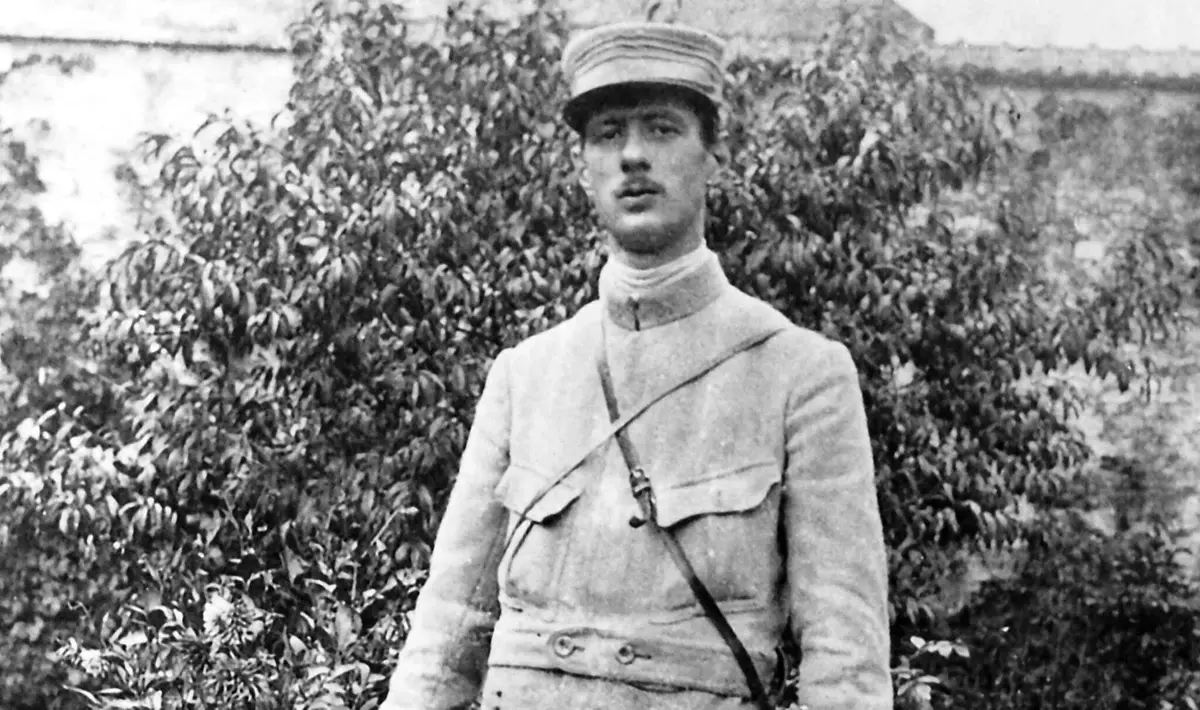
De Gaulle graduated from a military academy in 1912 with excellent marks and continued his education at the Higher Military School in Paris after being commissioned as a second lieutenant. He went to the front at the start of World War I: on August 12, 1914, he arrived with the 5th Army in the northeast and was wounded three days later. In the spring of the following year he was wounded again, and in 1916 for a third time. Before the Battle of Verdun, the young officer was promoted to company commander and was taken prisoner during the fighting near the village of Douaumont.
He did not die; instead, he was held by the Germans for 32 months. He was treated for his wounds in a hospital on the Main River and then confined in various fortresses, from which he attempted to escape five or six times without success. During his captivity, the future general discussed military theory with another famous prisoner, the future Red Army Marshal Mikhail Tukhachevsky; both studied German military practice, which later influenced their thinking. In the first part of his book “Call to Honor,” written while in captivity, de Gaulle argued for the priority of politics over war.
Career and Family
Ironically, life soon reunited the former prisoners in a new conflict. From 1919 to 1921, de Gaulle taught tactics at a military school near Warsaw and briefly saw action on the front lines of the Polish-Soviet War, where one side was commanded by Tukhachevsky. Afterwards, de Gaulle taught at military academies and at the Higher Military School back in France, having declined an offer of permanent service in the Polish Army. In April 1921 he married Yvonne Vandra — joking to a friend that he had married “the Vandra cookie” because her father was involved in biscuit production.
In dedicating his memoirs to his wife, Yvonne Vandra, Charles de Gaulle wrote: “To the woman without whom I could have done nothing.” In 1922 the couple welcomed a son, named after a key participant in the Battle of Verdun, Philippe Pétain, followed by two daughters, Élisabeth and Anne. The youngest daughter suffered from Down syndrome and died at age 20. As a result, de Gaulle became a patron of the foundation his wife established to help children with such conditions. Yvonne de Gaulle coined the phrase, “Presidency is temporary, but family is forever,” and she urged her husband to ban prostitution, pornography, and nudity on screen.
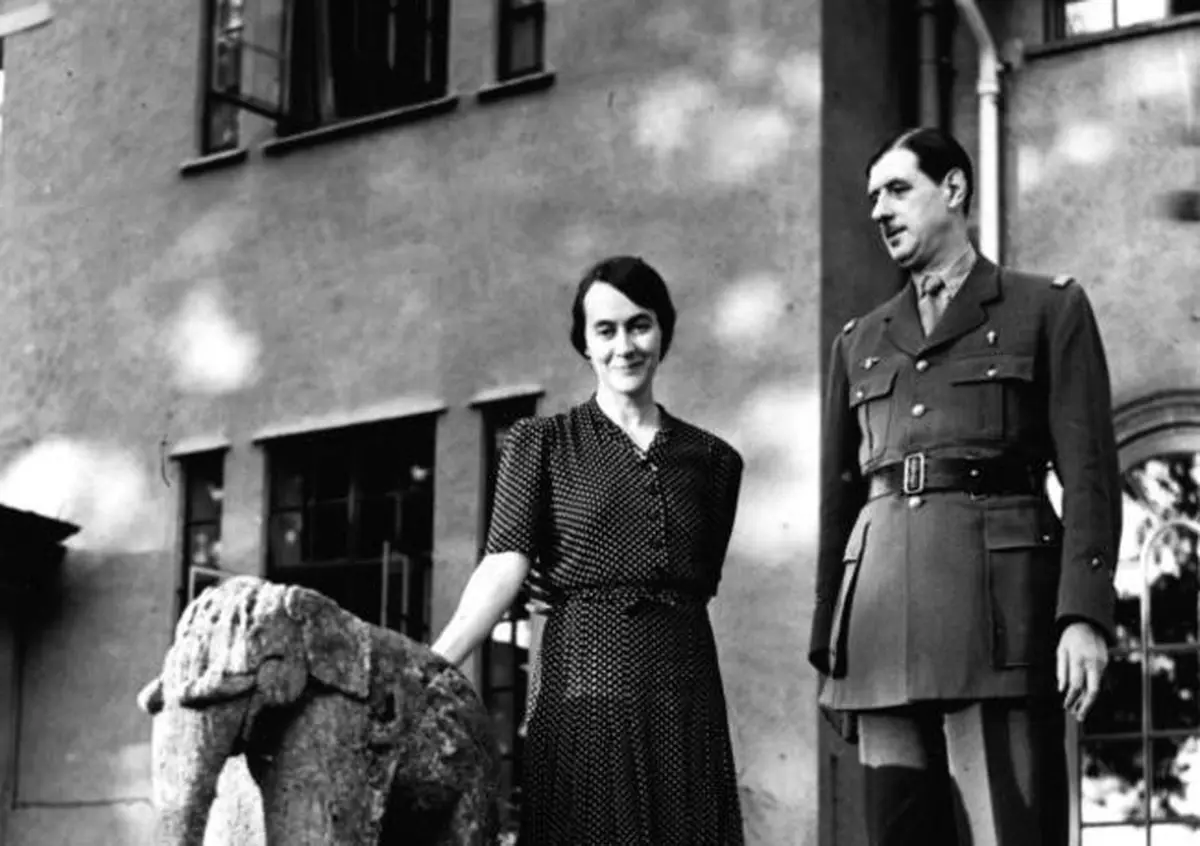
Charles de Gaulle with his wife
Meanwhile, year after year, de Gaulle gained recognition as a military theorist. By the onset of World War II he had reached the rank of colonel. In May 1940 he was given command of the 4th Armored Division, consisting of 85 tanks and 5,000 soldiers, and on June 1 he was promoted to brigadier general. At that stage of his career he was appointed Deputy Minister of Defense in the cabinet of Prime Minister Paul Reynaud. Refusing to accept the terms of an armistice with Germany, de Gaulle faced the threat of arrest after Reynaud’s resignation and the transfer of power to collaborator Henri Philippe Pétain.
Rescue of Soul and Honor
De Gaulle’s political opponent was the 84-year-old marshal who had been a national hero of World War I. In 1918 the commander of Verdun’s defense had been awarded the highest military rank and enjoyed immense popularity, but after France’s defeat in 1940 he led the collaborationist Vichy regime and cooperated with Nazi Germany. After the war, Pétain was sentenced to death, later commuted to life imprisonment because of his age.
Forced to continue the fight from abroad, the brigadier general sought refuge in Britain. That became a turning point for both de Gaulle and France. Crossing the English Channel on June 17 in a biplane with Winston Churchill’s representative, General Edward Spears, he realized that upon arriving in London he was “nobody” — a deserter, an outlaw, and a rebel. In his “Memoirs of Hope,” de Gaulle wrote that “on June 18, 1940, responding to the call of the homeland, deprived of any chance to save my soul and honor, alone, unknown to anyone, I had to take responsibility for France.”

Charles de Gaulle addresses the French via BBC radio
On that historic day de Gaulle spoke “with full awareness of duty, on behalf of France” over BBC radio in an address “To All Frenchmen,” accusing the new government of treason and calling on the people to unite in resistance. He argued that “reconciliation will lead France to slavery” and that “France lost the battle, but did not lose the war.” From Britain, de Gaulle led “Free France,” an organization that resisted the Vichy regime and the occupiers and was recognized by the Allies of the anti-Hitler coalition. From that moment he became a political leader for many French people.
Romantic Pragmatist
Churchill admired de Gaulle’s fighting spirit and his conviction that France must follow its own path. At the same time, the independent, proud, stubborn “romantic pragmatist” earned a reputation as a difficult ally who refused to be anyone’s puppet. De Gaulle said, “Allies are foreigners who may become enemies tomorrow.” When American troops landed in the French colonies of Algeria and Morocco in November 1942 and contacted French commanders who supported Vichy, de Gaulle observed, “The U.S. brings spontaneous feelings and complex politics into great affairs.”
Those tensions complicated Allied coordination in North Africa. In 1943 the general moved to the French colony of Algeria, where he and Marshal Giraud set up a government of France in exile. From Africa, they directed much of the Resistance. De Gaulle did everything possible to preserve French national dignity and to prevent France from being handed over to the protection of other states. Thanks in large part to his efforts, France did not become a political appendage of the United States after the war.
On June 6, 1944, on the Normandy coast, de Gaulle pushed Allied commander Dwight Eisenhower to act quickly to liberate Paris. He entered Paris the day after its liberation and immediately took over the Ministry of Defense. In his speech at City Hall he emphasized the crucial role of the French themselves in the liberation, making clear he would not allow foreigners to dominate France. The speed with which he reestablished national authority also prevented the Allies from imposing a military government in the occupied territories.

Charles de Gaulle at the parade honoring the liberation of Paris
Personal Power Regime
De Gaulle called himself a “free Frenchman” who “belongs to no one”: “I do not support any politician — centrist, conservative, or leftist.” The provisional government he formed in September 1944 included participants from the Resistance. From then on the head of the Provisional Government effectively became head of state: power was concentrated in de Gaulle’s hands until 1946, and from 1947 he led the political party Rally of the French People, which he founded. To improve the country’s economy, his government nationalized major financial institutions and significant enterprises in its first year.
By nationalizing banks, coal mines, maritime transport, energy companies, several major firms, and the Renault automotive company, the government increased wages and abolished certain taxes for low-income groups. The statesman carried out democratic reforms after the war: he expelled collaborators who had cooperated with the Nazis from government positions, amended the constitution to strengthen the presidency, opened parliamentary and administrative positions to people from the colonies, and ultimately set a course toward colonial independence.
On December 21, 1958, “the most distinguished of the French” (as de Gaulle was later called by his successor) was elected president of the French Republic. Although the Fifth Republic is often associated with a strong executive, Gaullist policy produced rapid economic growth and scientific and technological progress. The period saw the development of high-tech industries (nuclear and missile), industrial modernization, higher production of consumer goods, and the elimination of the foreign trade deficit.

“The Last Great Frenchman”
During de Gaulle’s seven years as president, France’s gold reserves reportedly grew from zero in 1958 to $4.5 billion in 1965. The standard of living improved so much that household savings became the main source of domestic investment. The country paid off external debts and became a creditor, ranking third in the world for capital exports at that time. Financial stabilization made the franc a strong, internationally convertible currency. Unemployment fell, and the number of scientists and cultural figures grew. France developed ballistic missiles, nuclear submarines, and an atomic bomb.
By modernizing the armed forces and equipping them with modern weapons, de Gaulle pursued foreign policy goals: to reduce American influence in Europe, restore France’s greatness, and strengthen its independence. In 1966 he announced France’s withdrawal from NATO’s integrated military command, while keeping participation in the alliance’s political structures, and he advocated for a pan-European defense. He opposed Britain’s admission to the European Economic Community, viewing it as a potential conduit for U.S. influence in Europe. Though skeptical of communism, de Gaulle moved to balance U.S. power by opening relations with the Soviet Union while drawing France closer to West Germany. As a principled anti-fascist, he also opposed revanchist ideas.

Charles de Gaulle in Kyiv
How Charles de Gaulle Died
The independent politician had many enemies at home and abroad. There were 23 assassination attempts on de Gaulle. The most famous incident involved the OAS (Organisation de l’armée secrète), a clandestine nationalist group that opposed Algerian independence. On August 22, 1962, terrorists opened fire on de Gaulle’s car in the Paris suburb of Petit-Clamart. By luck and the skill of the driver, no one in the bullet-riddled vehicle was harmed.
“I feel fine, but I promise to die someday,” de Gaulle joked at a press conference in 1965. The tall Frenchman, known for his dry humor, attracted nicknames like “Colonel Motor,” “The Great Asparagus,” and “Big Charles” because of his nearly two-meter height (1.96 m). He visited Kyiv on June 27, 1967, and paid respects at Askold’s grave and the Unknown Soldier’s tomb. De Gaulle was not assassinated; he died at age 79 at his country estate from natural causes — a ruptured aorta.
After his death on November 9, 1970, the sitting president declared that “France had become a widow.” Yvonne de Gaulle, his wife of fifty years, died on November 8, 1979 — the day before the ninth anniversary of her husband’s death — at the same age he had been. The aircraft carrier Charles de Gaulle, Paris’s Charles de Gaulle international airport, and the lilac rose variety named “Charles de Gaulle” all honor the general. Even decades after his passing, the French remember him as a towering historical figure, often compared to Napoleon I.
Photo from open sources
