
 Gaby
Gaby
Who was Christopher Columbus? Most people learned his name in school, and the first thing many think of is America. Columbus’s arrival in the Americas was one of the most consequential events of his time, setting the stage for European colonization and reshaping the histories of many nations. But his accomplishments as a navigator went beyond that single moment. He was among the first European explorers to map parts of the Caribbean and the Sargasso Sea, and he was the first to make a sustained, successful westward crossing of the Atlantic Ocean.
Christopher Columbus: A Brief Biography
The life and personality of the famous navigator remain murky and often disputed. Even the question of where Columbus was born sparks debate: six cities in Italy and Spain claim to be his birthplace, and many details of his life are wrapped in legend.
According to various accounts, Columbus was born in Genoa in 1451. Some biographers say his parents were Italian, while others suggest they were converted Jews, known as Marranos. That debate helps explain how a son of a weaver and a homemaker might have received a surprisingly thorough education for the period.
He was educated at home until about age 14, learning mathematics and Latin and several foreign languages. His family included three brothers and a sister; one brother died young, and two later sailed with Columbus on his voyages.
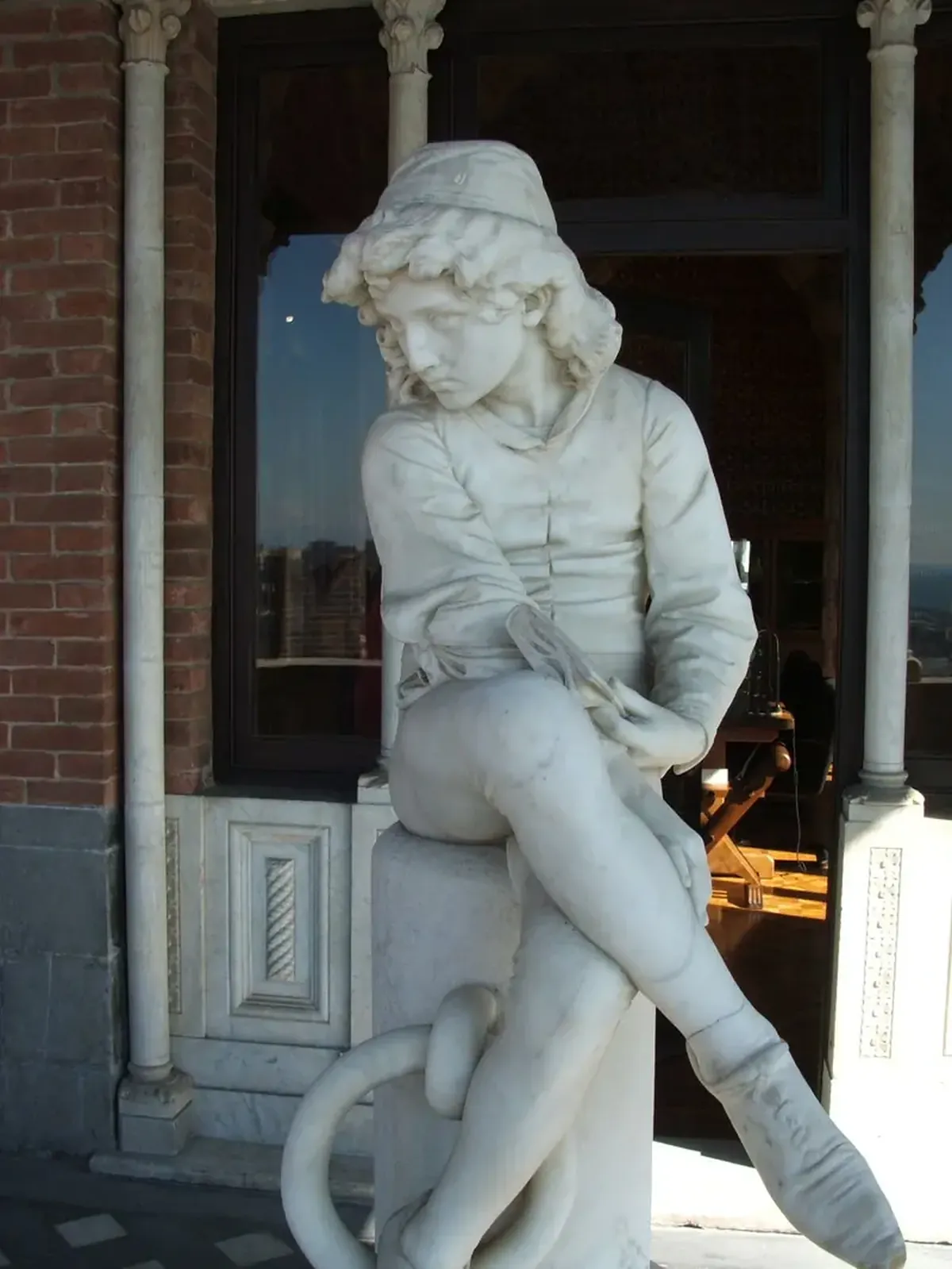
Young Columbus, by Giulio Monteverde, Genoa
Columbus continued his studies at the University of Padua, which suggests his family may have had support from Genoese financiers. His education exposed him to the work of ancient Greek scholars, and he rejected the medieval myth that the Earth was flat. At the time, such ideas had to be discussed carefully because of the power of the Inquisition.
During his studies he formed friendships with peers and professors; his closest friend was the astronomer Paolo dal Pozzo Toscanelli. Toscanelli calculated that it could be faster to reach Asia by sailing west rather than around Africa, and Columbus later refined those calculations. That idea—the chance to reach Asia by heading west—became the driving goal of his life.
Columbus also had maritime experience before university. His father found him work on a trading ship, where he learned navigation and trade. He sailed the Mediterranean and heard stories from Eastern merchants about riches and gold in distant lands. Early on, his motivation leaned as much toward wealth as toward exploration.
Much of Columbus’s later life was spent traveling, and his private life remains sketchy. Biographers say he had two relationships: an official marriage to Felipa Moniz and a long-term common-law partnership with Beatriz Enriquez de Arana.
Columbus had two sons. He cared for both and even took his younger son, Ferdinand, on voyages when Ferdinand was 13. Ferdinand later became his father’s first biographer.
Over time both sons rose to prominence. The elder, Diego, became Admiral of the Indies and later Viceroy of New Spain. Ferdinand became a respected writer and scholar and enjoyed favor at the Spanish court. Their titles and wealth were rewards the Spanish monarchs granted for Columbus’s services to the crown.
Christopher Columbus died on May 20, 1506, in Seville. By then he had been stripped of many privileges and died in relative obscurity. He was buried in Seville, but at his request Charles V ordered his remains moved to the West Indies, to Santo Domingo. After that territory fell to the French, his remains were transferred to Havana and eventually back to Seville—so even in death Columbus traveled once more.
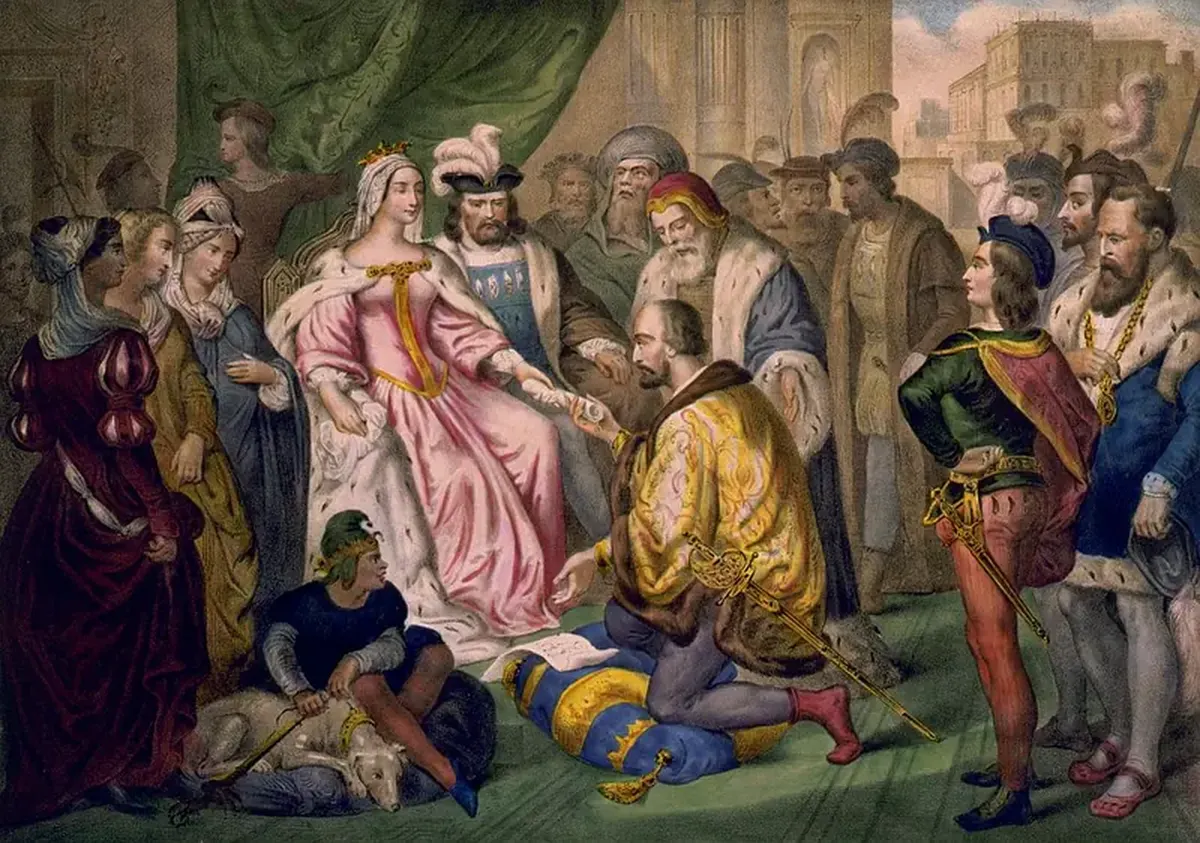
Christopher Columbus kneeling before Queen Isabella of Castile
Christopher Columbus: Discoveries
Columbus’s most famous accomplishment is opening the so-called New World to sustained European exploration. He was one of the first explorers of the Atlantic’s subtropical and tropical regions and a pioneer in the Caribbean and Sargasso Sea. His voyages reached:
- Parts of South and Central America, which paved the way for later exploration of those continents.
- Archipelagos including present-day Haiti, Cuba, Jamaica, and Puerto Rico, as well as islands from Dominica to the Virginia region, Trinidad, and the Bahamas.
Some researchers argue that calling Columbus the “discoverer” of America is conditional—Europeans may have reached parts of these territories earlier. But lacking decisive evidence of earlier, sustained contact, Columbus’s expeditions are treated as the start of a new era of exploration. His name became a global symbol of discovery, although his harsh treatment and subjugation of indigenous peoples have made him a deeply controversial figure in the Americas.
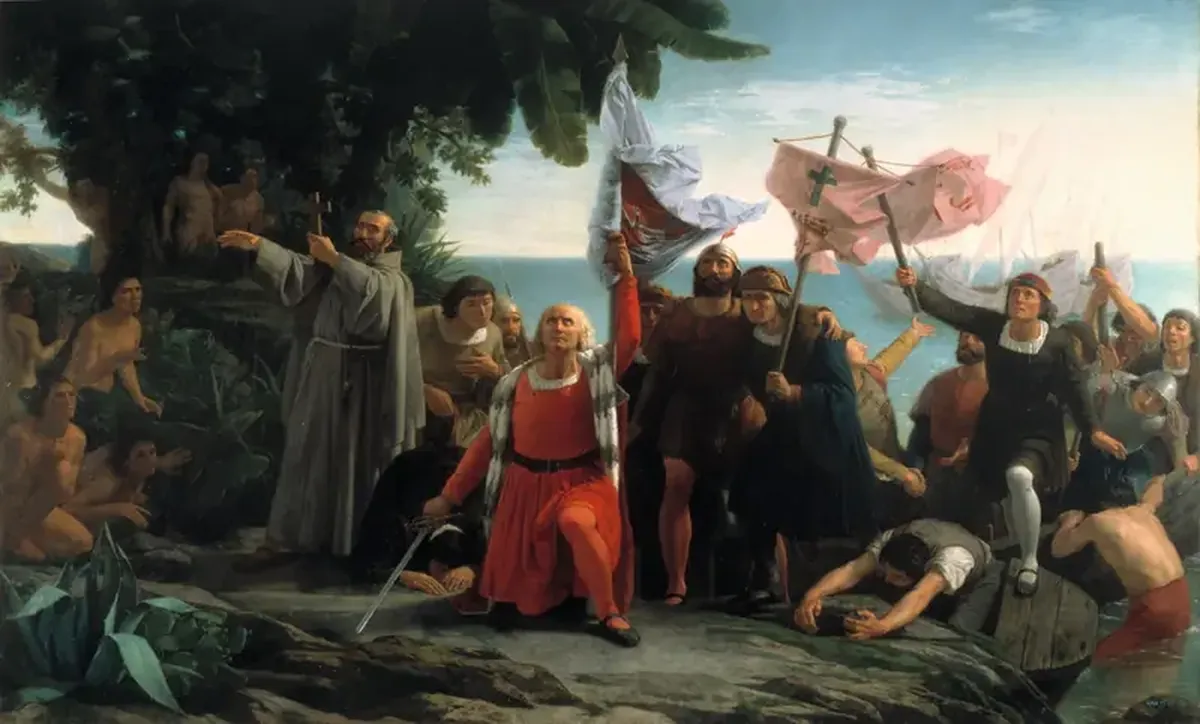
Columbus landing in the New World. Dioscoro Puebla, 1862
The Voyages of Christopher Columbus
He organized and led four major voyages across the Atlantic.
First Expedition
The first voyage began on August 3, 1492, with about a hundred men aboard three ships. They sailed to the Canary Islands and then turned west, crossing the Atlantic. During that crossing they encountered the Sargasso Sea, and in the fall they landed on a Bahamian island later called San Salvador. Columbus believed he had reached the shores of Asia, so Europeans long referred to the lands he found as the West Indies. This expedition also reached Cuba and Hispaniola (present-day Haiti and the Dominican Republic). The fleet returned to Spain in March with cargo holds full of unfamiliar plants and fruits, tobacco, bird feathers, and gold, and with several captured natives the crew called “Indians.”
Second Voyage
The second voyage lasted from September 25, 1493, to June 11, 1496. Columbus sailed with 17 ships and about two thousand people, including nobles, officials, and settlers; by then he had been granted the title of Admiral. The expedition visited the Lesser Antilles, Puerto Rico, Jamaica, and parts of the Caribbean coast, and it established colonies and settlements such as La Isabela and Santo Domingo.
This voyage marked the beginning of aggressive Spanish colonization. The local indigenous populations suffered massive oppression and decline. The sailors seized livestock, horses, and valuable plant seeds, and they took other resources back to Spain. The hardships of colonial mismanagement and lack of profits strained Columbus’s standing with the crown, but reports of gold and riches in Hispaniola kept interest in further expeditions alive.

A replica of the ship “Santa Maria”
Third Expedition
The third voyage was smaller: six ships and about 300 people, including prisoners from Spanish jails. The fleet left in 1498. During this voyage Columbus reached Trinidad and the island of Margarita, explored the mouth of the Orinoco River, and entered the Gulf of Paria. From there he sailed north to Santo Domingo, where tensions were high and his brother served as governor.
Columbus arrived in Hispaniola ill. A revolt by settlers and criminals sent on the voyage led him to impose harsh measures, including the institution of forced labor and slavery over indigenous populations. Meanwhile, news that Vasco da Gama had found a sea route around Africa to Asia—and brought back valuable spices—made it clear that Columbus had not reached Asia. The Spanish monarchs, frustrated by the lack of profits from the colonies, removed many of his privileges and had Columbus and his brother brought back to Spain in chains. After several months in prison he managed to clear some charges and later received permission for another voyage.
Fourth Voyage
The fourth expedition set sail in June 1502 with four ships; Columbus took his brother Bartolomeo and his son Ferdinand on the trip. The fleet entered the Gulf of Honduras near Martinique, sailed along the coasts of Central America, and discovered the Cayman Islands. Near Jamaica they came upon a shipwreck and gathered information that helped Columbus conclude the coastline they had found separated the Atlantic from what he called the Southern Sea. He also encountered peoples of the Maya civilization.
Columbus returned to Castile in November 1504, ill and broken, and he spent his remaining years trying to recover his reputation and privileges.
Christopher Columbus: Interesting Facts
- It took him about 10 years to secure funding for his first expedition.
- During his fourth voyage he came within roughly 65 kilometers of mainland Asia trade routes but never realized the true geography.
- For reasons that remain unclear, Columbus often wore a simple Franciscan robe.
- When he saw the Orinoco River emptying into the Atlantic on his third voyage, he described it as a kind of earthly paradise.
- Columbus is credited with initiating large-scale enslavement and the forced transfer of indigenous people to Europe when settlements failed to produce expected riches.
- To manage morale and expectations, Columbus kept two logbooks: one private record with what he believed to be accurate distances and another, simplified version for the crew.
- England, France, and Portugal refused to finance his voyages; their courts considered his plan risky or unrealistic.

Posthumous portrait of Columbus by Ridolfo Ghirlandaio, circa 1520.
Progress often depends on people willing to risk everything for an idea. The Ukrainian poet Vasyl Symonenko captured that spirit when he wrote:
Hey, new Columbuses and Magellans,
Let’s hoist the sails of our dreams!
They call us to explore the oceans,
The calm harbor is licked by the surf.
Who said everything has already been discovered?
Why were we born then?
How can we fit into the hold
Our youthful hopes?
The 21st century no longer offers many geographical frontiers to discover, but humanity still advances. Today those voyages of discovery often happen in front of monitors instead of at a ship’s helm, yet they shape the fate of individuals and societies just as profoundly.
