
 Gaby
Gaby
Not every actor’s life becomes the stuff of films. Elizabeth Taylor’s did. She lived and worked in front of the camera until the end of her days and never stopped fascinating the public. The British magazine Empire included her name on its list of the hundred most fascinating biographies in the world.
Elizabeth Taylor: The Beginning
She won three Oscars (two competitive Best Actress awards and an honorary one), became the first actor to be paid a million dollars for a film, and was named to the Order of the British Empire. She basked in luxury and fame, changed her faith and her husbands, indulged in pleasures, and admitted her flaws. The main trait Taylor called her defining characteristic was passion. In everything she pursued, she pursued it without restraint, with the same obsession she displayed chasing unruly flames as a child.
Liz Taylor was born on February 27, 1932, in London. In prewar London, her actress mother and art-dealer father lived comfortably: Francis Taylor, of Irish descent, managed an art gallery owned by his uncle, multimillionaire Howard Young, who also ran a similar business in New York. The couple’s two children had nannies, attended private schools, and took pony and horseback-riding lessons. After the family moved to the U.S., Liz began receiving film offers at age nine, thanks to her mother’s professional connections in California, and she quickly took control of her career.
The new Beverly Hills resident signed her first contract with a studio at the age of nine. She tasted success: her role in the film “Every Minute a Man Is Born” opened the door to the teenage hit National Velvet. In that cinematic tale about an English rider from a large family, the horse-loving girl from London played Velvet, who competed for the national championship with her horse, Pie. As a reward for her work, the studio gave Liz a horse with a flowing mane.
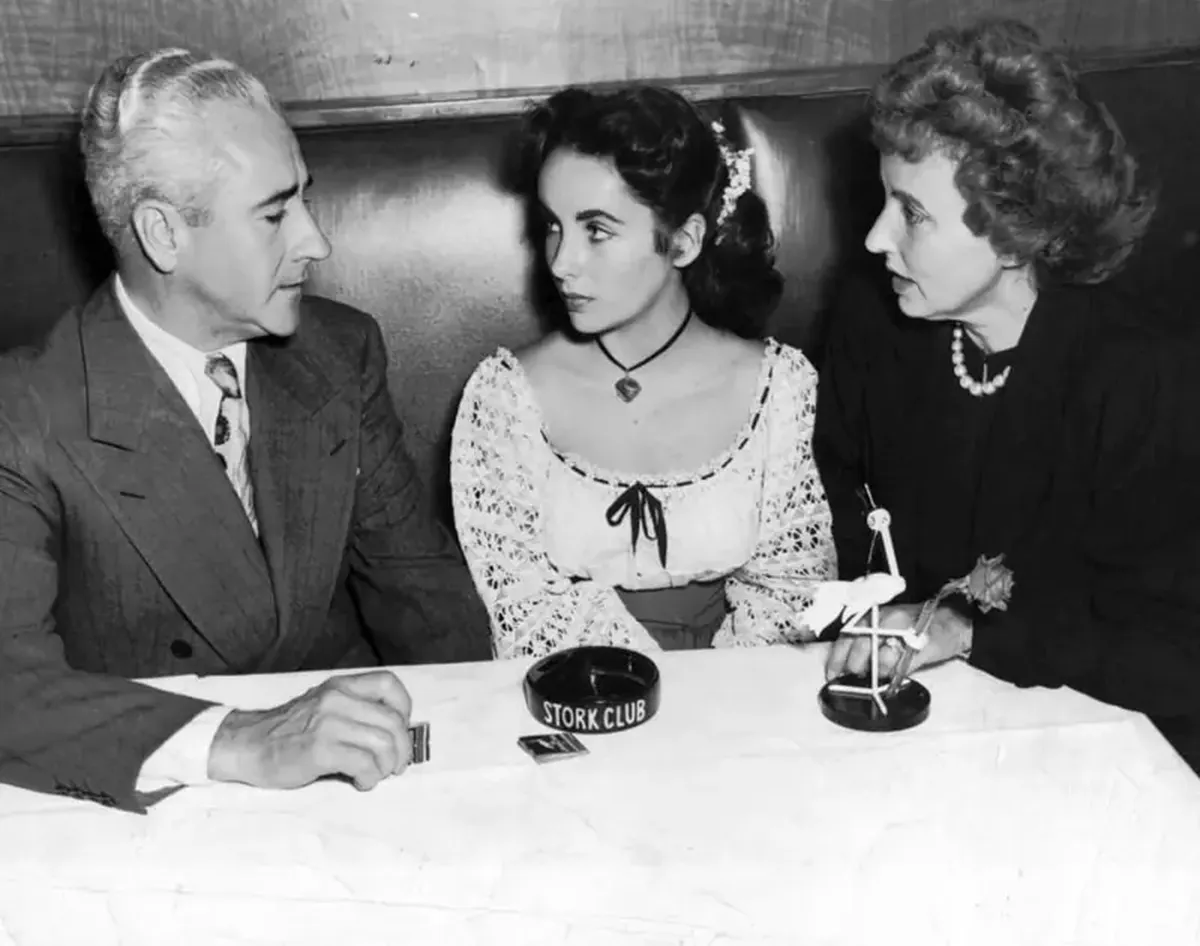
Elizabeth with her parents, 1947
Elizabeth Taylor: The Eyes
Expensive gifts would multiply as her fame grew. Each new success raised her star. Her eyes, thanks to rare mutations, were special: an unusual blue with a lavender tint and a striking double row of thick lashes. Directors sometimes asked her to wash off makeup during auditions just to prove how naturally striking she was. Makeup artists had rarely seen features like hers.
As an adult she often did her own makeup before shoots and even created a signature look for her most famous role, Cleopatra. The broad, arched brows and dramatic “cat-eye” liner that became fashionable in the mid-20th century were part of her influence on beauty culture. The star spent an hour and a half on her everyday eye makeup and another half-hour expertly lining her lips. She loved the process itself, which often made reporters wait for her.
Her “too mature” appearance as a 10-year-old ended her contract with one early studio, Universal. MGM, where she worked from age 11, wasn’t put off by that premature maturity.
At first, critics treated Taylor’s early performances cautiously, but by 1951, after A Place in the Sun, they recognized her professional ability. She had no formal acting training; her sharp observational skills helped her grow. She learned stagecraft from talented partners, while her real strengths were intuition, spontaneity, charisma, self-belief, and the power to persuade an audience.

Elizabeth Taylor, 1951
Liz from the First Take
“I was an unparalleled manipulator,” she once said, convinced she was a gift to everyone fortunate enough to work with her. At nine she earned more than her father; at fifteen she shouted at a director to defend her mother after the director had shown disrespect. On set, productions tolerated her diva behavior because she could deliver a scene in a single take.
The actress nicknamed “One-Take Liz” later accused studio moguls of using her to line their own pockets throughout her career. Hollywood paid the style icon a million-dollar salary for a film that flopped at the box office, supported her publicity, and supplied her with haute couture wedding dresses.

Van Johnson and Taylor in the romantic drama “The Last Time I Saw Paris” (1954)
Family Happiness in Elizabeth Taylor’s Life
Her marriages became a running subplot beside her 65 film roles. Taylor married eight times to seven different men; she married her Cleopatra co-star twice.
At 23, she married 18-year-old Conrad Hilton, heir to a hotel empire. The marriage didn’t last a year: after the couple lost their first child amid troubling circumstances, Liz divorced nine months after their lavish wedding, leaving behind shares and expensive gifts as mementos of her first marriage.
Her second husband, actor Michael Wilding, was about 20 years her senior. He left his first wife for the young star and fathered two sons, Michael and Christopher, with Taylor. She ended that marriage after five years.

Taylor with her third husband Mike Todd and their three children in 1957
Three days after that divorce, she married producer Mike Todd. He was 24 years older than Liz and provided her not only with wealth but also with high-profile roles that increased her fame. In that marriage Taylor gave birth to a daughter, Liza. A year later, she became a widow when Todd died in a plane crash during a storm; the aircraft had been named Lucky Liz after his wife and daughter.
Her fourth husband was singer Eddie Fisher, a close friend of the late Mike Todd. Their shared grief brought them together, and Fisher supported Taylor through the difficult days when she struggled with drinking. Fisher divorced his wife and married Taylor. Todd and Fisher were Jewish, and Taylor converted to Judaism during the marriage. After five years they divorced, having lived a life of visible wealth and social prominence. Because Fisher often deferred to his wife, studio gossip nicknamed him “henpecked.”
Elizabeth Taylor as Cleopatra
Then her life was interrupted by Richard Burton, the man who would become both her fifth and her sixth husband. Their romance ignited on the set of Cleopatra. Both were in relationships at the time; Burton even brought his wife and children to the shoot. Initially he joked about Taylor’s colorful habit of swearing on set, but their on-screen passion quickly turned into a real-life affair. A year later the couple had a daughter, and three years after that they married.

Richard Burton as Mark Antony with Taylor as Cleopatra in the film “Cleopatra” (1963)
On the bride’s yellow dress, Burton had pinned an extravagant gift: a $150,000 emerald brooch. Knowing his wife’s weakness for rare jewelry, Burton bought top lots at auctions. His lavish gifts included enormous pearls and famous diamonds worth millions.
During their time together the actors co-starred in 11 films. Their relationship inspired productions such as Burton and Taylor and Liz and Dick. Their loud arguments often ended in dramatic reconciliations and extravagant gestures. At the height of their fame they reported earnings of tens of millions a year and spent lavishly on lifestyle and travel. They could order delicacies flown in from Rome or Paris and stayed in hotels with staffs of dozens. After ten turbulent years the marriage ended, but their codependent mix of love and jealousy lasted beyond the divorce. In 1974 they tried again, but the second marriage lasted only nine months.

“His Divorce—Her Divorce” (1973) – Taylor’s last film with Burton
Elizabeth Taylor’s Filmography
As studios responded to competition from television by shifting to more serious scripts, Taylor found roles in films such as Giant, Cat on a Hot Tin Roof, Suddenly, Last Summer, Who’s Afraid of Virginia Woolf (her second Best Actress Oscar), Butterfield 8 (her first Best Actress Oscar), and Cleopatra. Filming for Cleopatra was postponed several times because Taylor suffered severe pneumonia. With rumors swirling about the deterioration of her health and even the possibility of her death, the studio began looking for a replacement. Photographs from that period show a fresh tracheotomy scar on her neck. When she recovered and later won another Academy honor, one rival reportedly quipped, “Tracheotomy won.”
After roughly 45 years in film (plus a few later roles), Taylor shifted toward theater and public appearances. She received an Academy humanitarian award in 1993 for her work supporting people with HIV. At charity events she raised funds for treatment, met with world leaders and lawmakers, and helped push attention toward AIDS and patients’ rights. She founded a charity to support people living with HIV and raised more than $120 million for it. Her personal jewelry collection, sold at auction, raised about $156 million for charitable causes.
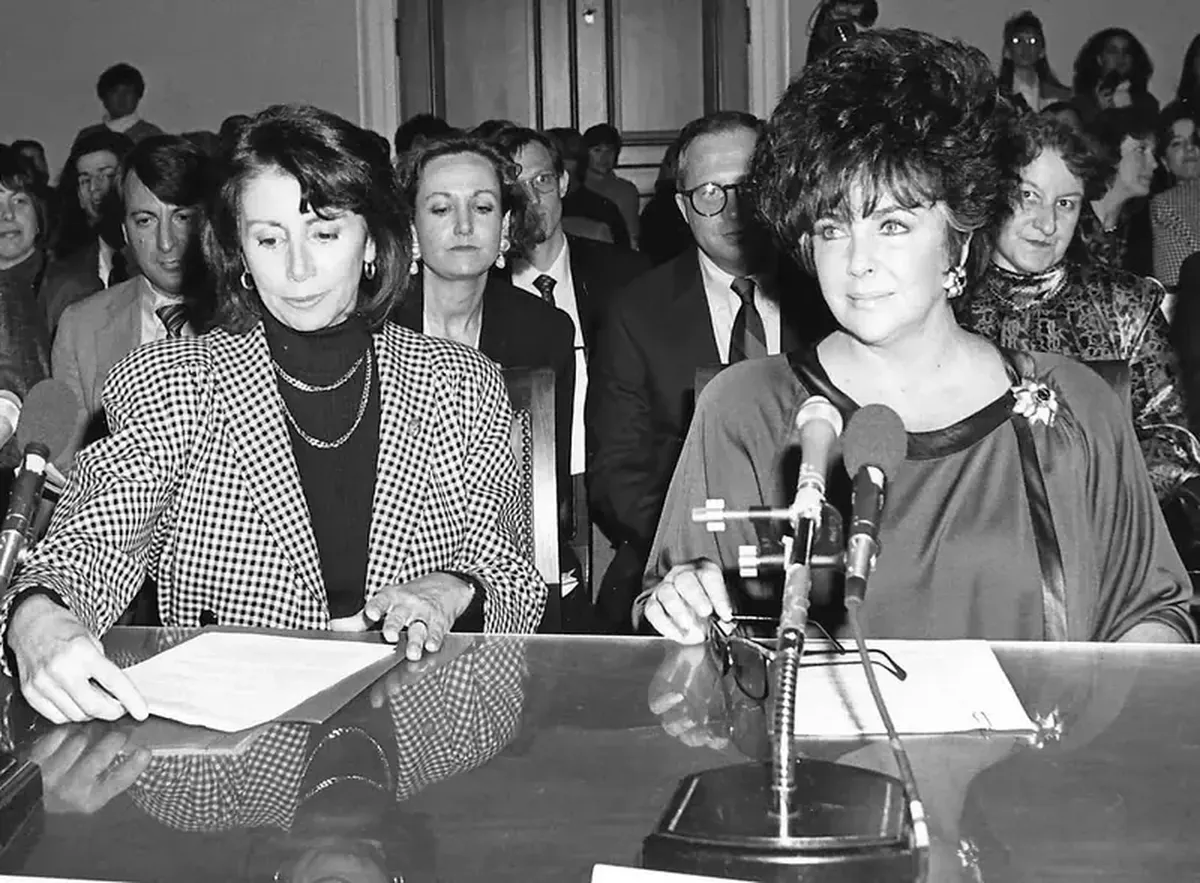
Taylor testifying before the House Budget Committee on HIV/AIDS funding, 1990 (left – Nancy Pelosi)
In Conclusion…
Taylor’s penultimate husband was Senator John Warner. She helped him with his political campaigns, but at home the couple had little in common. After six years Taylor, who had returned to drinking, left the marriage. She described that period as living with “a closed mouth.”
Taylor’s final marriage was to construction worker Larry Fortensky. They met during rehabilitation for alcoholism and held their wedding at Neverland Ranch, an event the tabloids covered along with the ranch’s owner and Taylor’s friend, Michael Jackson. The mismatched couple separated after a few years, and Fortensky later left when Taylor’s health began to decline.
Taylor’s life included repeated battles for personal survival. She publicly acknowledged alcohol and drug dependence and sought rehabilitation several times. She underwent three hip replacements and had a brain tumor removed. She also faced skin, lung, and heart illnesses. Despite a heart operation and ongoing medical care, Elizabeth Taylor died on March 23, 2011, at age 79. A rabbi used her Hebrew name, Elisheva Rachel, in the memorial.

Taylor’s star on the Hollywood Walk of Fame in the days following her death in 2011.
The American Film Institute ranked Taylor seventh on its list of screen legends. The actress seemed content with her place in life. In one of her last interviews, she thanked God for every moment she had been given.
