
 Carlos Solis
In the aristocratic creative legacy of the first Polish composer to enter the European pantheon of classical music, there are no operas, symphonies, or oratorios—Frédéric Chopin wrote almost exclusively for the piano, the instrument he played as a child prodigy. He published his first polonaise at age 8, and his final performance as a Warsaw Conservatory graduate featured the premiere of his Piano Concerto in F minor when he was just 20. A romantic composer who became a symbol of Polish national feeling, he was a subject of the Russian Empire, made his career in France, and left his heart—literally and figuratively—in Warsaw. What influence did love have on the work of the “poet of the piano,” and why is Chopin’s music often described as “cannons hidden in flowers”?
Emotional Sensitivity
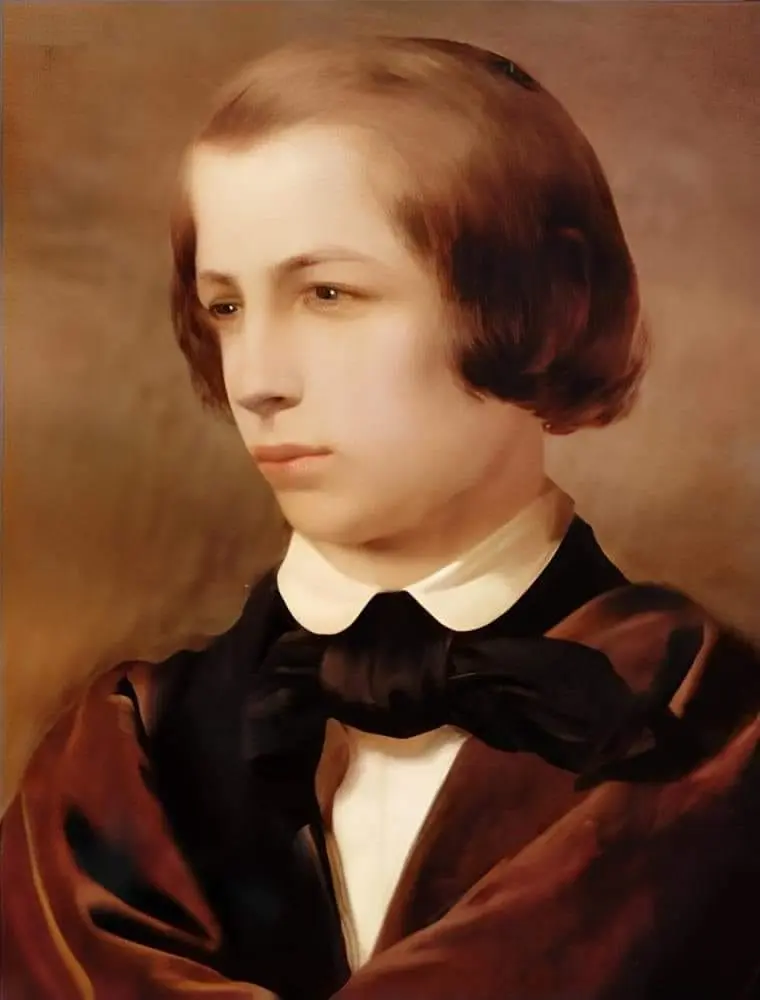
Frédéric Chopin was born on March 1, 1810, just outside Warsaw. His father, Nicolas Chopin, a Frenchman, worked as a tutor in the Skarbek household in the village of Żelazowa Wola. There he met Tekla-Justyna Krzyżanowska; they married and had four children—three daughters and a son whose genius showed early. The young composer inherited his passion for music from his father, who played violin and flute, and from his mother, a soprano who knew the harpsichord.
The soft, delicate son of musicians stood out from a young age for his heightened sensitivity and nervous temperament: he suffered bouts of sadness and melancholy, cried often, and experienced night terrors that felt all too real. Chopin showed particular responsiveness to music: as a four-year-old he would lie under the piano while his mother played, listening intently and trying to reproduce the melodies. By age seven he had already surpassed his teacher in performance skill.
While learning to play, the future virtuoso used a device he invented to stretch his small fingers so he could reach complex chords. The device caused him great pain, but Frédéric refused to take it off even at night. The boy who could stubbornly refuse to sit at the instrument during the day would fling himself at the keys in the middle of the night, leading the maid to think he was mad.
From childhood, the “poet of the piano” preferred to play in the dark: to find the right mood, he later asked that candles be extinguished during performances because light distracted him. His emotional vulnerability included visions that accompanied later epileptic seizures. Otherworldly spirits and deceased relatives reportedly “visited” him, and he described seeing “some damned creatures” in the belly of his piano. His frail health kept him in home schooling until he was 13.
Music Lessons
From age seven, the young prodigy was taught by the Bohemian pianist Adalbert Żywny, who introduced him to the works of Bach and Haydn. From 1816 to 1822 Chopin studied piano with cellist Wojciech Żywny and learned organ music from Wilhelm Würfel, a professor at the Warsaw Conservatory. In 1818 the eight-year-old’s first polonaise was published, and he debuted as a pianist, quickly becoming a favorite in Warsaw’s salons.
Chopin’s performance style was shaped in those chamber settings, where the salon musician favored a soft, restrained approach without theatricality. For his delicacy and refinement, audiences dubbed the aristocratic performer “the young prince” and compared him to a bodiless angel. Before concerts, the slender pianist—he always weighed under 110 pounds at about 5’7″—might go days without eating and would hyperventilate from anxiety; he preferred to play for a small circle of admirers and gave fewer than 30 public concerts in his lifetime.
A popular nickname among friends, the “Dog Waltz” (Op. 64) was not written in his childhood, and Chopin sometimes dedicated pieces to friends—even reportedly to George Sand’s dog. At age 10 he wrote a march that a military band performed repeatedly. From 13 he studied at the Warsaw Lyceum, where his father taught, and by then he was already a seasoned performer. He learned theory and composition from Polish composer Józef Elsner.
Elsner called his pupil “an undeniable genius.” In 1829 Chopin graduated from the Warsaw Conservatory and won praise for concerts in Prague, Dresden, and Vienna. After his final Warsaw performance on March 17, 1830—the premiere of his Piano Concerto in F minor—the 20-year-old set off for Vienna and soon moved to Paris, where political turmoil in Poland would keep him from returning.

Cannons in Flowers
That move was a turning point. The failed Polish uprising of 1830–1831 dashed his hopes of returning home, and Chopin spent the rest of his short life as an émigré in Paris. From 1815 to 1874 the Kingdom of Poland existed as an autonomous state within the Russian Empire, governed by a viceroy appointed by the Russian emperor, and the insurgents had sought to restore Poland’s independence.
News of the uprising’s suppression triggered a deep depression in Chopin. He worried constantly about the fate of relatives and compatriots and blamed himself for not being able to act. His letters reveal that he would “thunder on the piano” at night, and during this period his music began to include turbulent passages and stark contrasts—qualities heard in the “Revolutionary” Étude in C minor. “There will be no avoiding terrible things, but in the end, there is Poland,” he wrote to a colleague, Juliusz Fontana.
Critics and scholars called some of his pieces “cannons hidden in flowers.” Reviewers argued that if the tsar realized what a dangerous message lurked inside the simple melodies of mazurkas and the heroic polonaise, he might have banned Chopin’s music, as occupying forces later suppressed his patriotic works during World War II. National motifs became a hallmark of Chopin’s output.
The composer enriched European art music with Slavic intonations drawn from folk songs and dances he loved from his childhood in the countryside. Weaving ethnic harmonies into classical forms was also a patriotic act that added national color to his catalog: 57 mazurkas, 16 polonaises, 19 waltzes, 19 nocturnes, 3 sonatas, 4 ballades, 27 études, 26 preludes, 4 scherzos, and 3 impromptus.

Frédéric Chopin Playing the Piano in the Salon of Prince Radziwiłł. Artist: Heinrich Semiradsky, 1887
The Creativity of Frédéric Chopin
Estrangement from his homeland became a personal tragedy that shook his mental balance and shaped Chopin’s creativity. Suffering, fatigue, and dark thoughts often dominated his mind. “The best way out is death,” he mused during severe depressions, though he could be ironic and witty and had a gift for accurate parody. After moving to France in 1831, Chopin gained new admirers.
Friends and supporters included leading musicians, artists, and writers—Liszt, Berlioz, Mendelssohn, Rossini, Delacroix, Schumann, Balzac, Mickiewicz, and Heine. His reputation grew less from public performances than from his position as a music teacher in the Rothschild household. From the 1830s on he performed regularly and composed major works.
Major achievements include three piano sonatas (1827 in C minor, 1837 in B-flat minor, and 1844 in B minor), the Fantasy in F minor (1840), and the “Barcarolle” (1845). For piano and orchestra he wrote the Andante spianato et Grande Polonaise brillante, the Fantaisie brillante on Polish airs, Rondo à la Krakowiak in F major, the polonaise in E-flat major, and the concertos in E minor and F minor. The famous Funeral March (the third movement of Piano Sonata No. 2) is widely regarded as a pinnacle of the genre.
Even the marble monument erected in Paris in 1906 shows the “sad genius of romanticism” performing the incomparable Funeral March: at Chopin’s feet a girl weeps in grief while a sorrowful angel scatters flowers. Chopin himself described the main mood of his works with a single word—”sorrow.” That mood even belongs to his tender waltzes, his favorite genre: he wrote his first at 17 and his last a year before his death.

Chopin Monument Erected in 1906 in Paris
Chopin’s Illness
“My health is terrible; something is tormenting me inside,” Chopin wrote, confessing to dark premonitions. He told loved ones that anxiety alternated with calmness, indifference, and numbness, while his desire to live fluctuated with a longing for death. Teaching and publishing allowed him to live comfortably without frequent public concerts: he had a pleasant home, a carriage, elegant clothes, and servants, but he could not always enjoy his success.
Chopin first felt weakness at 16: after physical exhaustion he developed swollen lymph nodes and persistent headaches. His parents sent him to a spa with his youngest sister Emilia, who died a few months later of tuberculosis. Some researchers think Emilia may have infected her brother; shortly after she died he began showing symptoms associated with consumption: recurrent fever, cough, coughing up blood, and auditory hallucinations—the pianist reportedly heard bells ringing at his own funeral.
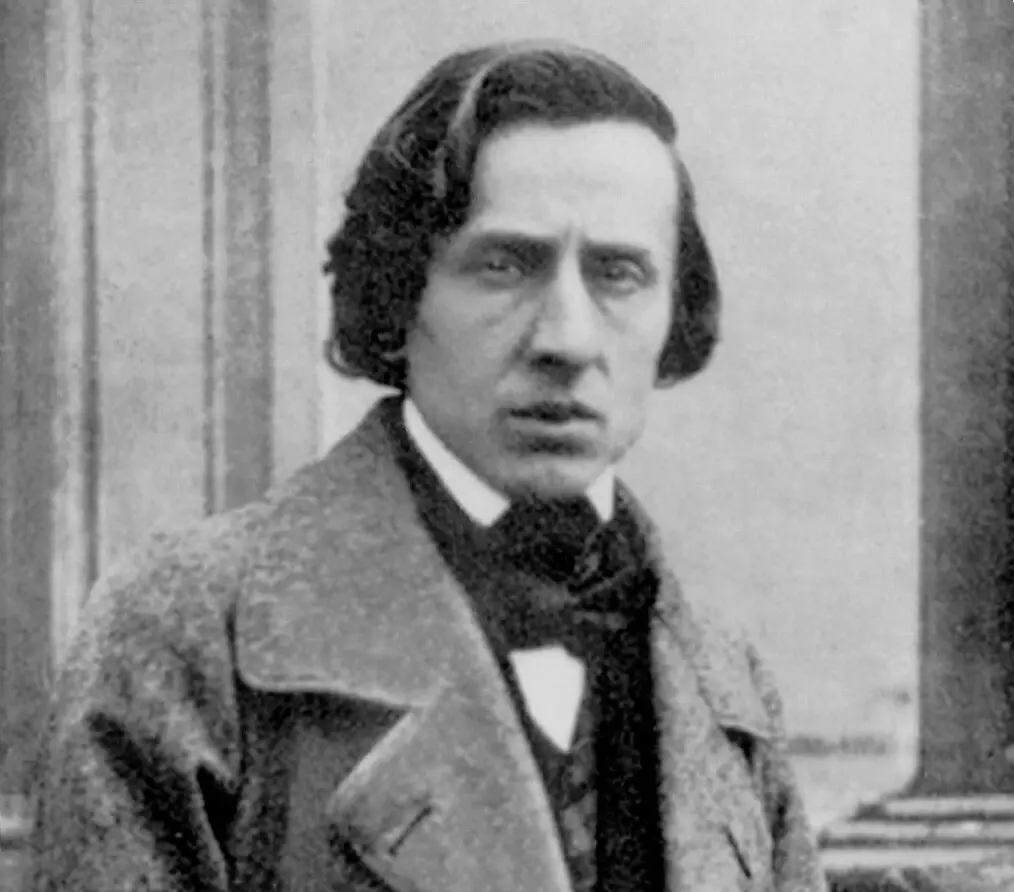
Under the weight of depression, Chopin wrote a will while still young. His extreme thinness, poor coordination, reserved expression, clouded gaze, and quiet playing style led some contemporaries to call him “a talent from a hospital bed.” His illness was chronic, and he died at 39 from related cardiac complications. Dr. Cruveilhier attributed the composer’s premature death to “tuberculosis of the lungs and larynx,” though others suggested different diagnoses.
There are accounts that doctors once called Chopin’s condition “an unknown disease.” Modern clinicians do not rule out a hereditary, chronic, multi-organ autosomal recessive disorder—cystic fibrosis—which was first described in the 1930s. That disease often causes recurrent respiratory infections and gastrointestinal problems, leading to weight loss and the thinness seen in Chopin from a young age.
Women in Chopin’s Life
Chopin periodically traveled to spa resorts for treatment and to see family. In 1836 at the spa of Marienbad the 26-year-old grew close to the family of his friend Feliks Wodziński and allegedly became engaged to Feliks’s sister, Maria Wodzińska. Legend says strict parents refused to let their daughter marry a sick pianist, ending the engagement.
Another account claims the engagement ended after Maria suggested that a visiting friend sit before her fiancé; offended, Chopin broke off the match. Scholars who have studied his letters found no clear evidence of passionate feelings for Maria, and his correspondence with her mother, Teresa Wodzińska, appears more intimate.
Chopin was discreet about romance: he never married and had no children. Still, love influenced his work—most famously in his brilliant, decade-long relationship with the French writer George Sand.
The couple shared a close partnership and love affair for more than ten years. When they met, Chopin was 28 and Baroness Aurora Dudevant—George Sand—was 34. After their introduction by Franz Liszt Chopin reportedly said, “What an unpleasant person. I wouldn’t even dare to call her a woman.” Few could have predicted that their later breakup would hasten the composer’s decline.
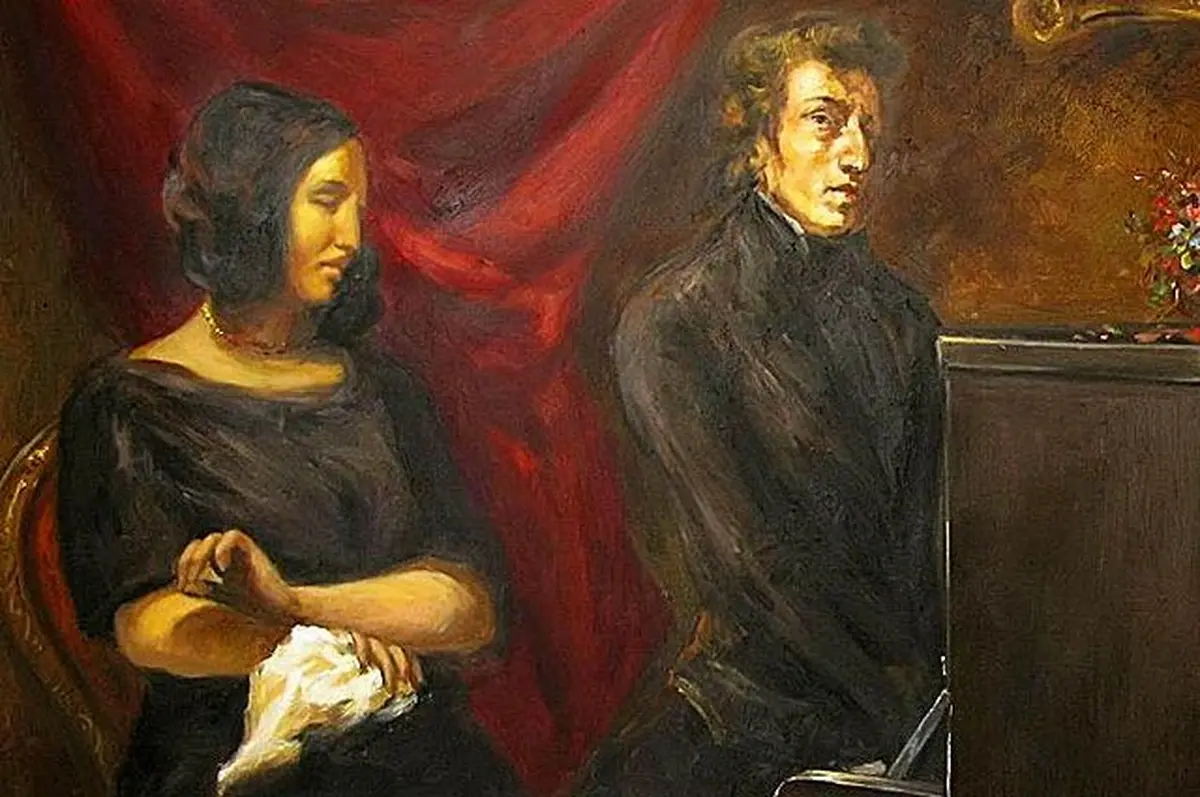
George Sand and Frédéric Chopin. Artist: E. Delacroix, 1838
George Sand and Chopin
The determined novelist pursued Chopin persistently and became his devoted caregiver. Her scandalous reputation repelled the virtuous young man; her habit of wearing men’s clothes baffled him, and the smell of her cigars bothered his lungs. Chopin’s frailty stirred a maternal instinct in the baroness, and she took to caring for him.
“I need to take care of someone,” she said, and she added Chopin to the list of those needing her attention. From her marriage to Baron Kazimierz Dudevant she had a son, Maurice, and a daughter, Solange. After her divorce she remained involved in her children’s lives while also caring for Chopin.
“I met her three times,” the musician later recalled of how their bond developed. “While I played, she gazed deeply into my eyes, leaning on the piano. Her affectionate gaze clouded my mind. I was conquered. She loves me.” As a devoted partner, she prepared broths and medicines, cooked his favorite dishes, fed him by spoon when necessary, and comforted him through visions of the dead. She set aside her work to tend to him.
George Sand became both lover and nurse. Chopin suffered colds and heat strokes, chronic digestive pain, and such exhaustion that sometimes he could not climb stairs and had to be carried. When the landlord of the house in Mallorca learned of Chopin’s condition, Sand hired men to haul the piano up a mountain path to the remote monastery cell where they sought refuge.

Scene from the film ‘Chopin, Chopin!’ 2025
“Closer to the Grave than to the Marriage Bed”
“As winter approached, Chopin’s health deteriorated, and all my efforts to dispel his gloom became futile,” George Sand wrote. “We felt like prisoners. It seemed that death was lurking for one of us, and I had to fight it off to protect my prize.” Chopin showed signs of delayed puberty—at 22 he reportedly had facial hair only on one side—and contemporaries believed he was infertile.
Their relationship eventually became platonic as Sand tried to shield Chopin from strong emotions that might harm him, and in 1847 the couple parted amid disputes with her children. After the breakup his health worsened dramatically. “I will either suffocate or go mad,” he said as he weakened, and within four years he became bedridden and dependent on morphine and outside care.
A year after the split, Chopin briefly rallied and toured the salons of England and Scotland, even playing before the queen; during that trip he reportedly changed residences dozens of times. Rumors linked him to a local pianist, Jane Stirling, but he dismissed marriage talk with a bleak joke that he felt “closer to the grave than to the marriage bed.” His last public performance took place on November 16, 1848. Returning from Britain, Chopin looked like a shadow of his former self.
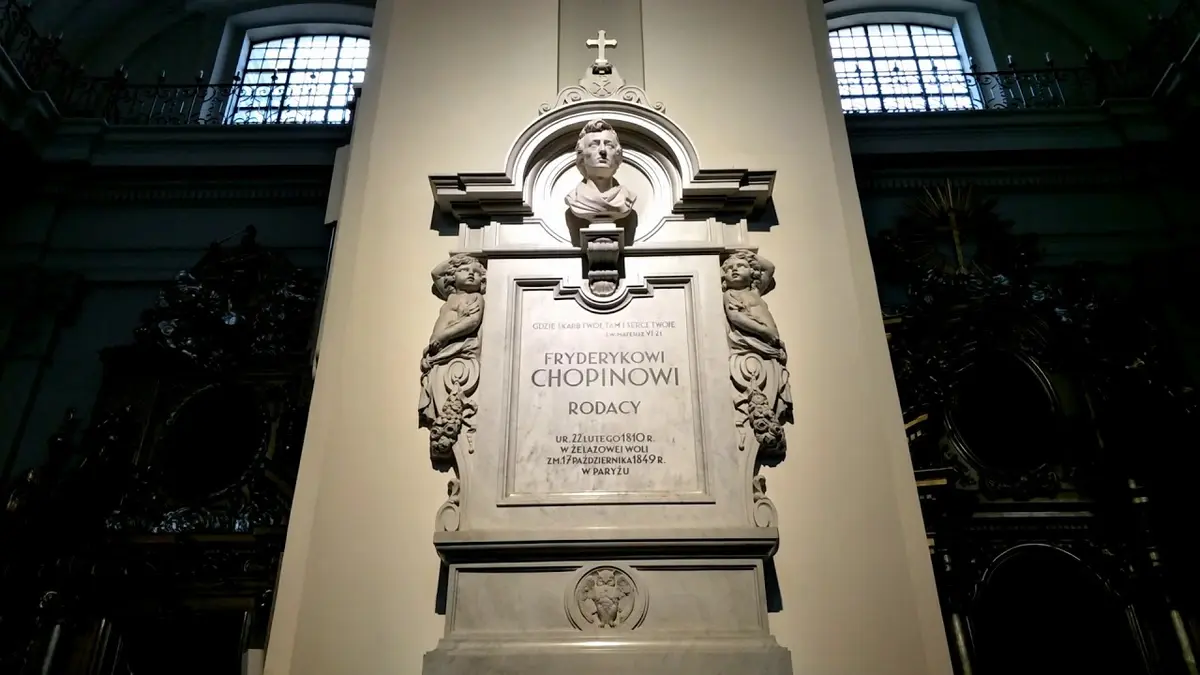
Frédéric Chopin’s Heart at Rest in the Column of the Church of the Holy Cross in Warsaw
In the last year of his life the composer could no longer write music and confessed he felt nothing but a waiting for the end. On October 17, 1849, the 39-year-old virtuoso died in Paris in the arms of his sister Ludwika. Chopin was buried in Père Lachaise Cemetery, but his heart returned to his homeland: according to his will, his heart is interred in a column of the Church of the Holy Cross in Warsaw—the city that holds a piano competition in his name every five years and awards annual Fryderyk prizes to musicians.
Photo from open sources
