
 Gaby
Gaby
She paused for a moment in the doorway… This time, there would be no turning back! She left this world peacefully and with dignity, because in her culture death is part of life. In the end she probably didn’t replay anything in particular—there was no dramatic deathbed scene, even though she hadn’t left her bed for many years. But to hell with sentimentality! Perhaps there was just a shot of tequila, a cigarette, bright red lipstick, and a shroud made from the flag of the Mexican Communist Party…
It wasn’t only that she lived and created in the post-revolutionary era; she had the rare gift of pouring her personality and talent into surreal, symbolically charged, modern, and cubist narratives with such virtuosity and feeling that she captivated millions—not only Mexicans who had fought dictatorship, but free thinkers around the world. Fate tested her relentlessly, never giving her a chance to recover—throwing harsher trials her way and then asking, “Are you still alive?” With every new suffering she grew stronger. She painted, painted, painted—154 works that charted her life. Through them she clung to the world and shook it in ways that felt unreal.

Frida Kahlo at work
A Feminist Who Loved Her People
Frida Kahlo was born in 1907. She later changed that date to 1910—the year of the Mexican Revolution. Issues like national identity, gender, class and racial inequality, and creativity as an expression of Mexican indigenous traditions mattered deeply to her. She was also engaged with feminism, the Chicano movement, and LGBTQ rights. She saw herself as part of the struggle against discrimination toward people of Mexican descent in the U.S., a struggle expressed through music, the visual arts, film, and body art.
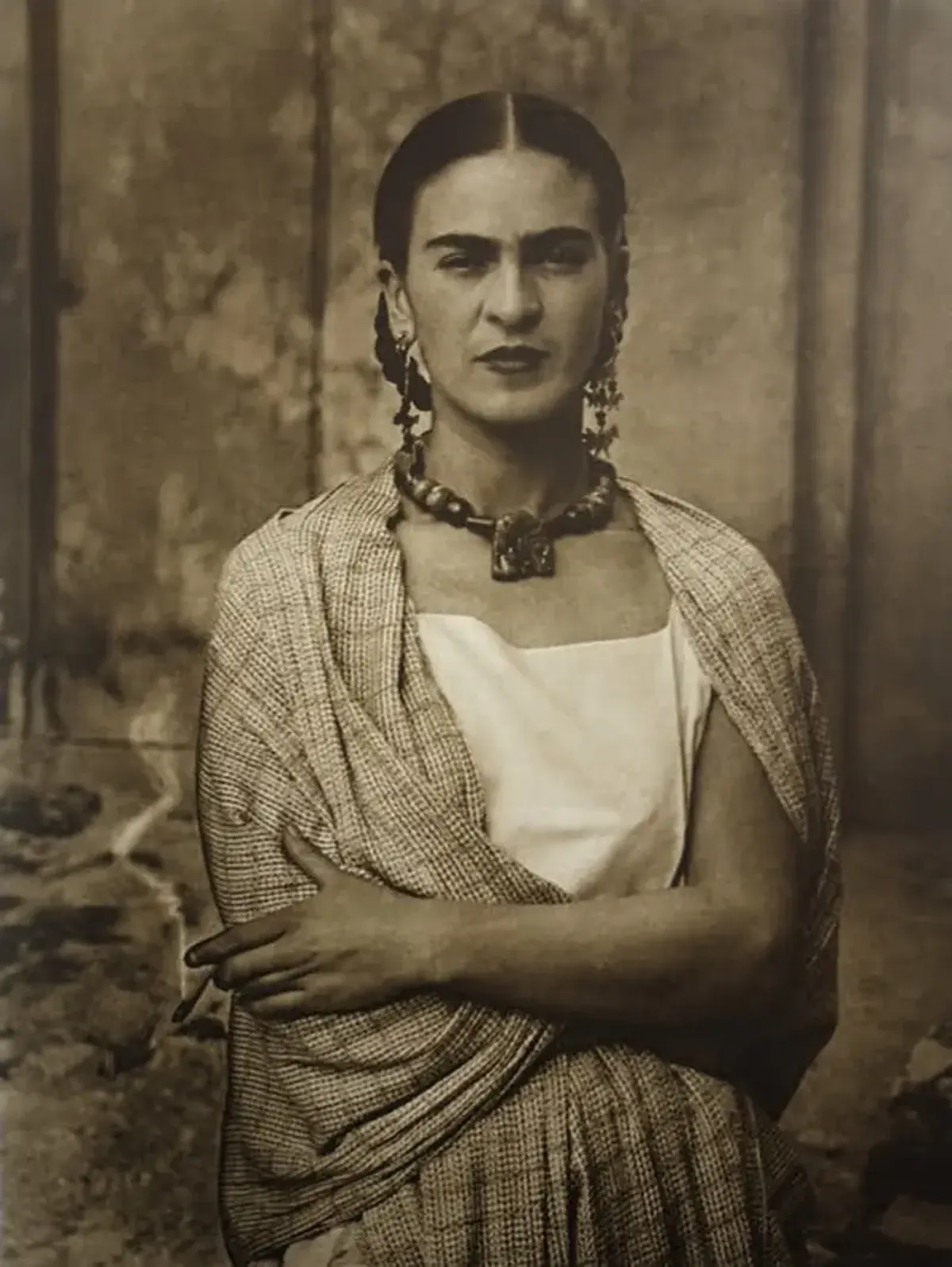
Frida Kahlo, 1929
Mexico was in the middle of a renaissance, with artists, writers, photographers, and filmmakers converging on the country. Frida was determined that Mexicans would not be treated as cultural outcasts. She showed that commitment in her appearance, dreaming of Mexican authenticity and clothes adorned with indigenous patterns. Even after her leg was amputated, at 43 she insisted on wearing a bright red, traditional-style boot on her prosthetic. She painted her prosthetic in her own style—just as she painted the leather corsets and plaster orthopedic devices that hid her physical disabilities, covering them with religious and communist imagery. Like her husband Diego, she imagined a communist future for her people.

Frida Kahlo in a wheelchair
Ultimately Mexicans chose their own path, but her country returned the love: her portrait even appeared on a Mexican banknote. Frida Kahlo’s works were declared national cultural heritage in Mexico, and their export was restricted. That didn’t stop the world from falling under her spell—or from paying high prices: her painting “Roots” was valued at $7 million at a Sotheby’s auction.

“Roots,” 1943
If tattoos had been trendy then, Frida might have embraced them. Instead she found other ways to express herself: in her self-portraits she emphasized her unibrow—like two outstretched black wings—and in life she darkened it with a black pencil from her favorite brand, Revlon. Today, people who value unconventional thinking get tattoos of Frida as a symbol of freedom, authenticity, and boldness.

Self-Portrait with Thorn Necklace and Hummingbird, 1940
What Are Legs When You Have Wings? The Phenomenon of Frida
Frida remembered her childhood in her parents’ “Blue House” in the Coyoacán neighborhood of Mexico City as “rather sad,” marked by her parents’ mutual coldness and recurring illnesses. She was especially close to her father, who shared his love of art, books, photography, nature, and dreams with his eldest daughter. Her relationship with her energetic but strict, devout mother was strained, as was her mother’s relationship with Frida’s three sisters and two stepsisters.
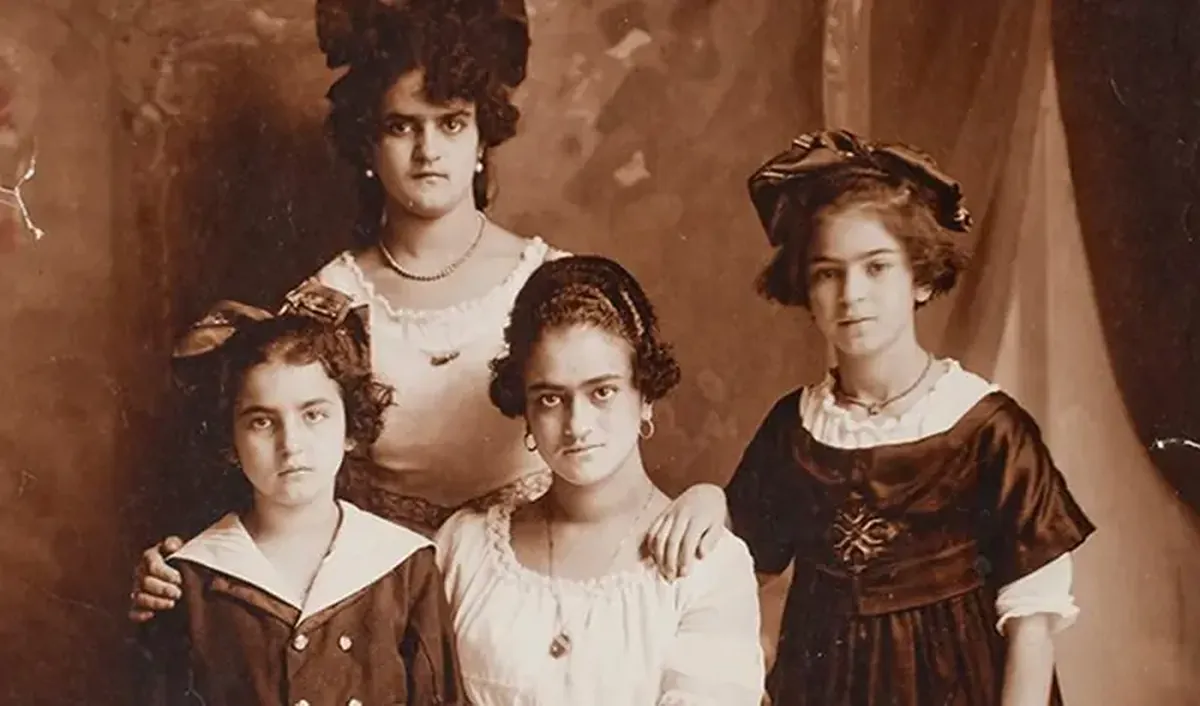
Frida Kahlo (right) with her sisters
What her mother did pass on was a sense of the unique beauty and mystique of their Indigenous–Spanish roots. Fate spared Frida’s life but not her health—at six she contracted a severe form of polio. The illness left her with a limp, chronic pain, and the mockery of peers calling her “Frida with the wooden leg!” After that initial period she played soccer, boxed, and swam a lot, even while bandaged.
Frida grew up into a rebel: she learned to smoke, curse, and get into trouble. Her father tried to help his favorite daughter find her way, sending her to various schools from which she was expelled for disobedience. At 15 she enrolled in the elite preparatory school Preparatoria to study medicine. Caught up in the whirl of student life—with underground gatherings, philosophical clubs, and free-spirited projects—Frida adopted an extravagant demeanor, masking her disabilities under long, dramatic outfits. It was there she first met Diego Rivera, though that initial encounter was only fleeting.
…The average artist has one, at most three self-portraits. Frida Kahlo has about 55. And in none of them does she smile. Here she is newborn; here she writhes in the agony of a stillbirth; here she stands among exotic flowers and birds; here she is… with a bare heart. She peers out from beneath thick brows, always looking directly at you with eyes as dark as the cosmos.
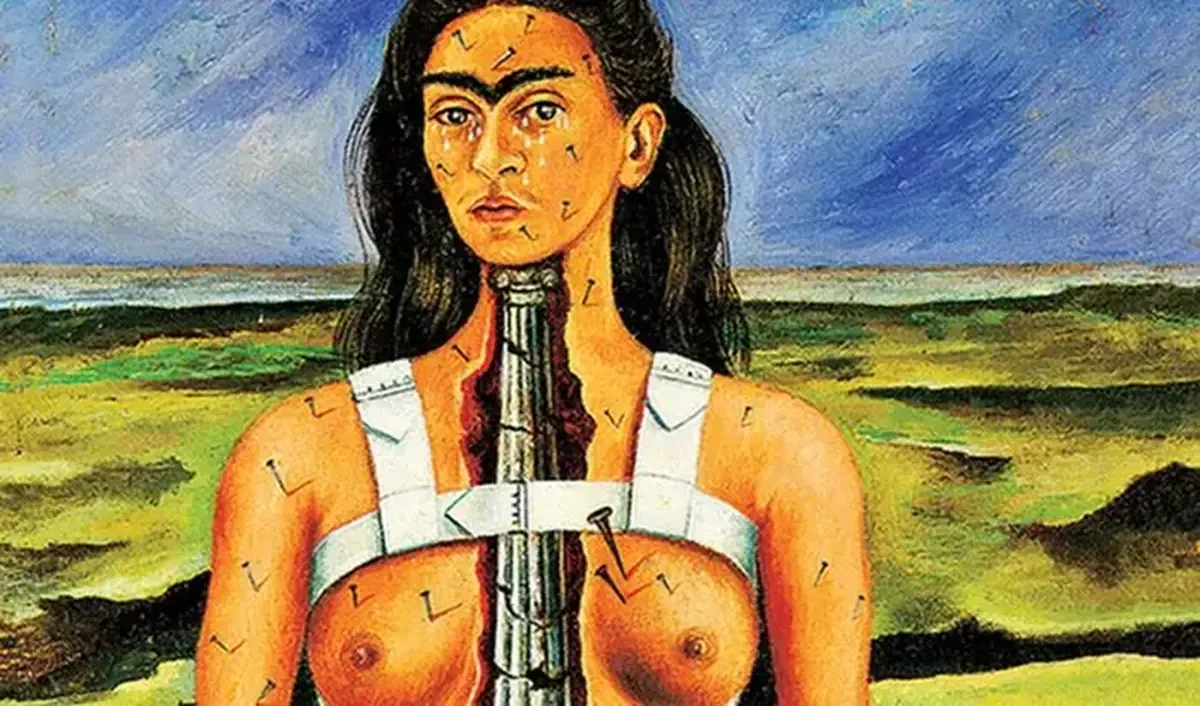
“The Broken Column,” 1944
“I paint self-portraits because I spend a lot of time alone, and because I am the person I know best,” she wrote when she had been confined to bed for a long time. She had been confined after a horrific accident: at 18 the car she was riding in collided with a streetcar. A metal pole from the streetcar impaled her, entering her abdomen and exiting through her groin, shattering her pelvic bone and damaging her uterus. She suffered a broken spine and hips, a leg fractured in eleven places, and underwent thirty-two surgeries. Weeks passed unconscious, and then she returned with a mystical thirst for painting.
She asked her father to bring paints, an easel, and a mirror, which she set up above her head. She looked into that mirror and painted immortal portraits—records of her soul. Her first pencil sketch, “The Accident,” dates to this period. Painting and the support of loved ones helped her survive, recover, and even soar, but loneliness shadowed her even when she learned to stand, painfully limping.

Frida Kahlo painting in bed
The Elephant and the Dove
Frida liked to say there were two great catastrophes in her life: the streetcar and her husband, Diego. When they became close she was 22 and Diego Rivera was 43. She was delicate, exotically beautiful, and refined; he was bulky, awkward, and not conventionally handsome—but undeniably charismatic. At the time, Diego was one of Mexico’s most famous muralists, a committed communist who fiercely supported his wife’s creativity. He wrote, “Frida is the only artist in the history of art who opened her chest and heart to reveal the biological truth of feelings.”

Frida Kahlo with her husband
Two strong personalities under one roof led to constant turmoil. Frida and Diego separated and reunited repeatedly, loudly arguing and publicly dramatizing their relationship. Diego’s infidelities piled up—his talent and charisma made him irresistible to many lovers—while Frida kept taking him back, hoping things would work out. Her injured body couldn’t carry the child she so desperately wanted with the man she loved; she lost two pregnancies. Those losses appear in works like “Henry Ford Hospital (The Flying Bed)” and the lithograph “Frida and the Miscarriage.”

“Henry Ford Hospital (The Flying Bed),” 1932
All the while Frida worked to capture Diego’s attention. She dressed vibrantly, loved changing outfits and accessories, favored bold makeup, and filled her life with flowers. She was passionate—the spider monkey, a symbol of desire, often appears beside her in paintings. Had her body been different, who knows how differently she might have lived. Inside her there was a constant clash of contradictory emotions, a strong cocktail of reality and fantasy. She sometimes turned to Freud for answers about feminine and masculine identities and was fascinated by psychoanalysis.
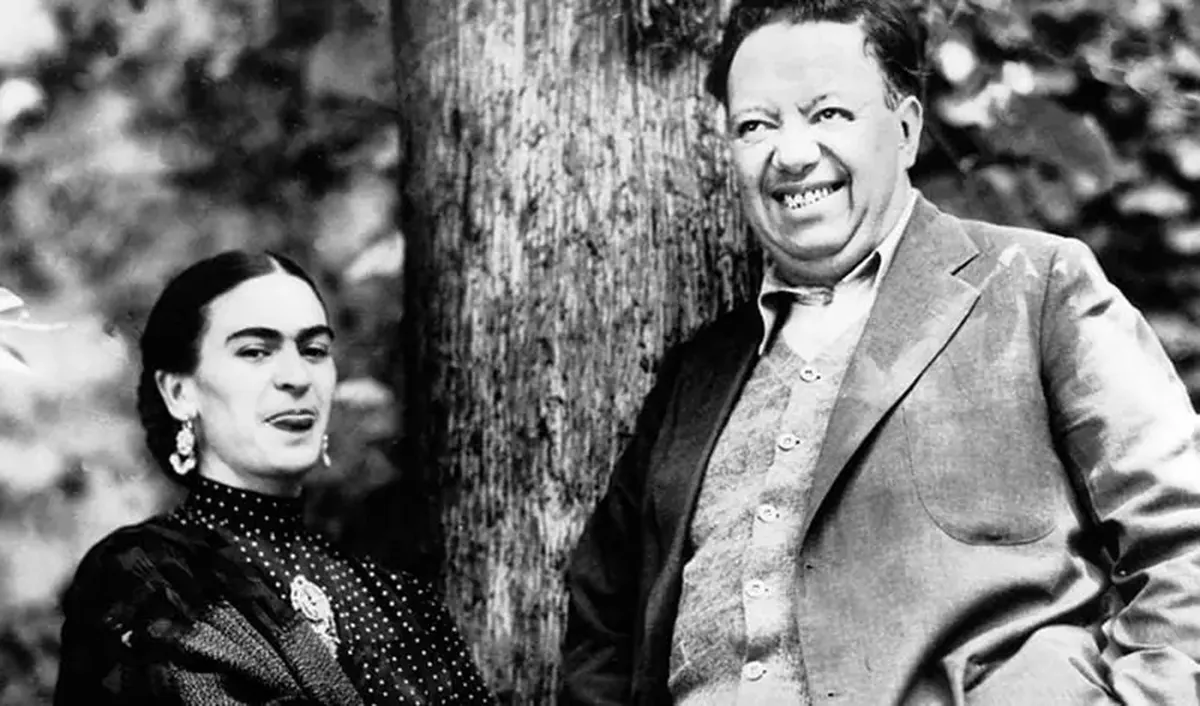
Frida and Diego
She was uniquely beautiful and delicate, but not conventionally feminine. Frida was among the first Mexican women to wear pants, curse like a sailor, smoke heavily, drink openly, and refuse to hide her bisexuality. She proudly kept her mustache in her self-portraits. She also had affairs—possibly out of anger or despair—and rumors swirled about relationships with the Marxist Leon Trotsky, the poet Vladimir Mayakovsky, and singer Chavela Vargas. Those rumors changed little. The final straw came when Diego had an affair with Frida’s younger sister; she filed for divorce. Something inside her broke—she cut her hair, wore a men’s suit, and her paintings grew even darker and more visceral. That period produced works like “Just a Few Scratches!”

Frida Kahlo and Leon Trotsky
Viva La Vida!
Frida Kahlo died of acute pneumonia. She had expected death and did not fear it. About a year earlier she had her first and only solo exhibition; already gravely ill and with an amputated leg, she greeted guests from a bed in the center of the gallery—complete with drinks, risqué jokes, and songs. Diego was once again by her side.
A week before she died Frida painted a still life of bright watermelons against a piercing blue sky, one slice inscribed “Viva la Vida”—”Long live life!” That feels fitting for someone who had fulfilled her mission and made peace with both life and death. The 2018 Victoria and Albert Museum exhibition “Frida Kahlo: Making Her Own Self” displayed about 6,000 photos, 300 personal items and pieces of clothing, and 12,000 documents that had been stored in the bathroom of their home for 50 years; it took historians four years to sort through the collection. Diego Rivera outlived his “dove” by just three years.
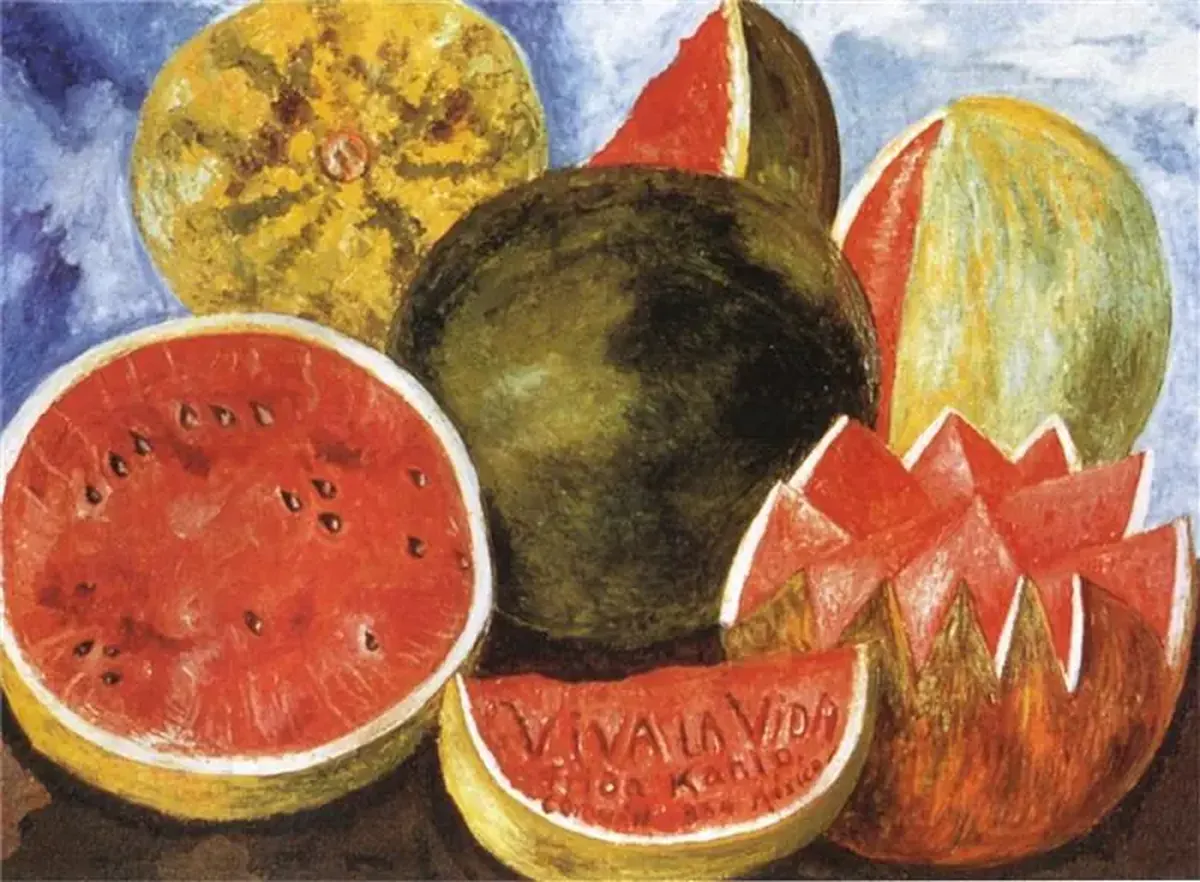
“Long Live Life, Watermelons,” 1954
Profile
Frida Kahlo de Rivera (Magdalena Carmen Frida Kahlo y Calderón) – Mexican painter, writer, and memoirist.
Born: July 6, 1907 (Mexico City, Mexico)
Died: July 13, 1954 (Mexico City, Mexico)
Father: Guillermo Kahlo, a German immigrant and professional photographer
Mother: Matilde Calderón y González, born to an Indigenous father and a mother of Spanish descent
Husband: Diego Rivera, a world-renowned Mexican muralist and graphic artist who worked for the revolutionary government’s state art program, creating monumental frescoes in public buildings across Mexico. A committed communist, he worked both in Moscow and the U.S.—such were the times!
