
 Gaby
Gaby
The High Renaissance reached its peak with Raphael Santi, the Italian painter and architect who helped close the era. He was one of the three titans of the time—alongside Leonardo da Vinci and Michelangelo—who together defined early 16th-century “Roman classicism.” Fate brought the three of them into close proximity: they lived near one another, worked for many of the same patrons, and competed for the same commissions, each producing masterpieces that have lasted for centuries. Raphael was 31 years younger than Leonardo and eight years younger than Michelangelo. Some art historians have called him the “happy painter,” a creator for whom the intense act of making art was neither the torment it was for Michelangelo nor the mystery it was for Leonardo da Vinci.
The Lucky One from Urbino
Born on March 28, 1483, in the eastern part of Italy, Raphael belonged to a new generation of the humanist era. His origins in the fortress city of Urbino show up in his full name—Raphael Santi da Urbino—and in his official signature, “Raphael Urbinas.” The life of this “chosen one,” as some envious contemporaries imagined the handsome, wealthy, and charming young man, began with early loss. He lost his mother at age eight and his father three years later. Giovanni Santi had been a respected painter who served as court artist to Duke Federico of Urbino and Montefeltro. Even that brief time with his first mentor taught Raphael valuable lessons: Giorgio Vasari, the artist’s first biographer, wrote that Raphael already assisted his father with commissions when he was a child.

“Madonna and Child” (1498)
Raphael’s earliest work, the fresco “Madonna and Child,” can still be seen centuries later in his house-museum in Urbino. As a student of Pietro Perugino, he initially absorbed his teacher’s style. Critics have argued that if Raphael had died before moving to Rome, he might have remained another talented painter of the Umbrian or Florentine schools. It was only in the third phase of his career that the distinctive style that made him extraordinary finally emerged. After his early years in Umbria, Raphael spent four years learning in Florence, and his last 12 years in Rome—under the patronage of Popes Julius II and Leo X—became a true triumph for him as painter and architect. He never had time to start a family, but the 37 years he was given were enough for him to fulfill his artistic purpose.
Beauty and Style
Contemporaries remembered Raphael for his astonishing productivity. He ran a large workshop, trained many students, and left a deep artistic legacy. His works are marked by calm, clarity, elevation, and idealism. Raphael’s “Roman style” in painting, drawing, and architecture set a new classic standard. Art historians identified in that aesthetic both beauty (bellezza) and a grand manner (maniera grande). Raphael’s innovation was his creation of “ideal types.” During his Roman period he developed a “harmonic ideal,” a kind of artistic convention that contrasted the imperfect nature of reality with an abstract ideal of beauty, rather than simply copying nature. In short, Raphael prioritized the perfection of form and high ideals over literal content.

“The Triumph of Galatea” (1511)
A good example of Raphael’s approach appears in his correspondence with the nobleman Baldassare Castiglione. When Castiglione asked who had modeled for the magnificent figure in the fresco “The Triumph of Galatea,” Raphael answered, “No one.” He explained that to paint a beauty who would leave a strong impression, he had to consider many models and, together with the patron, choose the best elements. “Because of the lack of beautiful women and skilled judges, I must rely on my own imagination,” he admitted, revealing his method. At the start of the 16th century, this abstract-idealistic approach was highly praised. After Raphael’s death, however, the style fell into crisis and none of his followers could match his success.
The Contest for Supremacy
Raphael became rich and famous with the support of a key mentor and patron: Donato Bramante. Some rumors even hinted at kinship between them. With help from the Vatican’s chief architect, Raphael secured the role of official painter to the papal court. He arrived in Rome in 1508 and, at the behest of Pope Julius II, began decorating a suite of rooms in the papal palace. Those frescoes, now known as the “Raphael Rooms” (stanza is Italian for “room”), include the Stanza della Segnatura, where Raphael painted his celebrated masterpiece “The School of Athens,” a visual embodiment of Renaissance classical principles. These works are on view in the Vatican Museums.

“The School of Athens” (1509)
In “The School of Athens,” Raphael painted himself and the two artists who most directly competed with him for papal commissions. Michelangelo appears as Heraclitus, Leonardo appears as Plato, and Raphael represents himself as the ancient painter Apelles. Michelangelo, the most solitary and often troubled of the three, resented Raphael’s facility with commissions and his rapid execution of ambitious projects. Rivalry and creative jealousy marked the relationships among the Vatican’s top masters: Michelangelo accused Raphael of plagiarism and suspected a kind of conspiracy with Bramante, the architect of St. Peter’s Basilica. Michelangelo believed they had persuaded Pope Julius II to give him the daunting Sistine Chapel ceiling commission—a task that could have ruined his reputation if he had failed. Paradoxically, that rivalry may have pushed both artists to achieve the extraordinary works we still admire today. Raphael, too, benefited from the creative stimulus of his brilliant peers.
The Beloved Woman
Raphael’s monumental painting “Sistine Madonna” became a treasure of Western art. The canvas, roughly 2.65 × 1.96 meters, was painted between 1512 and 1513 for a church altar at the request of Pope Julius II and is often considered one of Raphael’s most complete works. That reputation rests on the painting’s symbolic complexity hidden behind a simple subject and on the way Raphael blends a worldly ideal of beauty with a religious scene. In 1754 the work was moved from the San Sisto Monastery in Piacenza to the Gallery of Old Masters in Dresden, where it adapted to a new audience and setting.

“Sistine Madonna” (1515)
In Raphael’s “Sistine Madonna,” the Madonna holds the infant Christ while Pope Sixtus II and Saint Barbara appear below. Two cherubs lean on their elbows, gazing upward. The figures form a triangle, and the open drapery at the sides underscores the composition’s geometric balance. The effect makes it seem as if the Madonna is descending from heaven and looking directly at the viewer.
The Madonna was Raphael’s favorite subject: depictions of the Virgin Mary appear in 42 of his paintings. His many variations—Madonna with Child, Madonna with a staff, Madonna with carnations, Madonna with fish, Madonna in a chair, Madonna under a canopy—were painted in Umbria, Florence, and Rome and are suffused with the warmth of maternal love, perhaps reflecting the loss he felt in childhood. Although Raphael claimed many of his female figures were inventions of his imagination, art historians believe several were inspired by a real model: Margarita Luti, the baker’s daughter he nicknamed Fornarina (from fornaro, “baker”). Some experts think Fornarina’s features informed the face of the “Sistine Madonna.”

Variations of “Madonna and Child”
Matters of the Heart
Raphael’s relationship with Fornarina lasted about 12 years and appears to have been more than professional: the mysterious young woman in his portraits is often called his secret fiancée. The connection between model and artist shows in the painting known as “Portrait of a Young Woman” (also called “Fornarina”). On the model’s wrist hangs a ribbon bracelet engraved “Raphael of Urbino,” an intimate signature. Recent restoration work revealed a previously hidden ring on the model’s left hand; Fornarina was not married, and in another Raphael portrait she appears with her head covered as a married woman would, which has led some researchers to suggest a secret engagement.
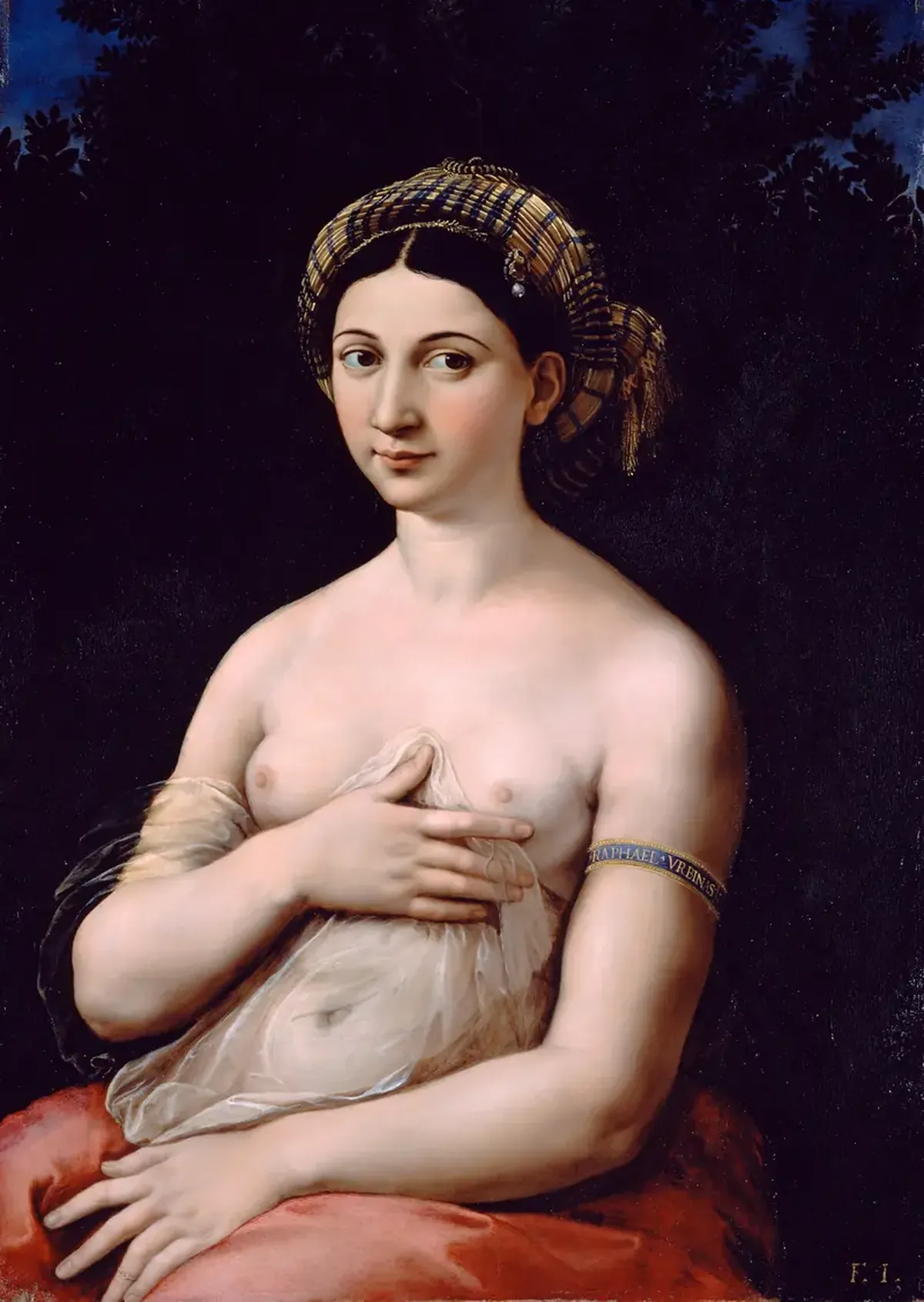
“Portrait of a Young Woman, or Fornarina” (1518-1519)
Raphael also had an arranged betrothal to the niece of Cardinal Bernardo Dovizi Bibbiena, a match that would have offered professional advantages. He repeatedly postponed that wedding, and on April 6, 1520, he suddenly died of pneumonia. Giorgio Vasari wrote that Raphael’s death came “after an even more dissolute time than usual.” More likely, cold and the medical treatments of the era—including bloodletting—contributed to the death of the exhausted lover of women. In the same year, his betrothed Maria Bibbiena also died and was buried near the artist. Raphael rests in the Roman Pantheon, and the ring in the portrait of his “secret wife” stayed hidden for 500 years; shortly after Raphael’s death, a friend sold the painting with that “interesting detail” painted over.
