
 Gaby
Gaby
A weathered stone slab found in Bulgaria may be one of the earliest human attempts to map the night sky. Georgiy Georgiev, one of the discoverers of the site, says the stone’s strange carvings form a prehistoric star map. Georgiev and his colleagues believe this finding will reshape our understanding of ancient astronomy and the spiritual lives of early Balkan civilizations.
A Serendipitous Discovery
The stone depicting the night sky was uncovered by researchers Georgiy Georgiev and Ivelina Georgieva during a field expedition near an ancient Thracian necropolis.
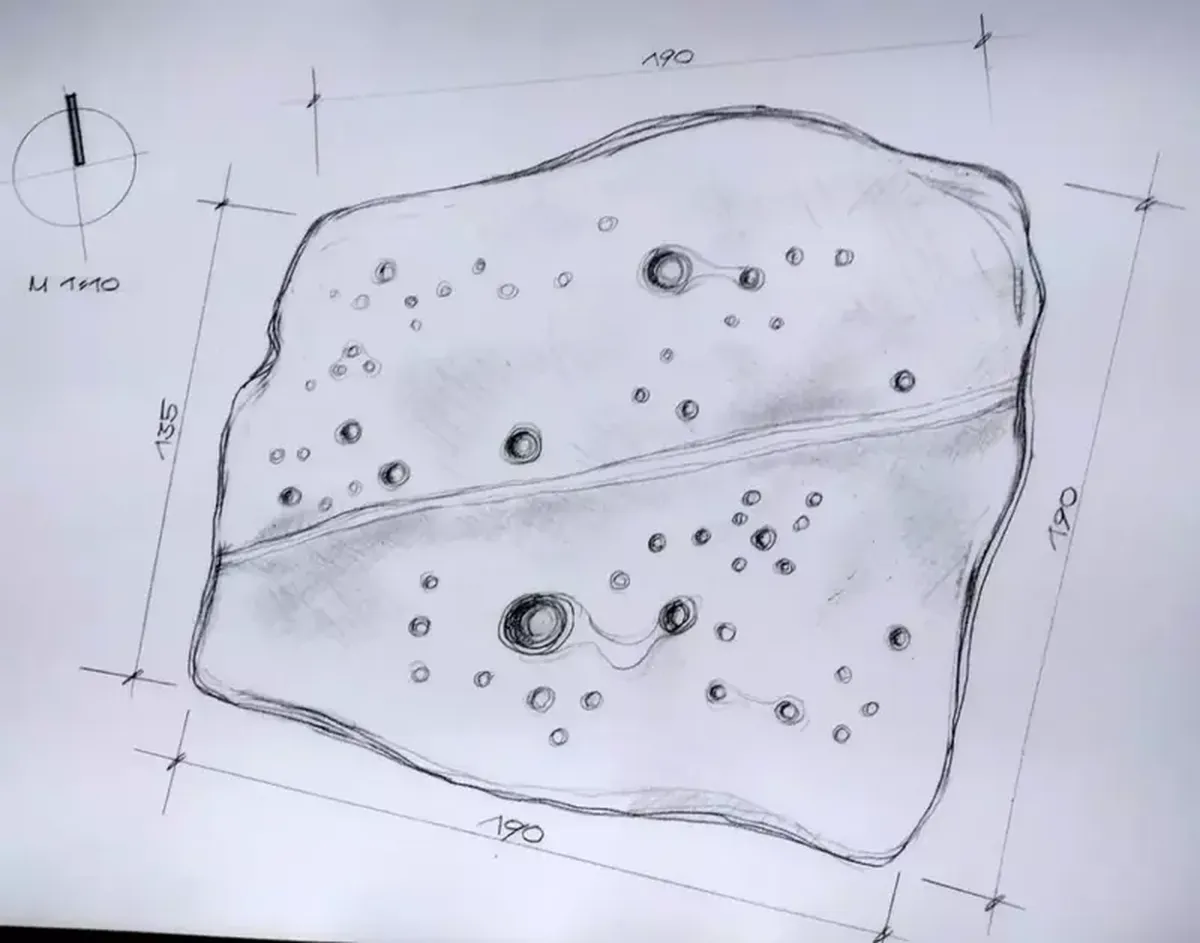
This carved rock fragment, measuring approximately 2 by 3 meters, was found hidden deep in the forest near the village of Skobelevo (which is why scholars refer to it as the Skobelevo Map). The stone is laced with a glowing vein of natural marble, which the team associates with the Milky Way.
On the surface of the stone, there are 56 meticulously carved conical holes of varying diameters: 24 in the northern half and 32 in the southern half. These holes symbolize stars of different magnitudes, as reported by Arkeonews. The map clearly depicts several constellations, including Ursa Major and Leo. Researchers have also identified Cassiopeia, Cygnus, Lyra, and the star cluster Pleiades on the stone.
Estimated Dating: When Was the Map Created?
Although the Skobelevo Map of the night sky has not yet been officially dated, researchers suggest it may belong to the late Neolithic to early Iron Age (around 2000–500 B.C.). This estimate is based on the proximity of the site to Thracian necropolises and burial mounds, and on its location near similar prehistoric sanctuaries in the Balkans.
No pottery or organic materials were found directly at the excavation site, making radiocarbon or stratigraphic dating currently impossible. However, the archaeological context of the map points to a period when ancient people actively observed celestial phenomena and recorded them for ritual and agricultural use.
The Sky Captured in Stone
Experts believe these carvings were not random; they reflected the daily and annual movements of celestial bodies in the Northern Hemisphere. The presence of constellations in precise configurations and relative scales suggests a deep knowledge of astronomy by the prehistoric inhabitants of this region.
One theory posits that the stone served as a primitive star clock, helping ancient observers track time and the changing seasons.
The stone’s surface, rich in mica, produces a shimmering effect in sunlight that mimics the night sky. This visual quality further supports the stone’s astronomical purpose.

Cultural and Ritual Context
Archaeological evidence found nearby (necropolises, tombs, and remnants of sanctuaries) suggests that the carved stone may have been part of a larger cult complex. It could have functioned both as a focus for rituals and as a navigational aid for travelers and seafarers.
The Skobelevo Map of the night sky, etched into stone, offers a rare glimpse into the cosmology of prehistoric Balkan communities. Scholars of early astronomy, mythology, and cultural development are especially interested. With further study, the artifact could become a milestone in archaeoastronomy and a draw for cultural tourism in Europe.
