
 Gaby
GabyThe gas giant Jupiter is the largest planet in the Solar System and the fifth planet from the Sun. But if Jupiter has no surface, what does it have? Let’s try to figure it out with Benjamin Roulston, a professor at Clarkson University.
“As a physics professor who studies unusual phenomena, I understand the concept of a planet without a surface can be hard to grasp,” he said. Much about Jupiter remains mysterious — especially that NASA’s Juno probe has been orbiting the planet for nine years.
Quick facts
Jupiter sits between Mars and Saturn. It’s so large it can hold more than 1,000 Earths. Jupiter’s mass is about two and a half times the mass of all the other planets in the Solar System combined.
While the four inner planets — Mercury, Venus, Earth, and Mars — are made of solid, rocky material, Jupiter is a gas giant with a composition similar to the Sun. It’s a stormy, wildly turbulent ball of gas. In some regions on Jupiter, winds reach about 640 kilometers per hour, roughly three times faster than a Category 5 hurricane on Earth.

In search of solid ground
If you move down through the upper layers of Earth’s atmosphere toward the ground, air pressure increases until you reach the planet’s surface — land or ocean.
Roulston says the situation on Jupiter is very different. If you descend from the upper part of Jupiter’s atmosphere, which is mostly hydrogen and helium, the pressure also rises — but far more dramatically. As layers of gas press down, it would feel like being at the bottom of an ocean, except the surrounding material would be gas rather than water. Eventually the pressure would become lethal for a human body.
If you go down about 1,600 kilometers, the hot, dense gas begins to behave oddly. It gradually turns into a liquid form of hydrogen, creating what could be considered the largest ocean in the Solar System — except it isn’t made of water.
And if you continue another roughly 32,000 kilometers, the hydrogen starts to behave more like a flowing liquid metal — an exotic state of matter scientists have only recently recreated in laboratories. In this liquid metallic hydrogen, atoms are so tightly compressed that their electrons can move freely.
These transitions between layers are gradual, not sudden. The change from gaseous hydrogen to liquid hydrogen and then to metallic hydrogen happens slowly; there’s no sharp boundary, no solid crust, and no surface.

Jupiter’s gamma-ray radiation
Terrifying to the core
Sooner or later you would reach Jupiter’s core — the central region of its interior, not a surface. Scientists continue to debate exactly what that core is made of. Most likely it isn’t a solid rock but a hot, dense, possibly metallic mixture of liquid and solid material.
The pressure in Jupiter’s core is enormous — on the order of 100 million times Earth’s atmospheric pressure, like having two Empire State Buildings pressing on every square inch of your body.
Pressure isn’t the only problem. A spacecraft attempting to reach Jupiter’s core would be destroyed by extreme heat — roughly 20,000 degrees Celsius, about three times hotter than the surface of the Sun, Science Alert reported.
How Jupiter protects Earth
Jupiter is a strange, hostile place. But if it didn’t exist, humans might not exist either. Jupiter acts as a shield for the planets of the Solar System, especially Earth. Its immense gravity alters the orbits of asteroids and comets over billions of years.
Without Jupiter’s gravitational influence, more space debris might have collided with Earth, Roulston explains. A catastrophic impact could have caused a mass extinction, similar to the event that wiped out the dinosaurs.
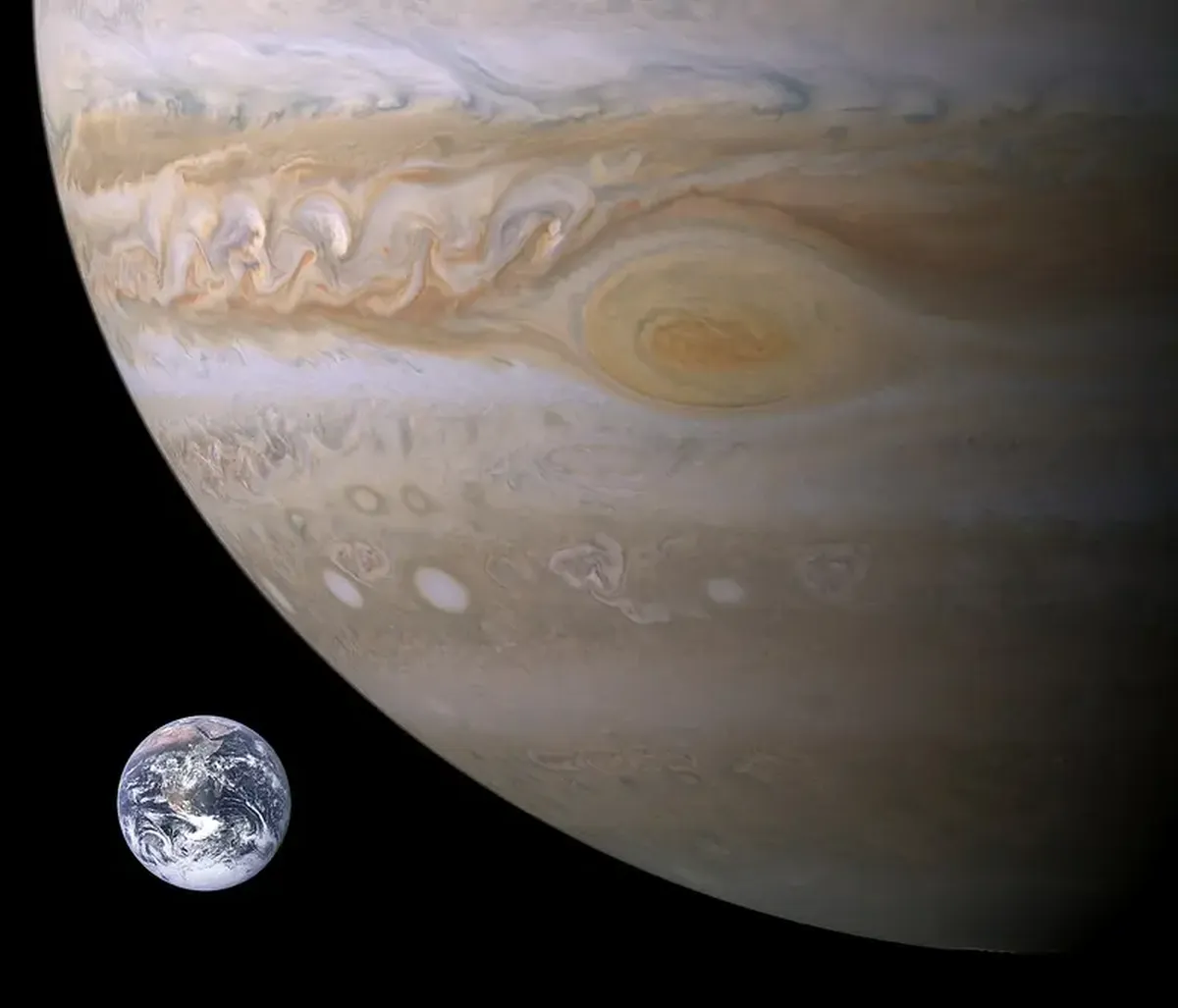
Comparative sizes of Earth and Jupiter
Still, even though Jupiter helped protect Earth, the planet itself remains uninhabitable — at least as we know life.
One better candidate in Jupiter’s system is Europa, a moon that may offer our best chance of finding life elsewhere in the Solar System. NASA’s Europa Clipper spacecraft, launched on October 14 of this year, is scheduled to make about 50 flybys of the moon to study its vast underground ocean.
Will there be life in Europa’s waters? Scientists won’t know for some time. Because of Jupiter’s distance from Earth, NASA’s probe won’t arrive at Europa until at least April 2030.
