
 Gaby
Gaby
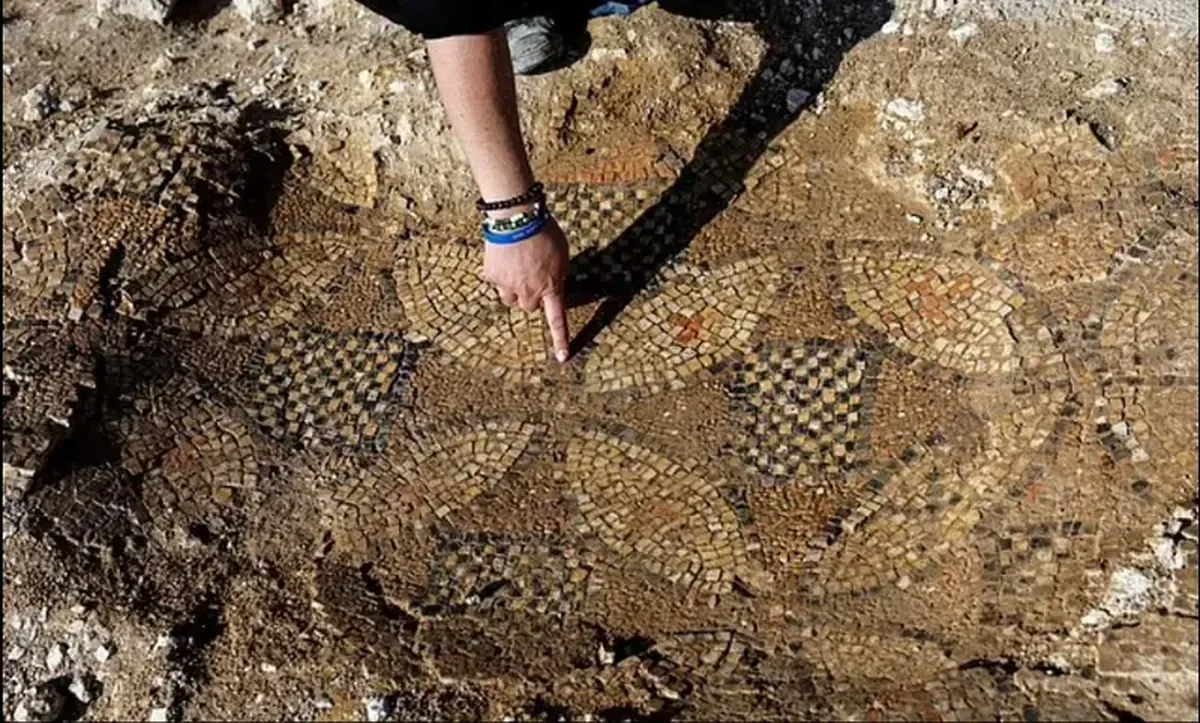
The Israeli Antiquities Authority (IAA) has uncovered a 5th–6th century AD Christian monastery near the city of Kiryat Gat. On its intricate mosaic floor, researchers found a Greek biblical verse that blesses anyone who reads it: “Blessed are you when you come in, and blessed are you when you go out.”
Scholars call the monastery one of the most significant discoveries in the region in recent years.

What Did the Researchers Report?
The monastery was built during the Byzantine Empire — the Eastern Roman Empire. During that period, Christianity spread rapidly, visible in the construction of major religious sites such as the Church of the Holy Sepulchre in Jerusalem.
The recently discovered monastery sits on the site of an ancient settlement that dates back to the Roman era.
“This is the most significant Roman and Byzantine-period monument found in this area,” said excavation leaders Shir Lifshitz and Maayan Margulis.

“The mosaic discovered in Kiryat Gat is one of the most distinctive ever found in Israel,” said Mark Avrahami, head of the IAA’s art restoration department.
Researchers say the mosaic’s distinctiveness comes from its geometric pattern, created with tiny pebbles. Besides the Greek verse, the floor shows crosses, lions, doves, an amphora, flowers, and other decorative motifs.
The IAA plans to move the mosaic to a restoration workshop soon. After restoration, the mosaic will be displayed for public viewing. “Moving the mosaic is a complex process that requires great skill and precision,” said Mark Avrahami.
What Else Did Archaeologists Discover During the Excavations?
In addition to the monastery, researchers uncovered the ruins of at least ten buildings, a wine press, and a large storage facility.
The team described the wine press as “very complex,” saying its construction probably required substantial money, time, and a range of professional skills. The researchers believe wine produced here was likely sold across Byzantium and around the Mediterranean.
They also found many artifacts, including imported goods, marble fragments, and metal and glass vessels. Excavations revealed clear signs of local pottery production. Taken together, these finds point to “a large and wealthy community” that lived here, the researchers said.

The settlement sat at a central crossroads linking the hill country to the coastal plain, the Daily Mail reported.
The Byzantine Empire existed from 330 to 1453 AD. Its rule began when Emperor Constantine divided the Roman Empire into western and eastern parts. Constantinople, the capital of Byzantium, was conquered by the Ottoman Turks in 1453, marking the end of more than a thousand years of imperial rule.
“The discovery of this site highlights the historical richness of Kiryat Gat and its surroundings, shedding light on the area’s key role in ancient times,” said Svitlana Talis, director of the IAA’s Southern Region.
