
 Gaby
GabyIn March 2017, Alain Thébault and Anders Bringdal, both sailing-speed world record holders, launched a startup. They aimed to build energy-efficient, eco-friendly marine transport. That idea matters in France, a country bordered by the English Channel, the Atlantic Ocean, the North Sea, and the Mediterranean — and dotted with many picturesque lakes. This year, you can travel between some of them using a flying water taxi.
No magic — just physics.
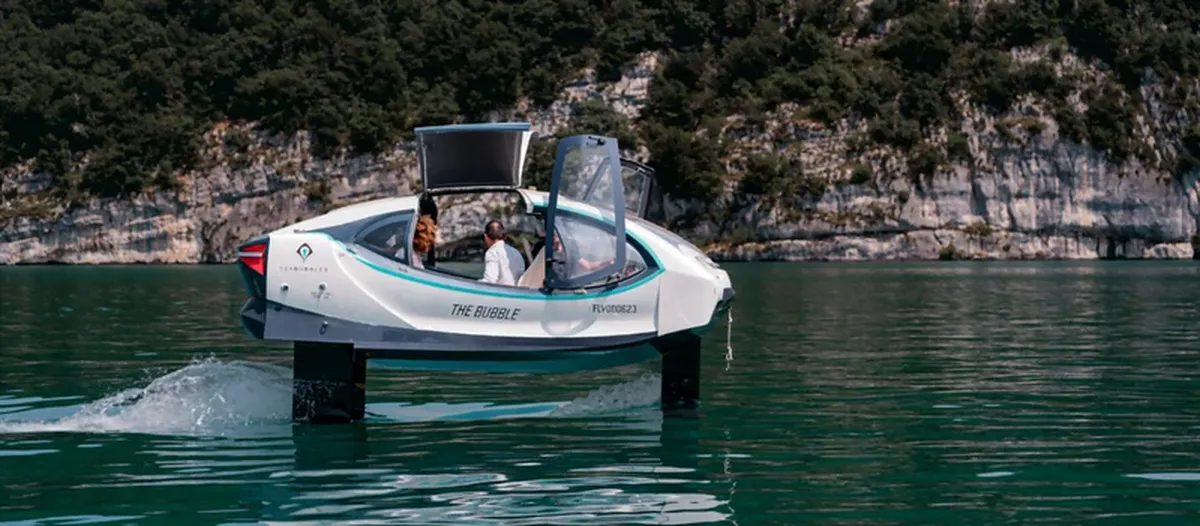
SeaBubbles is a five-seat electric sea taxi with underwater wings that allow it to lift above the water. Sounds futuristic, right? It makes sense once you consider the physics.
Water is more than 700 times denser than air, so moving through it takes a lot more energy. To cut that resistance, engineers developed underwater wings mounted beneath the hull that generate lift as the craft moves. That lift raises the vessel fully or partially out of the water, reducing the contact area and cutting hydrodynamic drag. The result: speeds that conventional boats can’t reach.
This principle formed the basis for SeaBubbles’ design.
First passengers
Six years passed between the test model’s presentation in Paris and the launch of a commercial service. The project’s organizers say this is the first transport of its kind in France. At the beginning of July this year, SeaBubbles carried its first passengers from the pier in the small town of Veyrier-du-Lac to Annecy-le-Vieux. From July 1 to August 31, 2023, the city authorities of Annecy and SeaBubbles Mobility Solutions teamed up to test the water taxi as a public transport option.
Over the next few weeks, there will be eight round trips every day. The service runs between the previously mentioned Veyrier-du-Lac and Annecy-le-Vieux. You can catch the flying water taxi between 9:00 a.m. and 7:00 p.m.
“Our eco-boats are the perfect place for unique events and unusual meetings, where you can enjoy incredible water landscapes without any noise or pollution,” the company said.

Futuristic design and aesthetic pleasure
From its looks alone, the craft promises an unforgettable way to take in scenic views. Designers added features like folding doors and windows that open at various angles. The doors slide to the side and then lift upward, leaving a configuration that resembles a winged hydrocycle. There’s also a retractable roof to increase airflow, let sunlight in, and give passengers unobstructed panoramic views.
After the debut of the first water-air electric taxi, the company began developing the next model, named SmartBubbles. The larger sibling will also use underwater wings, this time with extendable surfaces for better maneuverability. With a wider hull, the model is roomier and will carry between 8 and 12 passengers. The first prototype is already being tested on Lake Annecy, and SeaBubbles plans more trial flights in the coming months.
The company also announced a new SeaBubbles version with fast charging. The update will allow the battery to be fully charged in 4 minutes.

Without noise and emissions
The SeaBubbles hull rides on inverted T-shaped underwater wings controlled by a dynamic system. Those wings have flaps similar to airplane control surfaces. Electric actuators automatically adjust the vehicle’s height and counteract unwanted roll, pitch, and yaw. Side sensors measure altitude and send stability data to an onboard computer that uses an inertial unit to tweak the flaps in real time.
SeaBubbles’ concept aims to combine passenger comfort with environmental protection. The company follows the principle “zero waves, zero noise, zero emissions,” so the craft is both passenger-friendly and eco-friendly. That makes it suitable for use in protected areas such as nature reserves.
The project’s creators say they drew inspiration from nature: the craft’s design is as sleek as a bubble, and its mode of operation resembles the movements of flying fish, Designboom reports.

