
 Gaby
Gaby
Now believed likely to have been autistic, he became a source of vital knowledge for the world and an architect of economic reforms for his homeland.
True Values
The creator of physical science and a remarkable mathematician is recognized for numerous contributions in mechanics, optics, astronomy, and economics. During the “plague years,” he developed the theory of color, built the reflecting telescope, and was the first to describe the Earth as an oblate spheroid. In mathematics he made major advances in differential and integral calculus, methods for finding roots of functions, and the classification of cubic equations, among other discoveries. Some of these works were published only 20 to 40 years after he first conceived them. His earliest work on the fundamentals of analysis was recognized only 300 years later.

A copy of Newton’s reflecting telescope, which he gifted to the Royal Society in 1672.
“I find nothing appealing about fame, even if I deserved it,” the 27-year-old Newton reflected, aware of his own values from a young age. “Perhaps notoriety would increase the number of my acquaintances, but that is precisely what I am trying to avoid above all else.”
Born January 4, 1643, he was effectively a semi-orphan: his father died before he was born. Named after his grandfather, Isaac was left to fend for himself from an early age. His mother remarried and had other children, and she sent him away from Woolsthorpe for schooling in the neighboring town of Grantham. Nothing about the sickly, frail child—he was even late to be baptized—hinted at the longevity that awaited him. He died peacefully in his sleep at 84, free from illness and with a clear mind. The gifted boy grew up in the home of a local apothecary. Isaac was good at drawing, reading, counting, and crafting, and he remained intensely focused on his interests. Throughout his long life, Newton never traveled outside England; everything that interested him lived inside his own mind.

Woolsthorpe Manor, the house where Newton was born.
In His Own World
Even in adulthood, because of his personality and temperament, Newton was reluctant to publicize his scientific achievements; he preferred to avoid drawing attention to himself. Harsh or ill-informed attacks drove him into depression, draining his energy on unnecessary disputes. Scientific controversies, intrigues, and social interactions weighed heavily on him—any engagement with people could be torture for this “armchair scientist.” Newton even asked the Royal Society not to send him letters and threatened to stop publishing altogether.
Today, scholars at Oxford and Cambridge have identified signs consistent with autism spectrum traits in Newton’s behavior. He showed intense focus on complex problems and limited social skills. Newton was spare with words and emotion, never married, and rarely made friends.
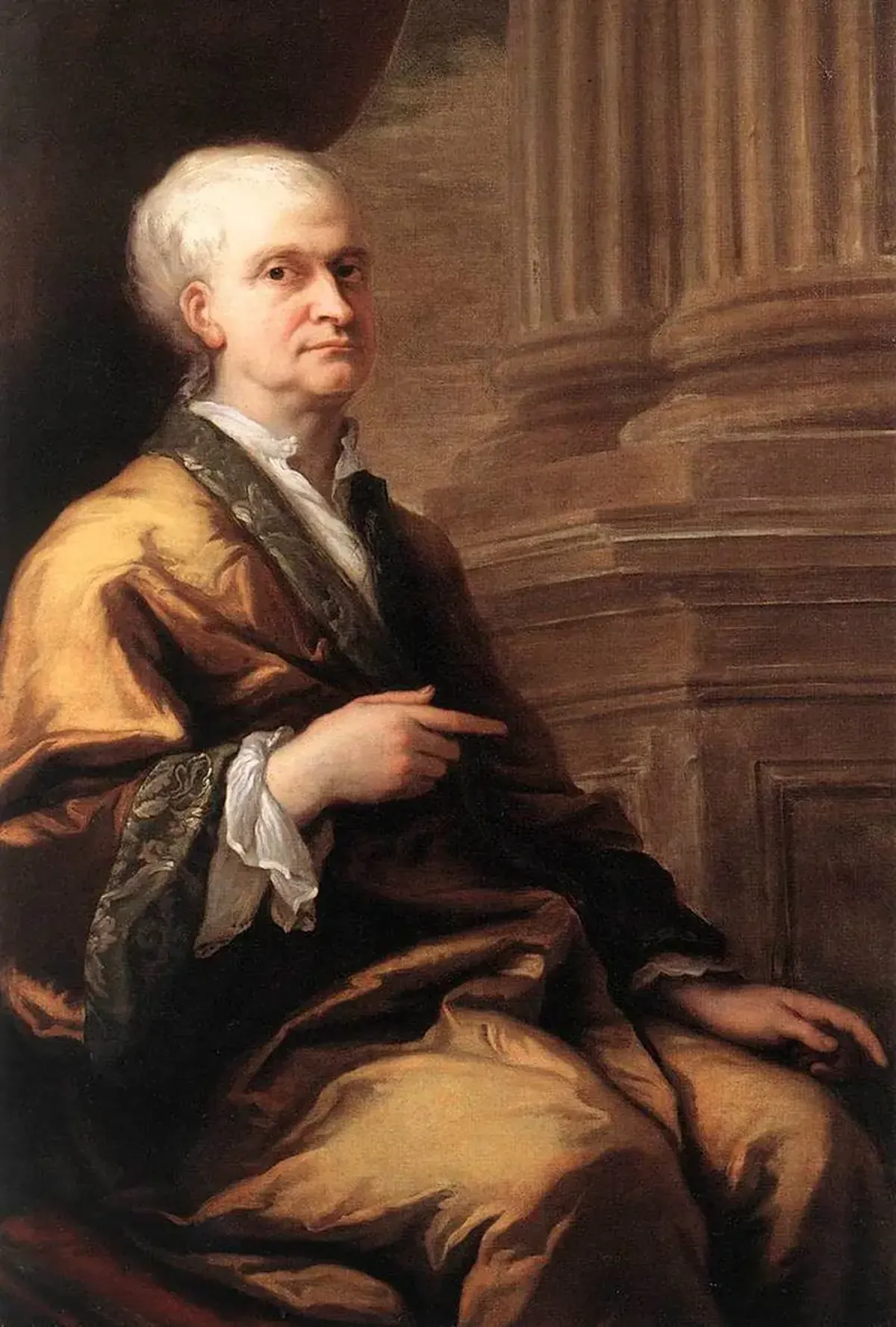
Isaac Newton in his later years, 1712, portrait by Sir James Thornhill.
He seemed outwardly aloof and constantly inwardly focused, which made him appear inattentive: he might invite guests, go to the pantry for wine, and never return to the table, instead heading to his study if an idea struck him. Newton was so absorbed in his work that he often forgot to eat or sleep. If students did not attend his lectures, he would deliver prepared material to an empty classroom. Opponents of the autism interpretation argue that his desire for solitude was simply introversion and an intellectual’s intolerance for idle chatter.

An illustration of a dispersive prism separating white light into the colors of the spectrum, as discovered by Newton.
Money Loves Accounting
Ascetic and self-disciplined, Newton was frugal but not stingy: he helped young colleagues and cared for his family, leaving them a large portion of his wealth. Near the end of his life, the “master of numbers“—who had calculated the orbits of comets and spent forty years writing “The Chronology of Ancient Kingdoms”—offered to personally compensate victims of a financial fraud in which he had been wronged.
Newton’s scientific curiosity went hand in hand with pragmatism, as he showed during his tenure at the English Mint and as president of the Royal Society. In these leadership roles, which he held simultaneously for nearly three decades, he proved himself an able administrator, consultant, engineer, investigator, and problem-solver.
In 1696, Isaac Newton was appointed a warden at the Royal Mint, and three years later he became its head, serving for 28 years and pulling England’s monetary system out of a deep crisis. The situation required decisive, practical action: a swift replacement of the country’s silver currency.
A serious problem for the 17th-century English economy was the debasement of coins, which were then minted by hand and often lacked a proper rim. Criminals exploited this by clipping the edges of coins. From 1662, coins with defined rims were produced using a French stamping machine, but both new and old coins of the same denomination still circulated. People paid with the lighter, clipped coins and hoarded the new, full-weight coins for their metal value, which harmed the state. Newton’s ability to analyze complex systems and derive their underlying laws helped him succeed in the economic realm as well.

Newton’s own copy of “Mathematical Principles of Natural Philosophy,” now housed in the Wren Library at Trinity College, Cambridge.
The Great Recoinage
Amid the war with France, rising living costs, and growing national debt, mass bankruptcies struck England. Charles Montagu, then president of the Royal Society and an acquaintance from Trinity College, became Chancellor of the Exchequer and launched the “Great Recoinage” to restore order to the currency.
Defective coins were withdrawn from circulation and initially exchanged at face value, then valued by weight. But poor discipline among refiners delayed the release of new coins, and authorities feared public unrest from a shortage of money. Newton had to personally oversee the process. He worked from four in the morning for up to 16 hours a day, following a carefully developed plan. He calculated the resources of gold and silver blanks, regulated operations, reduced the time to strike a coin by roughly twentyfold—to about one second—and standardized procedures that governed the state’s monetary system for the next two centuries.
At the same time, Newton hunted thieves and counterfeiters. As Warden he obtained permission to open prison cells and an investigative office at the Mint, creating an unprecedented bureau for uncovering financial crime. He organized a network of informants and personally exposed around a hundred offenders.
Thanks to the technological and organizational changes he introduced, coin production surged. By 1698 the Mint had issued twice as many coins as in the previous thirty years. Newton helped save the monetary system from devaluation and pulled England back from crisis. That economic stability was a factor in England’s later rise to wealth.
