
 Gaby
Gaby
Jack London published more works than even Hans Christian Andersen. He burst onto the literary scene after a life shaped by hardship and a deep hunger for adventure.
Fame … Before Birth
Jack London became a remarkable writer through talent and hard work, but he gained notoriety even before he was born. San Franciscans read in the newspapers about the impending arrival of what they called an unwanted child from a flamboyant couple. The private story went public after a scandal around his mother’s suicide attempt. Flora Wellman, the youngest daughter of a large family, was a music teacher who became fascinated with spiritualism. That interest led her into a relationship with William Chaney, an astrologer of Irish descent. The news of his partner’s pregnancy did not please Chaney, but Flora refused his suggestion to terminate the pregnancy.
In despair, she attempted suicide and was injured. The press erupted: journalists rushed to cover the story of the unfortunate American woman who had suffered because of the well-known professor of astrology and magic. The city’s oldest daily, the San Francisco Chronicle, ran an article titled “Abandoned Wife.” For the first time the expected birth of the future American writer was announced by city reporters, and when the child was born on January 12, 1876, he was already “famous.”
The newborn took his biological father’s surname: he was named John Chaney. Biographers describe William Chaney as a lawyer with knowledge of literature and mathematics. Worried about the bad publicity, Chaney refused to acknowledge paternity. Still, Jack appears to have inherited a taste for travel and adventure from his father, who loved sea voyages and had no fixed residence.

Flora Wellman and John London
A Difficult Childhood
After marrying again, Jack’s mother changed her son’s surname to the one the world knows: within eight months, John Chaney became John Griffith London. The boy was adopted by John London Sr., a farmer and Civil War veteran who had lost his own wife and son. The widower arrived with two daughters, one of whom, the elder Eliza, would later become Jack’s closest friend and protector. John Jr. developed a warm relationship with his stepfather, but he was especially attached to his Black nurse, Jenny Prinstar.
Jack London’s childhood coincided with a deep economic slump that began in the United States in 1873. During that downturn, hundreds of thousands of Americans lost their jobs, and Jack’s stepfather struggled with farming. The family moved to Oakland, where the boy finished elementary school and discovered the public library: he became its most loyal visitor, devouring books one after another. While his mother chased get-rich-quick schemes, the hardworking student earned money selling newspapers, setting up bowling pins, and cleaning beer pavilions in the local park.

9-year-old Jack London
Because of financial hardship, Jack had to end his formal education at 14 after his stepfather was hit by a train and became a double amputee. From that point on, the burden of supporting the family fell heavily on the teenager, who worked long hours and tried to make up for lost schooling through self-education. Working 12-hour days at a canning factory, 14-year-old Jack dreamed of escaping that life for a world of creativity and adventure.
Captain Jack
Determined to escape poverty, at 15 Jack left the “slave galleys” rather than become, in his words, “working cattle.” He borrowed $300 from his nurse to buy an old schooner, the Razzle-Dazzle, planning to get rich. With friends forming a makeshift “pirate crew,” “Captain Jack” set sail to explore the oyster grounds. The catch sold well to restaurants, and Jack soon tasted the sweetness of money. This was also when alcohol entered his life, a companion he would struggle with until he finally rejected it near the end of his life.
Leading the poaching “oyster fleet,” the young man matured and won respect among professional sailors. What began as stealing mollusks in a private San Francisco bay, where young “sea wolves” took risks, later turned into work catching poachers while serving on the fishing patrol. In 1893, Jack London went to catch sea lions off the coast of Japan — one of many adventures that would later inspire his writing.
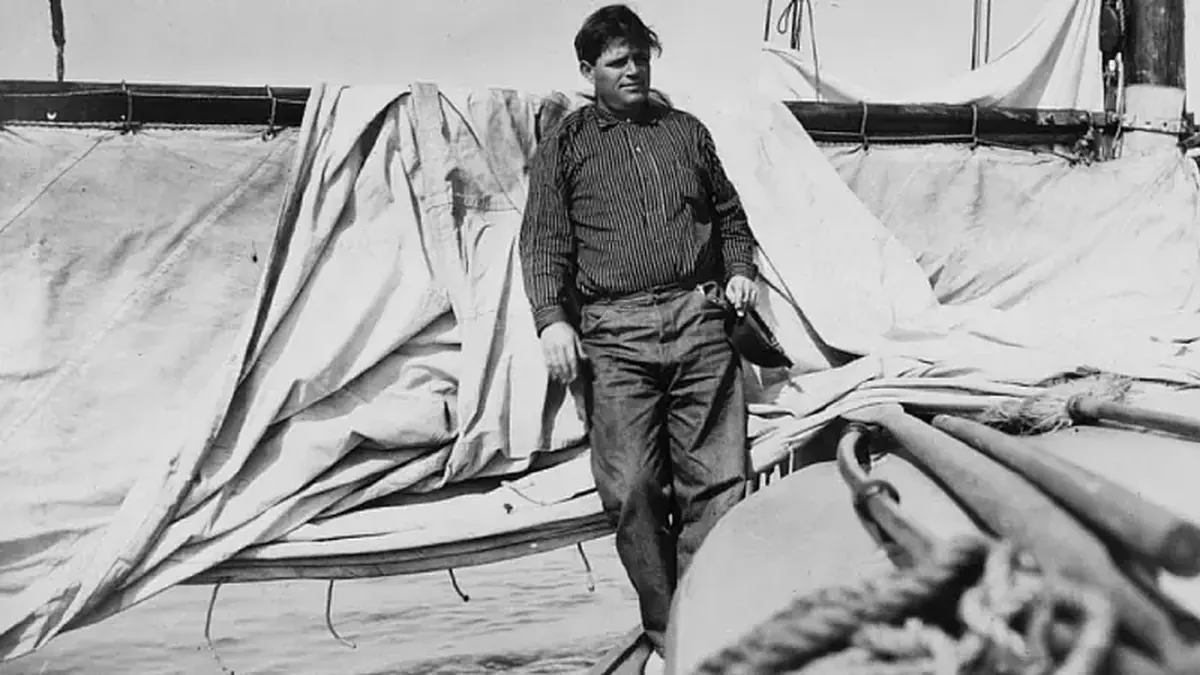
Jack London on the schooner
He actually began writing while still in school, where he was excused from disliked choir practice on the condition that he write “a thousand words” each day. That discipline helped him pass his high school exams externally and enroll in university, where he stayed for only one year. By 23, after a string of jobs, Jack London had found his calling in literature; his wide-ranging life experience made him a writer.
Readers of London’s books learn about his days on the industrial schooner Sophie Sutherland, his brutal schedule at a jute factory, and his arrest while marching with unemployed workers on Washington — he was a committed socialist and was jailed during that protest. He also wrote about prospecting in the gold fields. The Gold Rush didn’t make him rich, but it supplied stories. Alaska would become his literary Klondike: the harsh “White Silence” revealed the value of friendship and love that helped men survive the toughest trials.
Shaking Up American Literature
Jack London earned his first literary fee of $25 in 1893 for the essay “Typhoon off the Coast of Japan,” winning a contest held by a California newspaper and beating writers from two universities. That success convinced the young writer he was on the right path. Writing would become the outlet where his independence, free-thinking, and work ethic shone.
His creativity brought both success and frustration, especially in his autobiographical novel Martin Eden. Like its tragic hero, who wonders why people overlooked his best work, London pushed against what he called the “sentimental boredom” of American letters. Beginning in 1900 he published collections such as The Son of the Wolf and The God of His Fathers, and novels including The Daughter of the Snows and The Call of the Wild, followed by adventure tales and animal stories like The Sea-Wolf and White Fang.
At the turn of the century, Jack London married Bessie Maddern, the fiancée of a deceased university friend; she bore him daughters Joan and Bess. Three years later he left that family after falling in love with another woman. In 1905 he married Charmian Kittredge, a former war correspondent who had covered the Russo-Japanese War.

Jack London with his wife
Two years later he set out on a planned seven-year round-the-world voyage aboard the Snark, a yacht built to his specifications. Illness forced him ashore after two years.
“Death is Peace”
Back on land, he focused on the work that made him wealthy: fees for a successful writer with his style could reach up to $50,000 per book. Over roughly 17 years he published two to three books a year. He often worked 17 to 20 hours a day, driving himself with his famous line: “Don’t wait for inspiration; chase it with a club.”
His work includes The Iron Heel, a dystopian novel about the rise of an oligarchic dictatorship in the U.S., reflecting his interest in Marx and Engels. He joined the Socialist Party in 1901. His engagement with writers like Herbert Spencer and Friedrich Nietzsche shows up in Martin Eden (1909), a philosophically rich, politically charged novel many regard as his masterpiece.
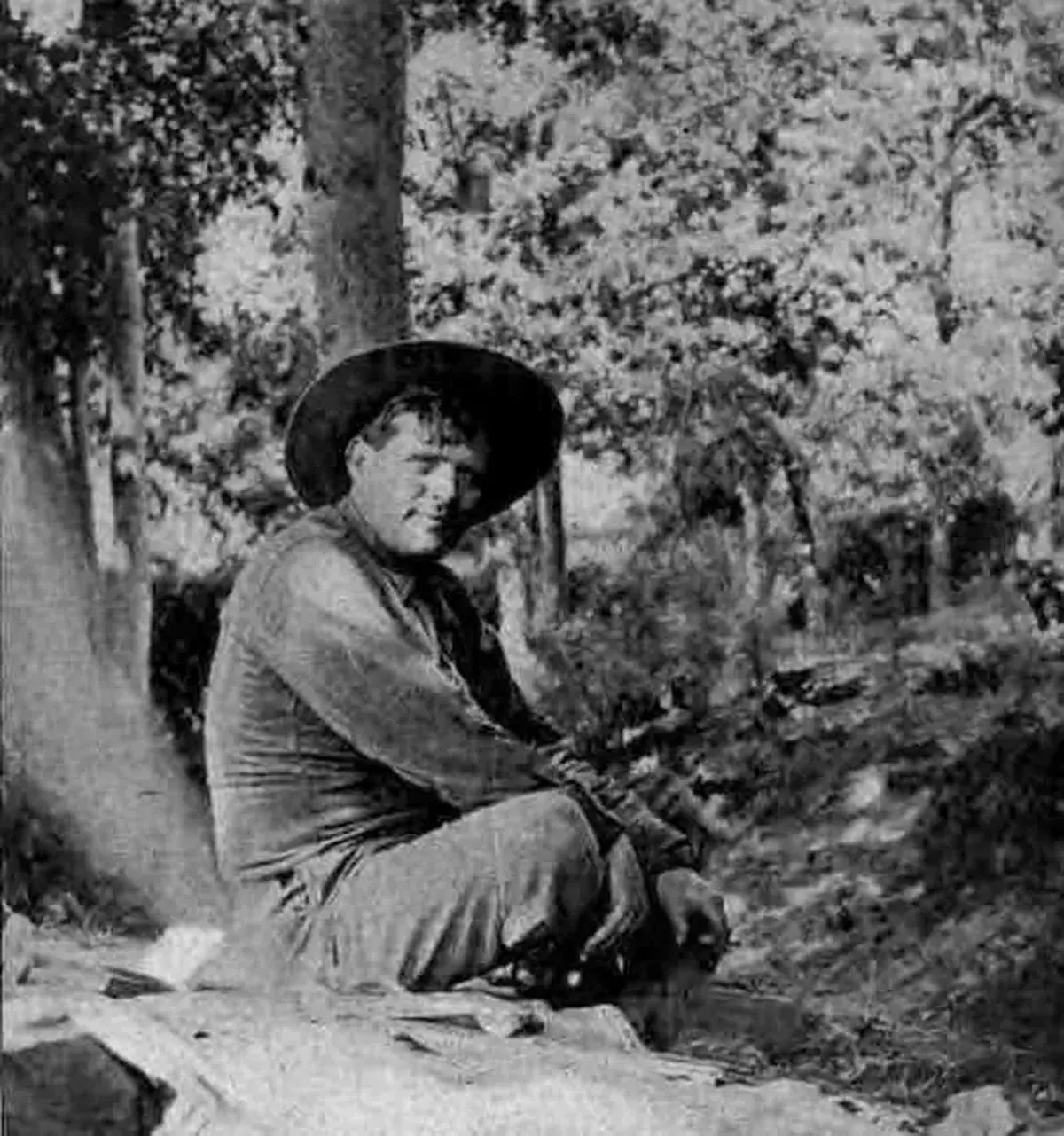
Jack London at work, 1914
The protagonist Martin Eden is drawn from London’s own experience: a working-class sailor who wins literary recognition through talent and grit. The novel is a kind of hymn to the creative potential of the ordinary person. Tragically, London’s life ended in a way that echoes his hero’s fate, and some have speculated about suicide. In his memoir John Barleycorn he wrote, “Death is the end, peace. Why then does a person not want to die?”

The writer’s grave in Jack London State Park, Glen Ellen, California
On the night of November 22, 1916, while taking morphine to ease pain from uremia — he had already given up alcohol by then — he took an overdose. Jack London was found dead at his estate in Glen Ellen, California. The author of 40 books was 40 years old.
