
 Gaby
Gaby
Behind the artificially crafted image of a cheerful sex symbol lay the complicated reality of the “Queen of Pin-Up,” Marilyn Monroe. Her life was marked by a troubled childhood, three failed marriages, three unsuccessful pregnancies, professional dissatisfaction, scandalous revelations, a fight for equal rights, drug addiction, and a mysterious death at 36 surrounded by conspiracy theories.
The Mystery of Her Birth
Marilyn Monroe, born Norma Jeane Mortenson, arrived on June 1, 1926, in Los Angeles. Her mother, Gladys Pearl Baker, who worked at a Hollywood studio, registered her under that name. The world would later know her as Marilyn Monroe—listed among the 100 greatest Americans of the 20th century and one of Hollywood’s most famous stars. For her stage name she adopted her mother’s maiden name. Gladys’s first husband was nine years older than she was when they married; after their divorce he took the children to live with him in Kentucky. The son died young, and Norma Jeane only met her sister when she was 18.
Gladys later divorced a second husband, and his surname, Mortensen (misspelled on the birth certificate), was given to Norma Jeane before she was born. It turned out that Martin Edward Mortensen was not her biological father. The real father was Charles Stanley Gifford, with whom Gladys had an affair in 1925; after the pregnancy she did not pursue him. Even after learning about the existence of a daughter, Gifford ignored Marilyn’s repeated attempts to make contact. The two never met. Their kinship was officially confirmed only last year when Gifford’s relatives provided DNA material after a sample of the actress’s hair was found.

Norma Jeane Mortenson as a child, in the October 1953 issue of Modern Screen.
Among Strangers
From an early age, Norma Jeane was raised by guardians. At just two weeks old, Gladys placed her with a foster family in a nearby town. Gladys stayed with the family at first but soon began visiting only on weekends while she worked. When Norma Jeane was eight, her mother was diagnosed with paranoid schizophrenia, a condition that also affected her grandmother (the elderly woman once nearly suffocated her granddaughter during a psychotic episode).
Growing up among strangers, Norma Jeane moved from one foster family to another and spent time in an orphanage. She could have been adopted eleven times, but her mother never agreed to it. The child endured sexual harassment from some guardians and lived in constant fear of being sent back to a juvenile shelter.
When Norma Jeane was nine, Gladys remarried and moved to another state, but the law prevented her from taking her daughter. To avoid ending up in an orphanage again, Norma Jeane followed her mother’s example and married young, tying the knot at 16. Her first husband was James Dougherty, a neighbor or school acquaintance. A year later he joined the merchant marine, and Norma Jeane left school to work at an aircraft factory. Later she moved her mentally ill mother from a state psychiatric hospital to a private clinic. Gladys stayed there until Marilyn’s death; after that, Gladys’s older daughter took over her care.

Norma Jeane Dougherty at the aircraft factory, 1945.
Chasing the Dream
In the postwar years at the Radioplane factory, a curly-haired beauty with chestnut locks met army photographer David Conover, who was there to photograph women in wartime production for propaganda. Marilyn enjoyed modeling and earned about $5 an hour. At 19, Norma Jeane began a new life at a modeling agency.
Her hourglass figure proved ideal for pin-up work. She straightened her hair and dyed it bright blonde—after experimenting with 14 shades she eventually settled on the platinum look that became her trademark. Colleagues at the agency remembered Norma Jeane as hardworking and ambitious; she appeared on more than thirty magazine covers within a year.

An early photo of Norma Jeane for a postcard, before her acting career.
Her growing popularity helped her sign with an acting agency, where she adopted a new image and a new name: Marilyn Monroe. She divorced her first husband, who disapproved of the changes in her life. Marilyn threw herself into the work. “Studying acting, singing, and dancing, I realized I had dreamed of this since I was five!” she later recalled. “I always loved pretending to be someone else and imagining a more pleasant world around me than the one I actually lived in.”

With her second husband, Joe DiMaggio, 1954.
Shy of the Camera
New roles came through romances with influential mentors, costly plastic surgeries financed by those connections, and intensive work with a personal acting coach. Natasha Lytess, teacher and friend, was Marilyn’s closest professional ally until 1955. Lytess accompanied her to interviews and shoots, holding her hand during close-ups to calm her nerves and to help manage the crew. The coach’s advice often clashed with directors’ wishes, but Marilyn refused to be sidelined.
At one point, her coach discouraged Marilyn from taking a role in the film Breakfast at Tiffany’s, persuading her the part was inappropriate. The movie ultimately starred Audrey Hepburn, while some people associated with the project had wanted Monroe for the role. Unsure of her own professionalism, Marilyn often relied heavily on her mentor’s guidance.

Marilyn Monroe during a studio shoot, 1947.
As one mentor followed another, Marilyn’s working habits stayed the same. Even at the height of her career, she struggled with camera anxiety. Despite being an avid reader—her personal library reportedly held about 400 books—Monroe often felt uncomfortable delivering lines and frequently forgot dialogue. Co-stars noted her persistent nervousness and even saw skin rashes appear before she entered a scene. Sometimes a single scene required forty takes. Combined with regular tardiness, this behavior hurt her reputation at the studio.
A Prisoner of Her Image
Monroe’s dependence on teachers and her reliance on barbiturates grew out of chronic stress driven by low self-esteem and perfectionism. Film historians point to sexism at 20th Century Fox as a major factor in Marilyn’s struggles: one of the studio’s most sought-after and profitable actresses was, by many accounts, among the least well paid.
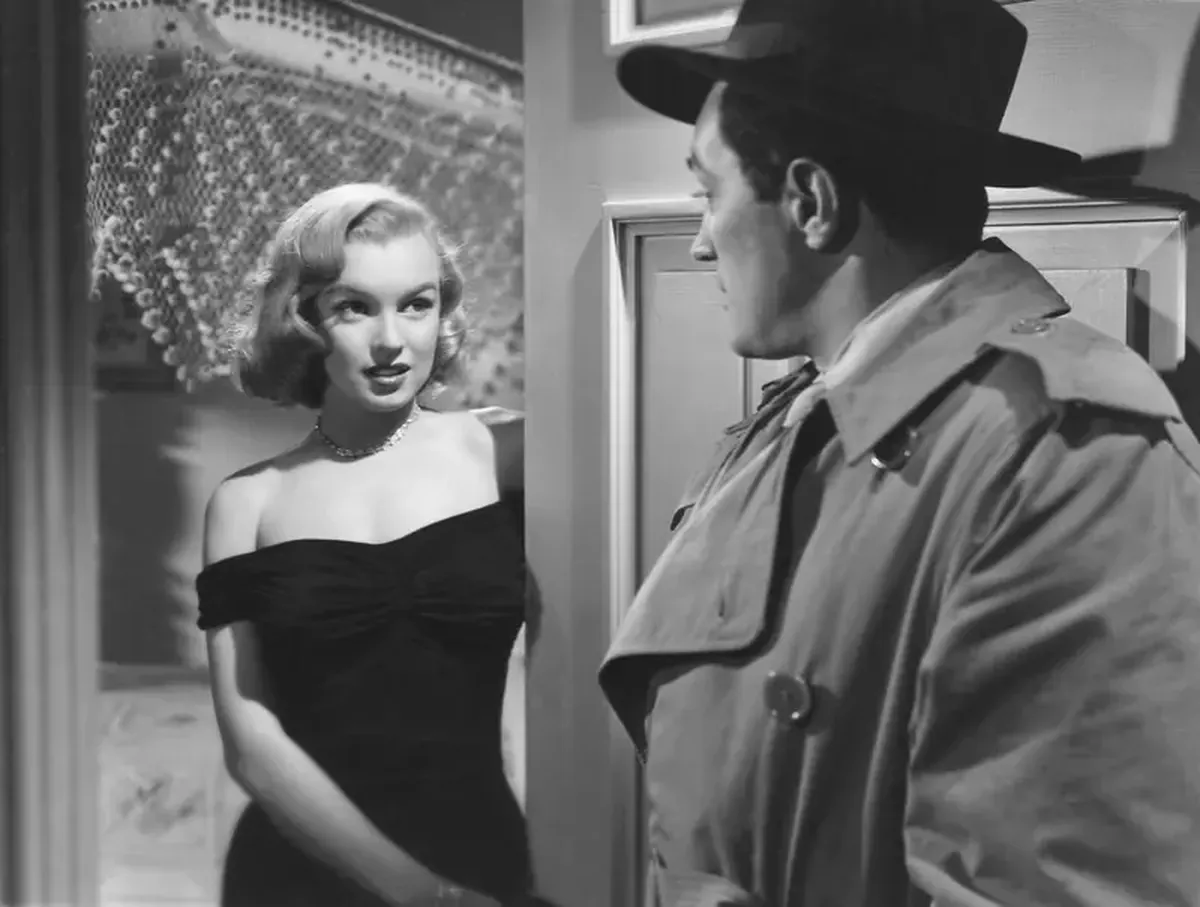
In the film “The Asphalt Jungle” (1950).
That injustice pushed Monroe to become a producer herself. She set a precedent, showing other women that it was possible to break free from discriminatory boundaries. Facing condescending treatment from studio management and often denied even a full script before deciding on a role, she founded her own production company. Although Marilyn Monroe Productions was short-lived, the move strengthened her position in Hollywood, where, as she put it, “they pay a thousand dollars for a kiss and fifty cents for your soul.” Throughout her career she wanted to shed the “dumb blonde” image and to escape Fox Studios’ control so she could showcase her talent in dramatic roles.

In the film “Don’t Bother to Knock” (1952).
Gentlemen Prefer Blondes
In her best-known comedy, Gentlemen Prefer Blondes, her character delivers the line: “I can be smart when it’s necessary, but most men don’t want that.” Critic Sarah Shane identified three main myths about Monroe—stupidity, weakness, and lack of talent—and argued that if audiences believed those myths, then Monroe had performed convincingly.

In the film “Gentlemen Prefer Blondes” (1953).
Another analyst of the Monroe phenomenon, Thomas Harris, described the star as embodying postwar “accessible glamour”—a social idea that met the public’s demand for joy and emotional uplift during the Cold War. Harris wrote that Marilyn’s humble origins and lack of family support made her seem more accessible to male audiences than an aristocratic contemporary like Grace Kelly, who was seen as refined and unattainable because of her status.

Marilyn Monroe’s third wedding to Arthur Miller, 1956.
A Sense of Kinship
Few people paid attention to the values behind Monroe’s pop-icon image, which carried a democratic undertone. The star was not fond of diamonds—she often rented them for appearances—and throughout her life she identified with the working class. According to the daughter of her personal psychiatrist, Joan Grinson, “Monroe was concerned about social inequality; she was troubled by the fight for equal rights for whites and blacks, the rich and the poor.”
Patricia Newcomb, Monroe’s secretary and friend, said the actress ended her last interview with a message she insisted should be seen as her most important: “The world needs a real sense of kinship. All people are brothers and sisters. This is my deep conviction.”
“I owe my career to Marilyn Monroe,” said jazz legend Ella Fitzgerald. “She helped me get a job at the popular club Mocambo by personally asking the owner. Monroe promised to come every night with the press and reserve a table by the stage. And she did. Ultimately, she promoted both the club and the performer. Thanks to her, I became a celebrity. Marilyn was an extraordinary woman who was ahead of her time. But she didn’t know it.”
“Something’s Got to Give”
The unfinished film Something’s Got to Give was the last project in which Monroe was involved. The production collapsed amid concerns about her unstable psychological state. On August 5, 1962, she was found dead in her Los Angeles home, lying with a telephone receiver in her hand and surrounded by empty bottles of sleeping pills. Doctors concluded that heart failure had been caused by a barbiturate overdose, and the official cause of death was ruled a suicide. Alternative theories ranged from medical errors in prescribing incompatible medications to politically motivated murder tied to the Kennedy brothers. Her home had reportedly been under surveillance, and her sudden death is said to have triggered a wave of suicides in the U.S.—the so-called “Werther effect,” in which some people took their lives in apparent solidarity with their idol.

During the filming of “Something’s Got to Give” (1962).
The most desired woman in Hollywood died with a poodle given to her by Frank Sinatra (the dog was later taken by his secretary). After divorcing her third husband, playwright Arthur Miller, Marilyn was rumored to be planning a reconciliation with her former husband Joe DiMaggio. The couple had divorced amid DiMaggio’s jealousy, and some accounts say the athlete was physically abusive; even after divorce proceedings began, Monroe sometimes continued to live with him, which made a reunion seem possible. DiMaggio remained devoted—he was involved in her burial arrangements and sent fresh flowers to her grave until the end of his life.
