
 Carlos Solis
 For years, scientists have wondered why Neanderthals (Homo neanderthalensis) disappeared. A new study led by Andrea Amadei at the University of Rome Tor Vergata argues that Neanderthals never truly went extinct.
A team of Italian and Swiss researchers says that Neanderthals didn’t die out because their DNA persists in the gene pool of modern humans.
Neanderthals (Homo neanderthalensis) lived in Europe and western Asia from roughly 400,000 to 40,000 years ago. Over millennia, Homo sapiens interbred with Neanderthals and produced offspring in a gradual process the authors call “genetic assimilation.” The research team used a mathematical model to untangle this complex history.
“Our results suggest that genetic mixing was likely a key mechanism contributing to their disappearance. The disappearance of Neanderthals, rather than their true extinction, can be viewed as a result of genetic dilution,” the study’s authors wrote.
What Did the Researchers Report?
Paleoanthropologists have long known that Homo sapiens interbred with Homo neanderthalensis; Neanderthal DNA appears in the genomes of modern humans. In fact, most non-Africans today carry Neanderthal genes.

Homo sapiens coexisted with Neanderthals for several thousand years before Homo sapiens became the dominant species. Homo sapiens migrated from Africa into Eurasia around 60,000 to 70,000 years ago and encountered Neanderthals there. When the two species first met, they may have used basic verbal communication to understand one another.
Around 47,000 years ago, the two species began interbreeding and producing viable offspring because they were genetically similar.
According to the study’s authors, the two species interbred for about 7,000 years before Neanderthal populations began to decline. The reason for their disappearance around 40,000 years ago remains contentious within the scientific community, the Daily Mail reported.
The team’s mathematical model indicates that “the extinction of Neanderthals was a gradual phenomenon, with the loss of local populations occurring at different times.” The researchers focused on the impact of small, repeated migrations of Homo sapiens into Eurasia. Their results show that prolonged interbreeding between Homo sapiens and Homo neanderthalensis could lead to the complete genetic absorption of Neanderthals by modern humans within 10,000 to 30,000 years.
“The constant flow of genes from the more demographically dominant species, Homo sapiens, may explain the genetic absorption of Neanderthals by modern humans,” the study suggests.
The authors’ explanation for the gradual disappearance of Neanderthals — a “turning point in human evolution” — was published in Scientific Reports.
Scientists have previously proposed other explanations for the Neanderthals’ disappearance, including disease, catastrophic climate events, and competition for territory and resources.
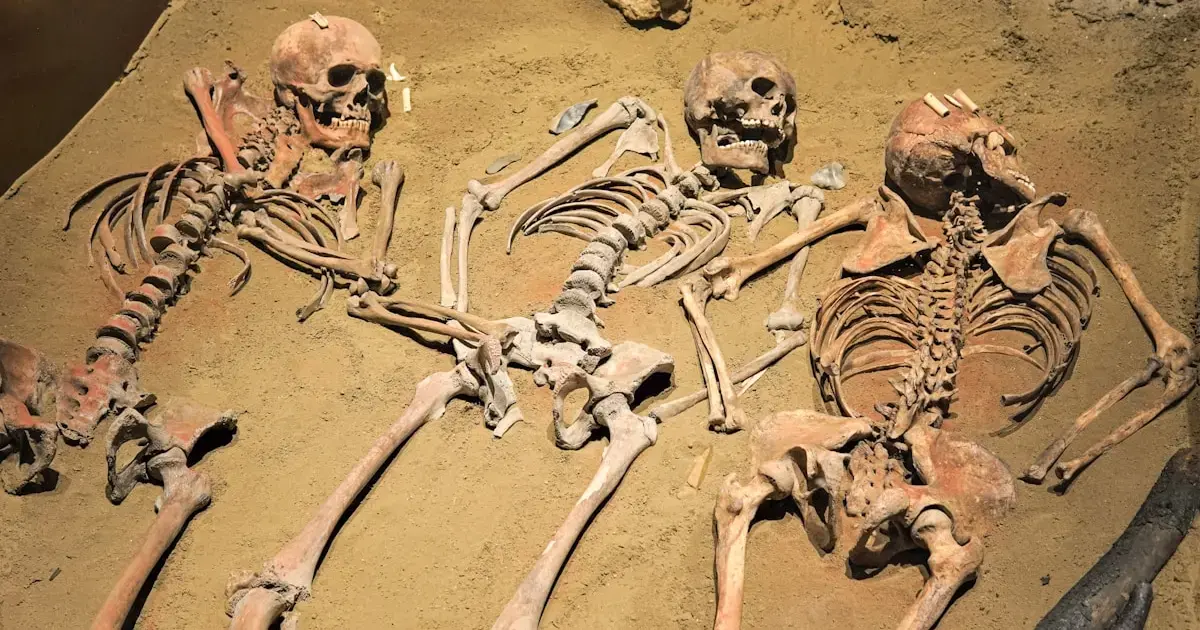
Previous studies have shown that not all interactions between Homo sapiens and Homo neanderthalensis were peaceful. Violent conflicts may have contributed to the Neanderthals’ decline. Evidence of weapon marks on the bones of both species suggests they sometimes fought one another.
Photo: Unsplash
