
 Carlos Solis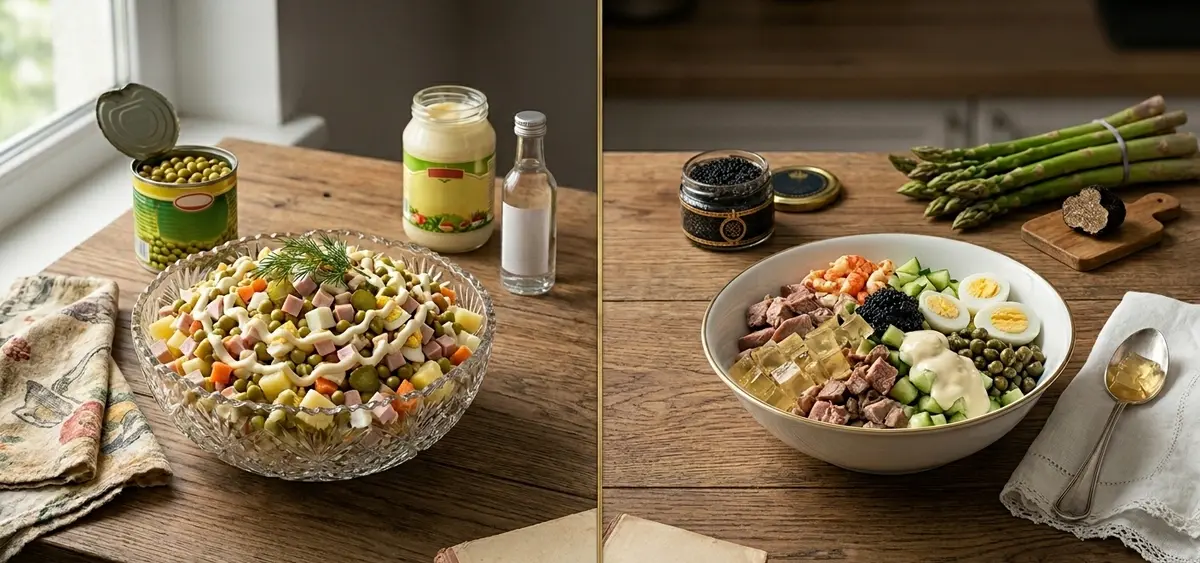
What we expect to see on New Year’s tables under a thick layer of mayonnaise has about as much in common with the original as an old scooter has with an Elon Musk rocket. Both kind of get you somewhere, but the vibe is totally different. The only things these two dishes really share are the name and a stubborn belief that tossing everything together in one heap is not culinary chaos but high art.
How the Hermitage Restaurant and Lucien Olivier started a gastronomic revolution
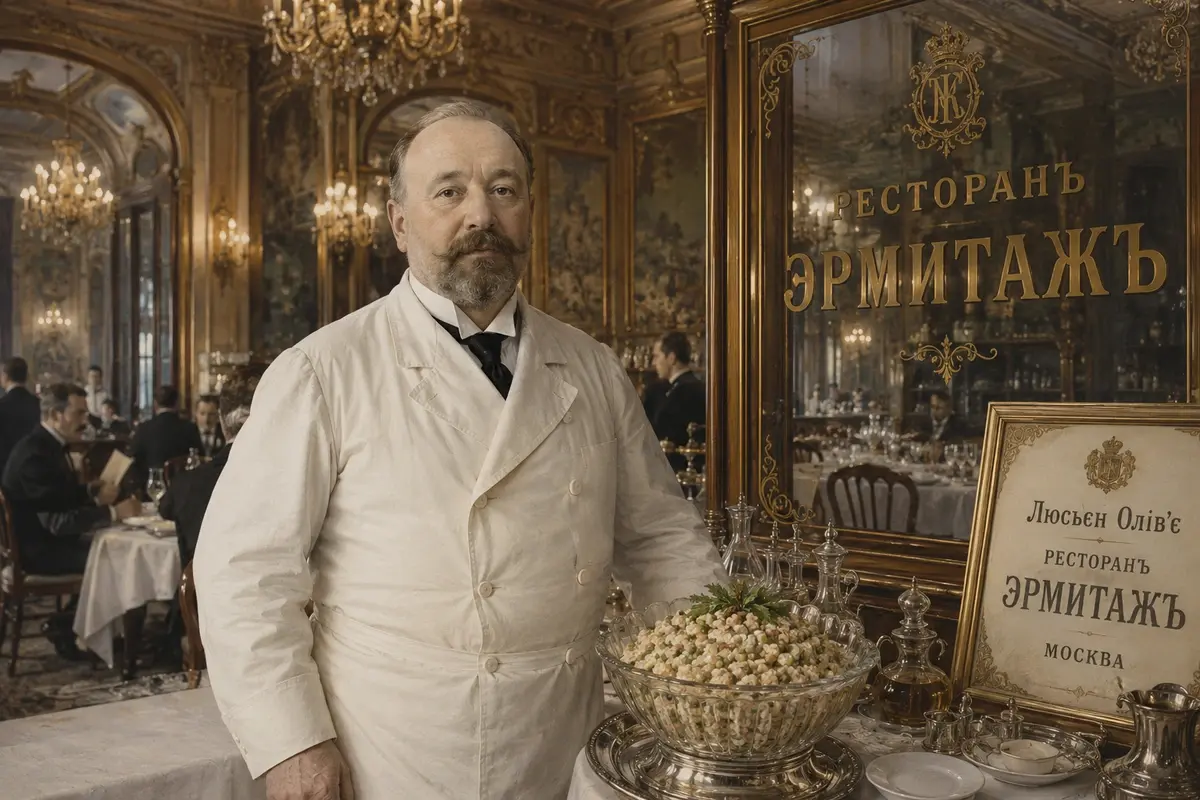
It all began in the 1860s in Moscow. The Hermitage restaurant on Trubnaya Square was the city’s social epicenter — a luxury spot with crystal chandeliers, waiters in white gloves, and a clientele that knew wine. The owner, Lucien Olivier, a Frenchman by birth, created a dish called “Mayonnaise with Game.”
Back then, “mayonnaise” referred not only to a sauce but to an entire category of cold dishes. Originally, Olivier wasn’t a salad at all. It was an elegant platter of chopped hazel grouse and partridge fillets layered with cubes of lanspig — a firm, set meat jelly. Sound familiar? Nearby lay crayfish necks, and in the center rose a mound of potatoes with cornichons. At the time, the potatoes were purely decorative. Lucien believed guests would eat the game and leave the vegetables untouched.
How merchants taught a French chef to cook “rich”
But the chef underestimated the appetite of Moscow’s hard-bitten merchants. They say he was stunned when he saw his wealthy customers mercilessly mixing that architectural beauty into a uniform mass and slathering it with sauce. Olivier took it as a personal affront at first — like it was disrespecting his art.
The next day, half as a joke and half in surrender, he served the dish already mixed. That’s how the salad that became an instant hit was born, and Lucien learned the first rule of successful business: aesthetics are fine, but a tossed-together dish is much closer to people’s hearts. That was the first step toward the giant bowl we know today. The merchants wanted something filling and familiar, and the Frenchman, sighing, gave it to them.
The secret he took to the grave: culinary espionage
You won’t find Olivier’s original recipe in old books in its pristine form. Lucien guarded the recipe for his signature sauce like state secrets. He prepared the dressing in a separate room behind closed doors. That sauce — not just the list of ingredients — made the dish unique. They say he used a special Provençal olive oil, French vinegar, and a secret ingredient imported to order.
Ivan Ivanov: the first “industrial spy”
There’s a legend about culinary spying that reads like a Bond movie. The story goes that Olivier’s assistant, a fellow named Ivan Ivanov, took advantage of a moment when the master was called away to see an important guest, peeked into the kitchen, and noticed the components laid out on the table. Culinary espionage is an old tradition, after all. Later Ivanov went to work at the Yar restaurant and presented the dish as “Stolichny” salad.
Critics called the copy a pale shadow, which was the usual refrain. But “Stolichny” became the bridge that let the recipe survive the revolution, when the Hermitage closed and bourgeois luxuries were banned. Lucien took the true secret of his sauce to Vvedensky Cemetery in 1883, leaving his descendants only guesses and thousands of variations on the theme.
So what was actually on the gourmet’s plate?
According to journalist Vladimir Gilyarovsky, the original delicacy contained ingredients that would trigger a financial panic in the middle class. It included fillets of hazel grouse, veal tongue, pa ius caviar (real luxury!), fresh lettuce leaves (laitue), boiled crayfish, English pickles, fresh cucumbers, and capers.
A special ingredient was “Soya-Kabul” — a mysterious spicy soy paste. Compare that list to the potato-sausage-pea lineup. Do you feel the social elevator racing down to the ground floor? In Soviet times the grouse flew away, the crayfish receded into history, and capers were replaced by peas because peas at least sometimes appeared in grocery deliveries.
The evolution of the big bowl: how the salad became a national antidepressant
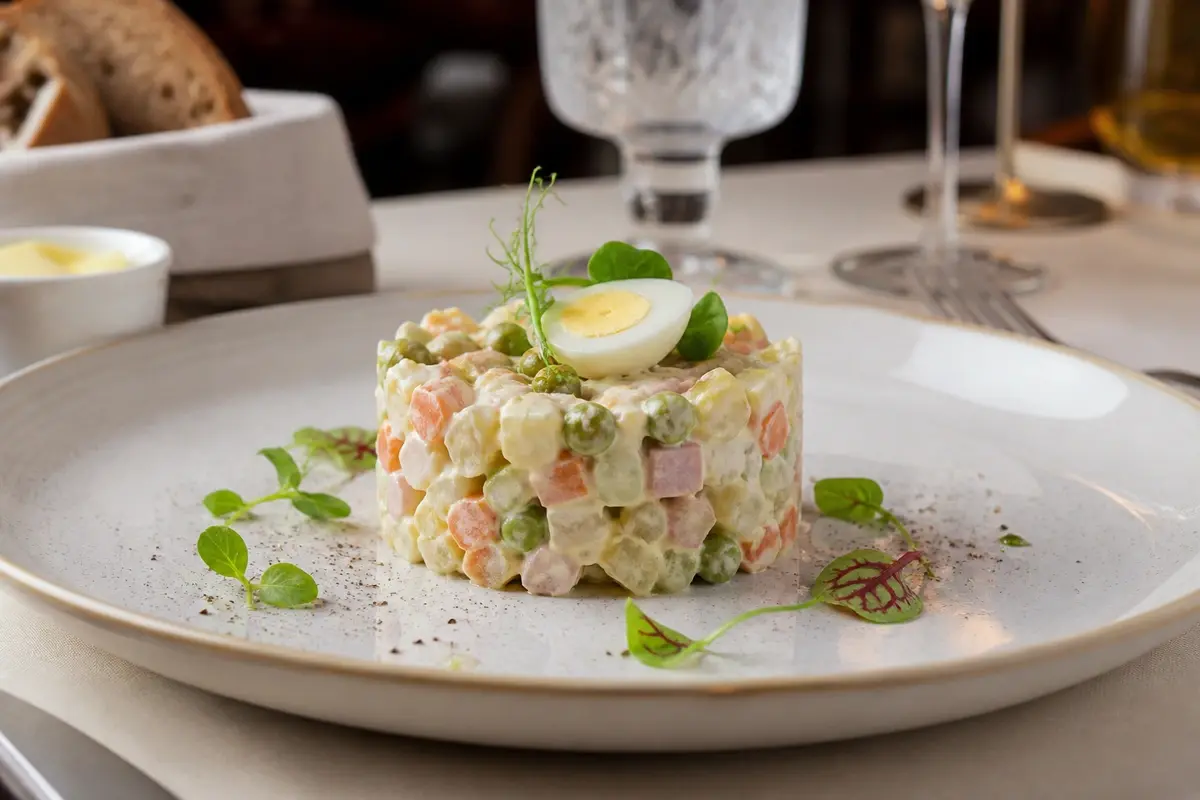
Turning an elite delicacy into a Soviet legend didn’t happen overnight. After 1917 the country shifted onto a track of cheap, simple, and filling food. But memories of fine dining stayed. In the 1930s professional cooks started adapting old recipes to harsh realities. This was a time of massive change in the food industry.
The proletarian tandem of “Doktorskaya” and “Provencal” — the Worker and Kolkhoz Woman of cuisine
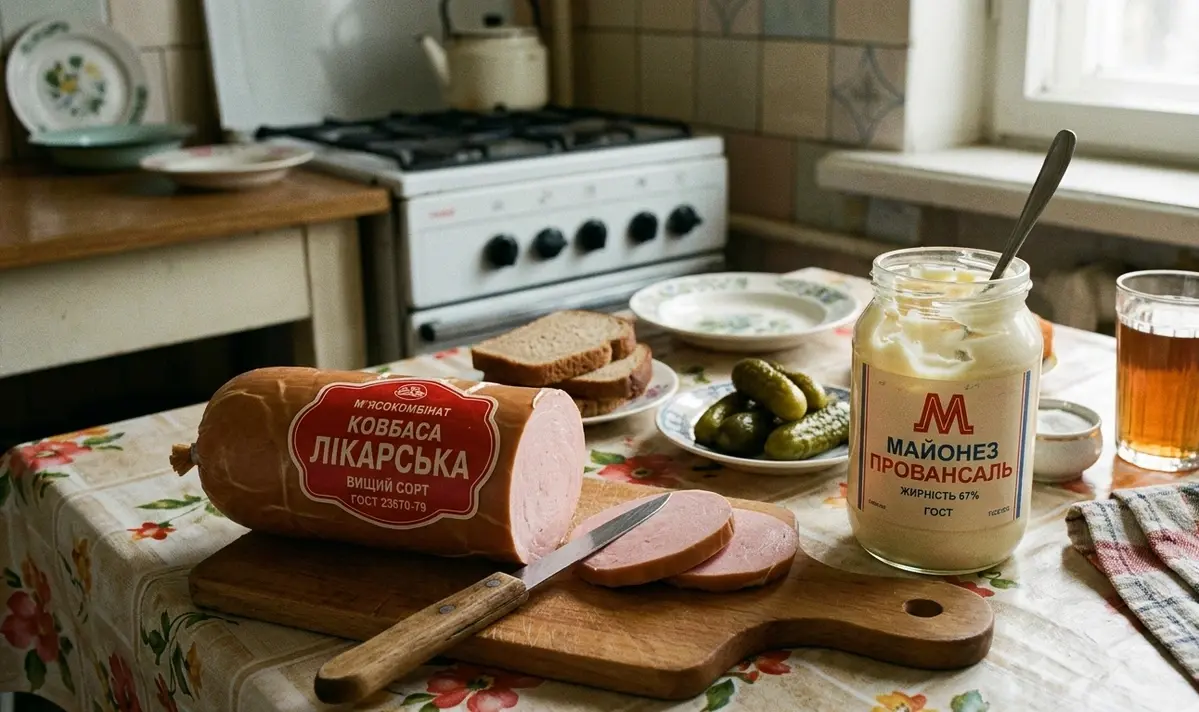
That’s when Doktorskaya sausage appeared — a true marvel of its era. It was conceived as a dietary product for those who “sacrificed their health on the fronts of the revolution.” Its original composition (per the first state standards) contained only meat, eggs, and milk, and its tender flavor replaced grouse perfectly. At the same time, “Provencal” mayonnaise went mainstream.
It was the perfect marriage: a fatty sauce hid the shortcomings of cheap ingredients and added satiety. Canned peas replaced capers not only because the latter were scarce, but because peas added a pleasant sweetness. The salad stopped being an appetizer for the few and became a mainstay for millions, turning into proletarian “food art” — best enjoyed with a shot of vodka.
Olivier as a symbol of stability and the “Globus” of luck
In the 1960s and ’70s Olivier became a marker of well-being. A giant bowl of the salad on the table meant the family was doing okay. People stood in line for hours to buy mayonnaise in glass jars and hunted for imported Hungarian “Globus” peas, which were considered the benchmark of quality.
The salad inspired jokes and starred in New Year’s films. Even celebrities couldn’t resist. They say actress Faina Ranevskaya joked that when she saw too much mayonnaise on a table, she’d quip, “There’s enough fat here to start sliding across the floor without leaving my chair!” Olivier in a Soviet apartment was an act of quiet defiance against everyday grayness.
Myths, facts, and kitchen diplomacy
There are so many myths around Olivier you could fill a season of a historical drama. It’s a chameleon of a dish: its ingredients changed with political regimes, exchange rates, and who had pull with the grocery manager. In a world where food often becomes a tool of soft power, Olivier acts like a diplomat. It can reconcile people with totally different views at one table, because when that coveted bowl arrives, political arguments fade in the face of the eternal question: “Where did you get the peas?”
The Olivier Index and world records
Economists sometimes joke that the cost of the salad’s ingredients measures real inflation better than official reports: if peas and eggs get pricier, expect economic turbulence. Olivier is also about scale. The largest Olivier salad in the world weighed over three tons. Chefs in Orenburg used 700 kg of potatoes and half a ton of sausage to make it. Picture that spectacle — did they hand it out with shovels?
There’s even an Olivier designed for cosmonauts — in squeeze tubes. Reportedly, without the characteristic crunch of cucumber, the experience isn’t the same. That proves the main point: Olivier is not just food but a complex sensory experience where texture matters as much as calories.
The battle for ingredients: apple or onion?
This is a true civil war in kitchens. Have you seen those Facebook fights? The country splits into camps: people who put apple in Olivier (preferably a tart variety like Semerenko) and those who consider that a crime against humanity. Apple fans say it adds “freshness”; opponents argue fruit has no place in a meat salad.
The same goes for onion. Some say without it the taste is flat; others insist onion kills the mayonnaise’s tenderness. Kitchen diplomacy recommends: if you want to add onion, pour boiling water over it after chopping — that tames the bite and leaves only a gentle hint of flavor.
The anatomy of the perfect bowl: pro tips
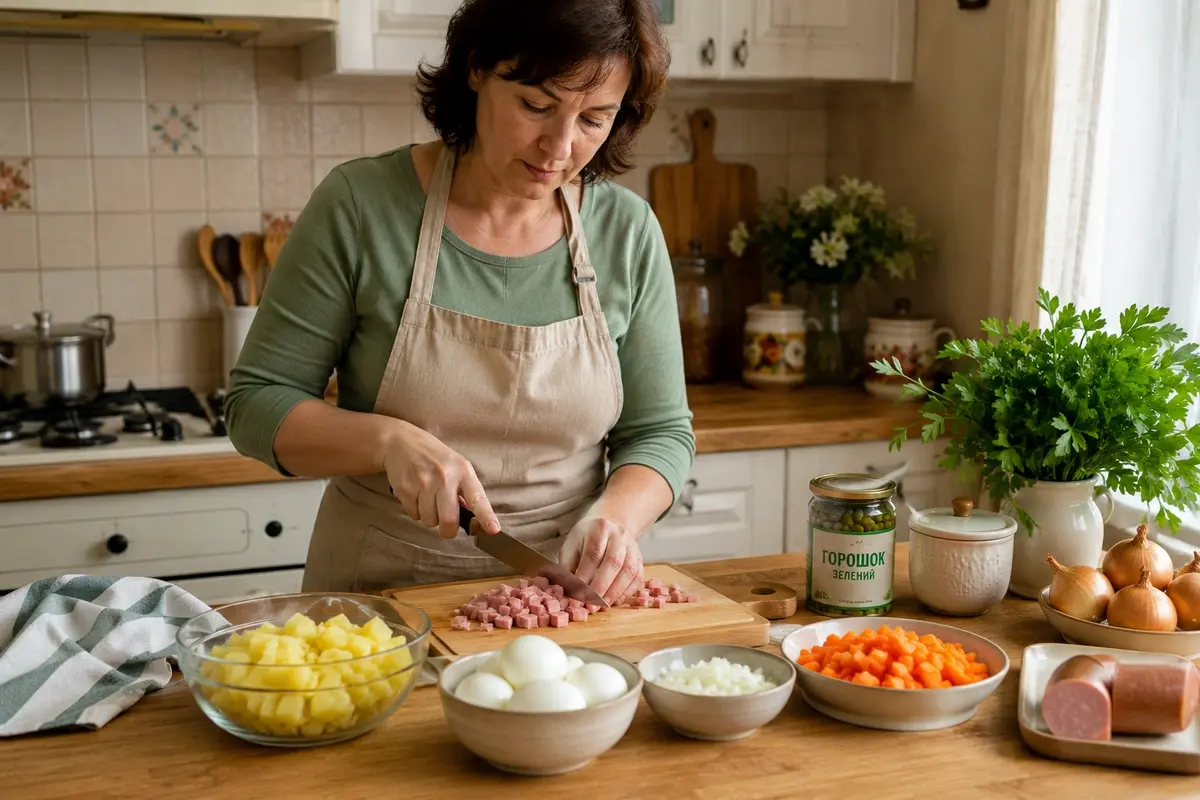
If you want your salad to look restaurant-level, follow the rules. First, temperature. All vegetables and eggs must be completely chilled. Preferably boil them the night before. Warm potatoes, for example, turn into glue when you dice them — noticed that?
Why potato is the foundation and cucumber is the soul
Use waxy potatoes so they don’t fall apart. Boil them in their skins to keep firmness. Cucumbers are a separate topic. Some people use only salted barrel cucumbers, others only pickled ones. The ideal is a 50/50 mix. Salted cucumbers give depth; pickled ones add tang.
The size of the dice matters too. The canonical cube is pea-sized. That way every spoonful mixes flavors evenly. Remember to drain excess liquid from cucumbers, or your Olivier will turn into a soup — and a mayonnaise soup is a much less festive story.
Mayonnaise etiquette: dress it or not?
The biggest mistake is dressing the entire salad early, especially if you’re prepping it three days ahead. Mayonnaise draws moisture from vegetables, and in a day you’ll have a sad sight. Store chopped ingredients without dressing in a sealed container and dress right before serving.
One tip from experienced cooks: add a drop of mustard to store-bought mayonnaise. That brings the flavor closer to Lucien’s “secret” sauce. Don’t skimp on mayonnaise, but don’t drown the ingredients either — they should breathe and crunch, not float.
The philosophy of New Year scarcity
For the 50+ generation Olivier is more than a recipe; it’s the memory of how ingredients were obtained. It was a real quest. “Globus” peas often came in company ration packs. Mayonnaise in glass jars with metal lids was practically currency.
Cutting rituals
The evening of December 30th usually sounded like a knife on a cutting board. Cutting Olivier was a family ritual. Dad peeled potatoes, mom sliced sausage, and got the responsible job of peeling eggs. Those kitchen conversations solved every world problem.
That’s why Olivier has a therapeutic effect. We love it not for grouse or capers but for the feeling of coziness and belonging. Even now, when you can buy a ready mix at the supermarket, a homemade salad cut by hand always tastes different. It contains that secret ingredient — the warmth of human hands and shared interests across generations.
Olivier around the world: from Mexico to Japan
You might be surprised, but this salad is known and loved far beyond its birthplace. Everywhere it adapts to local color, sometimes with results that genuinely surprise us.
Spain’s Ensaladilla Rusa and the Mexican version
In Spain the “Russian salad” is a mandatory tapa in every bar. But Spaniards would not be Spaniards if they didn’t add tuna and lots of olives. In Mexico they might add chili or lime, making the flavor explosive. That proves the base Lucien invented is a universal building block for many culinary cultures.
The Japanese approach: mashed potato, seriously?
Japan also has a potato salad very similar to ours. But Japanese cooks often mash the potatoes into a puree and leave cucumbers and ham in chunks. That creates a totally different texture, but the spirit of Olivier stays the same — comforting, homey, and filling.
So what do the French think?
The French relationship with this salad is ironic. What we call the “real French salad” they themselves call Salade Russe (Russian salad). For the average Parisian it’s something exotic you buy ready-made at the deli when you’re too lazy to cook, not something you heap into a giant bowl at Christmas.
Still, French cuisine has several relatives of our Olivier that follow similar principles but with French flair.
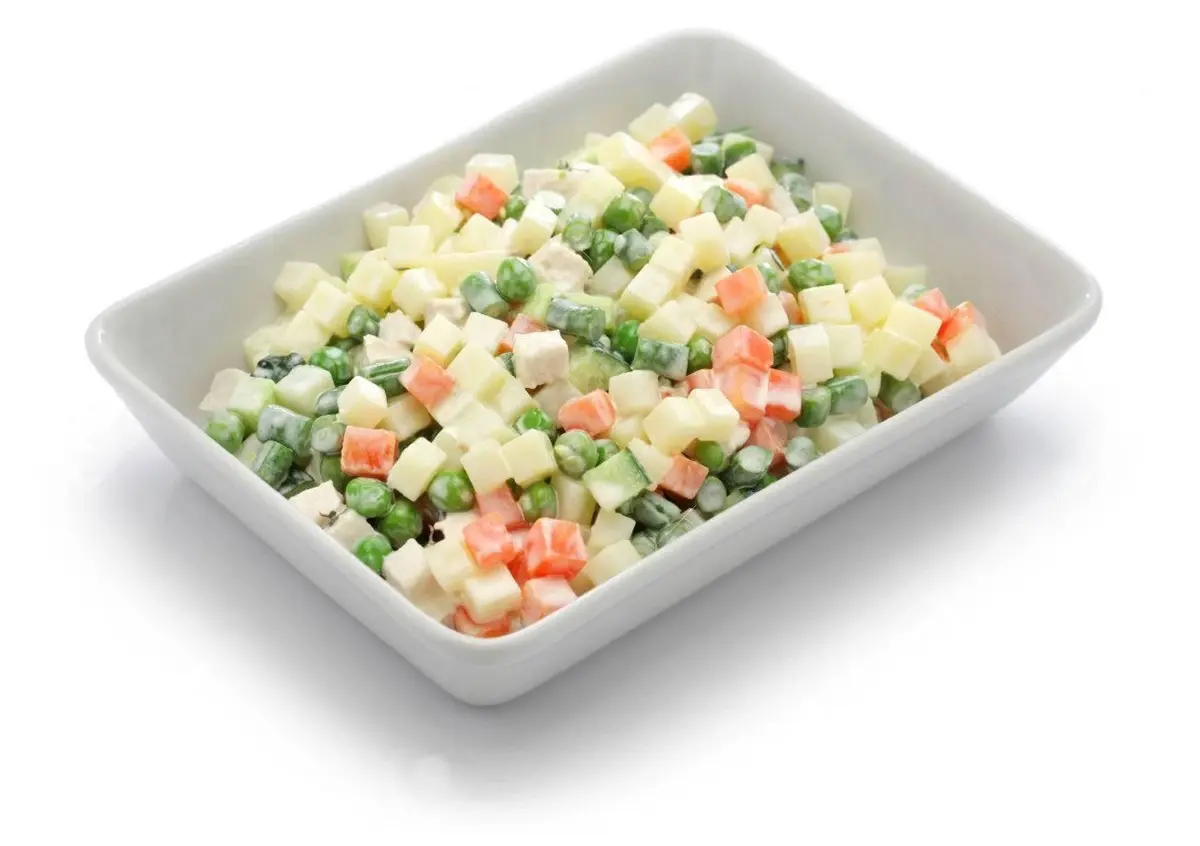
Macédoine de légumes (Macedoine)
This is the closest “sibling” to Olivier and the base for many similar salads. The name references Macedonia, hinting at a mix of different peoples — or ingredients — in one state.
- What’s inside: Precisely diced cubes (the French love form) of carrots, green beans, and turnip, plus peas.
- The twist: It’s dressed with mayonnaise or a vinaigrette (that’s oil mixed with vinegar, not what you might be imagining). Add ham or boiled eggs and you’re almost at our Olivier, but without the potato dominance.
Piémontaise (Piedmont salad)
If Olivier is the king of our tables, Piémontaise is the star of French picnics and family lunches.
- What’s inside: Boiled potatoes, fresh tomatoes, ham, pickled cucumbers, and eggs.
- The difference: Here tomatoes replace peas, giving the salad a very different texture and freshness. The dressing is always mayonnaise, often with mustard and herbs mixed in.
Why they didn’t adopt the giant bowl
For the French, food is primarily about distinct flavors. They rarely mix ten ingredients into one heap so they “marry” under mayonnaise. They prefer the Salade Composée format: separate piles of greens, slices of cheese, nuts or pear, each barely dressed. Our Olivier is too heavy for them. Imagine the face of a French aesthete offered potato smeared with mayonnaise and a baguette — for them that’s a gastronomic thrill bordering on extreme.
Salad etiquette: “Provencal” is a region, not a brand
The word “Provencal” in the mayonnaise name is a legacy of French cuisine. But while we treat it as a fatty jarred dressing, for the French it connotes a sauce based on the best olive oil from Provence, with garlic and anchovies — think aioli.
Three faces of Olivier: how to cook it by era
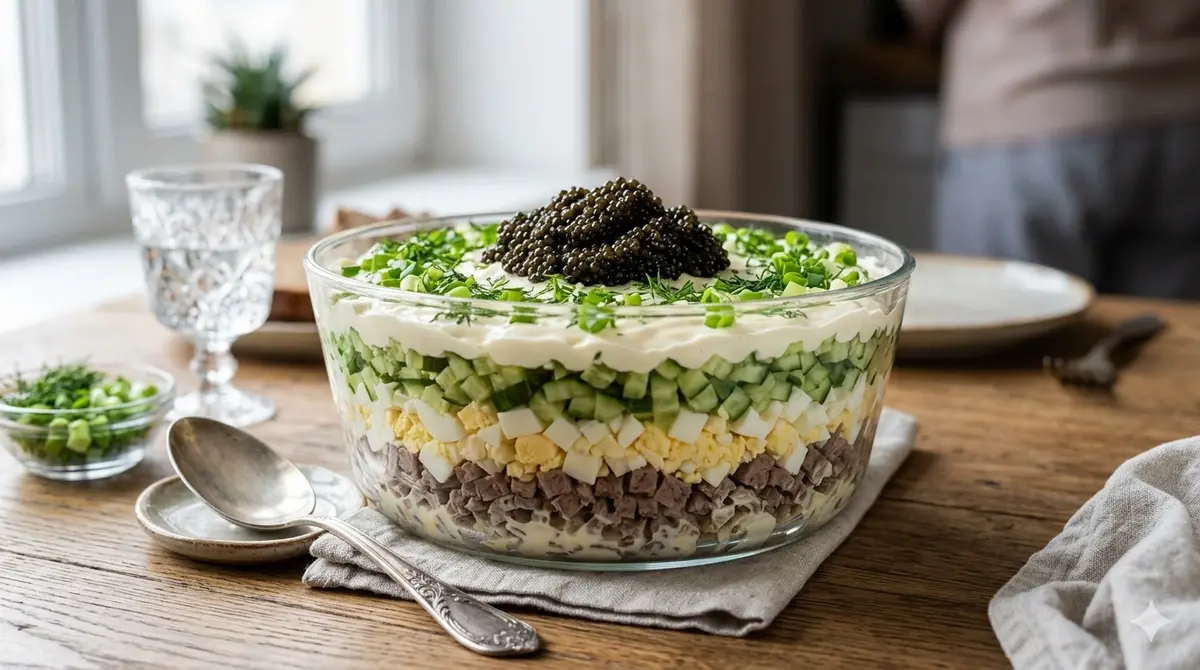
- “Bourgeois Chic” (Reconstruction of the 1860s)
For those willing to spend the budget of a small country on one dinner.
- Ingredients: Fillets from 2 roasted quails, 1 boiled veal tongue, 100 g pa ius caviar, 25 crayfish necks, 2 fresh cucumbers, 100 g capers, 5 hard‑boiled eggs.
- Dressing: Homemade mayonnaise made with egg yolks and olive oil with a drop of tarragon.
- Tip: Layer everything and don’t mix right away — let guests “vandalize” the beauty themselves.
- “Canonical Soviet” (The state‑standard of collective memory)
A taste you can’t forget.
- Ingredients: 400 g Doktorskaya sausage, 4 medium potatoes, 2 carrots, 5 eggs, 1 can of sweet peas, 4 pickled cucumbers.
- Dressing: Only full‑fat mayonnaise, 67% fat. No “light” options — this is not a diet, it’s a celebration!
- Feature: Add one finely chopped onion and half a peeled apple as a compromise for peace on the table.
- “Olivier 2.0” (For young people and health‑conscious eaters)
When you want the classic but also want to step on the scale tomorrow without tears.
- Ingredients: Boiled turkey (instead of sausage), avocado (to replace some potatoes), fresh cucumber + pickled gherkin, quail eggs, frozen green peas.
- Dressing: Thick Greek yogurt + a teaspoon of Dijon mustard + lemon juice.
- Vibe: Instagram looks for a million, and your stomach won’t beg for help an hour after dinner.
Olivier is more than just food. You can poke fun at the tradition all you like, but while this salad sits on the table we feel a link between generations. It’s one of those cases where French sophistication and Soviet inventiveness created a genuine folk masterpiece that fearlessly faces both time and nutritionists. Just remember: a salad is fresh until it starts talking to you from the fridge.
