
 Carlos Solis
The fork feels as natural today as the air you breathe or your morning coffee, but its road to the dinner table was longer and thornier than some pop stars’ careers. Now people elegantly spear an olive or twirl fettuccine with it, but at one time that same gesture could earn you the label “ungodly” and icy stares from stern ancestors.
This utensil’s history is less about food and more about a real cultural showdown. Religious bans, royal whims, and technical progress collided and turned a piece of iron into an engineered marvel. Every millimeter of curvature, every tine count, and even the markings on the back of the handle had practical reasons — reasons people once paid for with reputation, and sometimes with their lives. If you thought a fork was just “four makeshift fingers on a stick,” prepare yourself: there’s more technology, chemistry, and political intrigue in this little tool than in the average whodunit.
Byzantium kicked it off — and conservative Europe was shocked
Archaeologists have found the earliest fork prototypes in the ruins of ancient Rome and Greece, and in Bronze Age China (the Qijia culture). Back then cooks used massive two-pronged implements made of bone or bronze to pull hot meat from deep pots, because sticking bare hands into boiling vessels was simply painful and dangerous.
The personal table fork was born in Byzantium, the era’s center of outrageous luxury and cultural high tech. Byzantines developed the idea that touching food with your fingers was a sign of barbarism, not nobility. The first individual models had only two straight tines and lavish handles, often carved from ivory or cast in pure gold and inlaid with gems and enamel. These items were enormously expensive, similar to how salt once functioned as “white currency” and played a major role in trade and social status. Such precious utensils were used only for fruit, candied nuts, or sweet desserts so sticky juices wouldn’t soil aristocrats’ hands during polite conversation.
How a fork provoked God’s wrath
In 1072 the Byzantine princess Theodora Anna Doukaina, daughter of Emperor Constantine X Doukas, brought one of these luxury forks to Venice for her wedding to Doge Domenico Selvo. Local nobles were stunned that the new wife refused to eat with her hands, since eating with the hands was considered normal even at the highest tables across Europe.

The bride arrived with her own retinue, including a specially trained attendant who carved food into small pieces that could then be speared with the elegant utensil. When she died two years later of an unknown illness, priests declared her death a “just punishment from God” for outrageous pride and for using metal “fingers” instead of the hands God had given humans.
Because of that intense resistance and the religious bans that followed, the fork remained astonishingly rare for centuries. It was so valuable and exotic that aristocratic inventories listed individual forks as items well into the 14th century, alongside crowns and estates.
Medieval passions: why the church called forks satanic and sailors mocked them
Conspiracy theories about the fork multiplied so wildly that modern bloggers would envy their reach. The Catholic Church led the opposition. Theologians argued that two sharp tines strongly resembled the instruments of hell and Satan’s pitchfork. They claimed that refusing to touch food with one’s hands led people into the sin of pride and service to the unclean, since God had blessed human hands. The fork became an object of systematic vilification and was considered:
- “The devil’s antenna.” Critics said metal tines invited unclean forces directly to the dinner table, making the meal impious.
- A punishment for luxury. When the Byzantine princess Maria Argyropoulina (a relative of the emperor) died of the plague after using a fork, the church presented her death as retribution and used it to campaign against the “devil’s instrument.”
- A marker of dubious manliness. In Britain, men could be mocked in taverns for using a fork well into the 19th century. People believed the utensil turned a warrior into a delicate, “effeminate” creature unfit to be a real man. The moral was simple: a true conqueror of wild elements — whether knight or sea dog — should tear meat with his teeth and bare hands, not dither with a dainty bit of iron. The fork became a symbol of weakness: if you feared getting your fingers greasy, how could you hold a ship’s wheel or a sword in real combat?
- French conservatism. Even Louis XIV, the Sun King, banned forks at his court because he considered eating with the hands a sign of true refinement. Courtiers had to master the art of taking food only with the tips of their fingers so precisely that they left no grease on their costly lace cuffs. Using a “forbidden” fork risked angering the king, so guests competed to stay spotless without any utensils.
Only the Italians largely ignored the bans. They were simply tired of burning their fingers on hot pasta and soiling their expensive silk doublets with rich sauces. Italian cooks were the first to add a third tine, making the utensil far more convenient for twirling spaghetti. When cholera and plague epidemics made hygiene a matter of survival, society finally accepted that clean utensils weren’t a sinful affectation but a basic health measure.

Renaissance etiquette and Marina Mnishek’s ‘witchy’ scandal
The fork’s spread into common use rode on the influence of powerful women. Queen Bona Sforza brought the utensil from Italy to Poland and Lithuania. The nobility were shocked at first but quickly came to appreciate keeping their hands clean for a glass of wine or a handshake. The loudest scandal, however, happened in 1606 in Muscovy, where Marina Mnishek — the daughter of a Polish voivode — introduced the fork.
At her wedding banquet to False Dmitry I, the Polish bride produced her own silver fork and began to eat with it confidently. Boyars who were used to wiping greasy fingers on the tablecloth, the hems of their clothes, or even on hunting dogs waiting for scraps were stunned. Many people decided they were witnessing witchcraft. If the new ruler’s wife did not touch the food with her hands, she must be a witch. “An inhuman manner!” people cried. “She stabs food with a bit of iron!” the crowd murmured. That small sharp object became one of the formal pretexts for toppling False Dmitry: foreign influence had to be purged.
Another century passed before Peter I started imposing such fashions by force, just as he did with beard shaving. He even carried a personal case of cutlery in his pocket and could create a scene if he saw nothing but spoons on a host’s table. His despotic insistence helped strip the fork of its “witchy exotic” label and turned it into an obligatory sign of any supposedly civilized Muscovite.

Marina Mnishek with her father under guard, painting by M. Klodt
From the blacksmith’s forge to 18/10 stainless steel
The fork’s story is a classic upgrade from craft to industry. Once every piece was born in a forge, hand-forged and heavy, with rough, sharp edges that quickly “tired” — in other words, rusted. Comfort was not the priority.
The shape didn’t become what we know now overnight. For a long time the fork remained almost flat and awkward. Only in the 18th century did German craftsmen introduce the bend. That small innovation made it comfortable not just to spear food but to hold it, almost like a spoon. It seems trivial, but the effect was brilliant.
The rust and metallic aftertaste problem was solved much later with the advent of modern alloys. Today’s standard is 18/10 stainless steel: 18% chromium provides strength and corrosion resistance, and 10% nickel gives the characteristic shine and resistance to acids. Because of that composition, a fork won’t darken from lemon, won’t absorb odors, and won’t change the taste of food.
The fork also became an art object in the 20th century when surrealists brought fine art into everyday items. Salvador Dalí created a surreal flatware set in 1957 where forks and knives take the shapes of elephants, fish, and organic elements, turning utensils into objects of artistic fantasy and surrealist ideas.
Modern manufacturing can look like a brutal marathon in a metal shop, where steel sheets get pressed into maximum elegance:
- Blanking. A press punches flat blanks from a steel coil.
- Hot rolling. The metal runs through rollers to build weight into the handle for balance while making the tined section thinner and wider.
- Forking. A powerful punch forms the tines in one blow. Every gap matters here: uneven or too-narrow slots trap food residue that’s hard to clean.
- Bending. Manufacturers add the ergonomic curve conceived three centuries ago.
- Electrochemical polishing. Factories tumble the forks with abrasives (walnut shells or ceramic beads) and finish them on soft wheels with polishing paste.
Today’s complex stamping and rolling merely perfect the idea German craftsmen invented by hand. The whole journey from the forge to automatic production served one goal: to put a tool in your hand that you don’t have to think about during dinner.

Learning the language of tines and metal
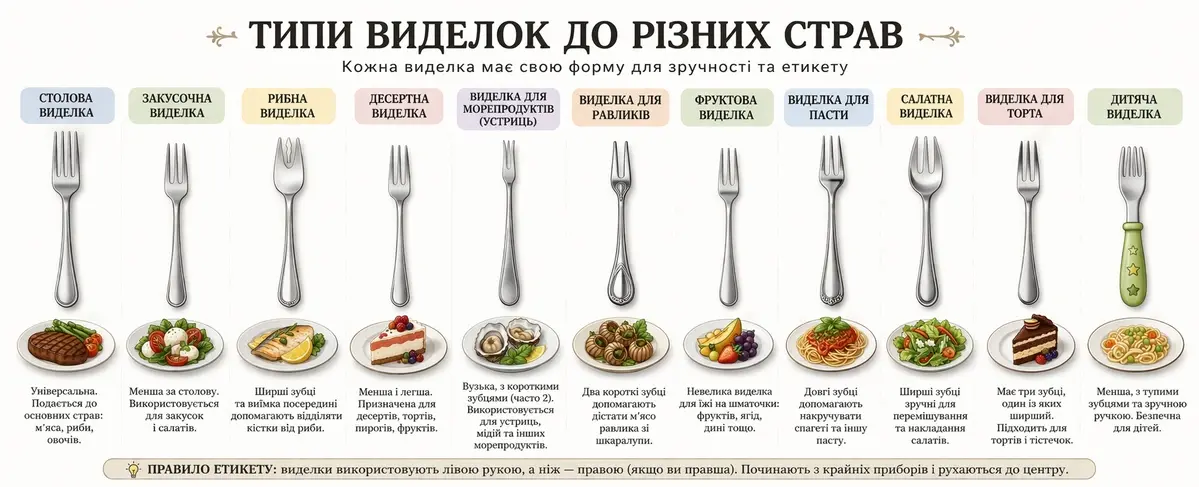
If the table fork is the basic tool, its many “relatives” are narrow specialists. Designers added each bend, extra slot, or sharpness of an individual tine not out of whimsy but in response to the physics of food. Some dishes need to be gently separated along fibers, others must be firmly held, and some need to be cut without using a knife.
The main players on the plate are often more interesting than the standard dinner fork, because every small detail in them was invented for a specific awkward food.
Trident anatomy: what each fork is for
- Fish fork. Short tines on a wide base make it easy to press the fillet and separate the meat from the backbone. The central slot lets you remove a large bone without shredding the fillet.
- Salad fork. The outer-left tine is made wider and sharper so one press can cut fibrous leaves as well as resilient avocado slices, cherry tomato halves, or firm cucumber rings. Instead of crushing a vegetable and squeezing out its juice with blunt tines, this “edge” neatly portions the ingredient right in the bowl.
- Spaghetti fork. An engineering hit with micro-grooves on the outer tines. The grooves act as stoppers and prevent pasta from slipping back into the bowl while you wind it.
- Gourmet tools. Oysters and seafood forks resemble surgical probes. Their job is to slice a mollusk’s muscle in one motion or extract meat from the narrowest lobster claw.
- Dessert and cocktail forks. Small size equals elegance. The dessert fork has one outer tine widened and sharpened along its side edge, turning it into a built-in knife for slicing a piece of dense cake or firm glaze without crushing cream or dragging pastry across the plate. The cocktail fork has very sharp prongs for securely skewering slippery olives.
For convenience we collected all the technical parameters and tine counts into a table so you always have a quick guide to form and function at hand.
Quick etiquette cheat sheet: modern fork types
| Type (tines) | Feature | Purpose |
| Dinner (4) | Largest | Meat, sides |
| Fish (4 short) | Wide, slot | Removing bones |
| Salad (4) | Sharpened edge | Cutting leaves |
| Dessert (3) | Sharpened edge | Portioning pastries |
| Spaghetti (3-4) | Notches | Twisting pasta |
| Lemon (2) | Tiny | Transferring slices |
| Oyster (3) | Thick edge | Cutting the muscle |
| Cocktail (2) | Thin prongs | Skewering olives |
In the end, all those clever tines and curves were invented so you don’t have to wrestle with the food on your plate. When a fork fits the dish, you can eat without worrying how to pick up that piece.
Fork ambassadors and famous influencers
The fork’s modern look and popularity owe a lot to historical figures who weren’t afraid to break old customs and set new rules:
- Catherine de’ Medici (16th century): The Italian princess who first brought the fork to the French court. Courtiers mocked her at first, calling the utensil “an unnecessary pampering,” but she made it a required element of royal etiquette.
- Henry III (16th century): The French king who loved the fork so much that he refused to eat with his hands even while hunting. He introduced strict etiquette that treated eating meat with the fingers as a sign of ignorance.
- Cardinal Richelieu (17th century): He ordered the tips of all table knives rounded so guests wouldn’t pick at their teeth during banquets. That move effectively pushed the aristocracy to adopt forks en masse.
- Napoleon Bonaparte (19th century): He insisted forks be placed tines down so guests could see the family crests stamped on the back of the handles — and that’s how the classic French serving tradition began.
- Thomas Jefferson (19th century): The third U.S. president promoted the fork in America. By bringing the French fashion for pasta back home, he practically forced the American elite to pick up forks, since that was the only elegant way to handle long noodles.
Thanks to the stubbornness of monarchs and presidents, the fork finally stopped being an exotic curiosity and became a respectable, convenient way to tackle a meal.
How technology is turning the ordinary fork into something ‘smart’
The fork continues to evolve in the digital age. The market already has ultra-light titanium utensils for climbers that won’t break on rock or freeze to your tongue in bitter cold, and “smart” forks that vibrate in your hand if you eat too quickly. Modern engineers apply PVD coatings to steel to produce black, gold, or “chameleon” utensils that reach near-diamond hardness — they can’t be scratched by ceramic and don’t lose color in the dishwasher.
We won’t dwell on disposable plastic; instead, note a genuine surreal twist: edible forks you can bite. Manufacturers make them from rice or wheat dough, and they taste like a cracker while holding their shape in hot borscht for about twenty minutes. Producers spice the dough with cumin, ginger, or black pepper, turning a table utensil into a zesty snack. If you don’t feel like finishing your gadget, toss it in the nearest bush — in a few days it will break down into compost.
Apparently the drive to avoid greasy fingers ended in one of the funniest outcomes in tech history. Starting from gold tines and passing through steel, plastic, and space-age titanium, the technological race suddenly gave us something crunchy. The ironic ending is this: instead of further complicating alloys or adding sensors, people simply turned the fork into an appetizer. That might be the truest measure of success — when a tool becomes so perfect that after dinner it simply disappears along with the garnish.
