
 Carlos Solis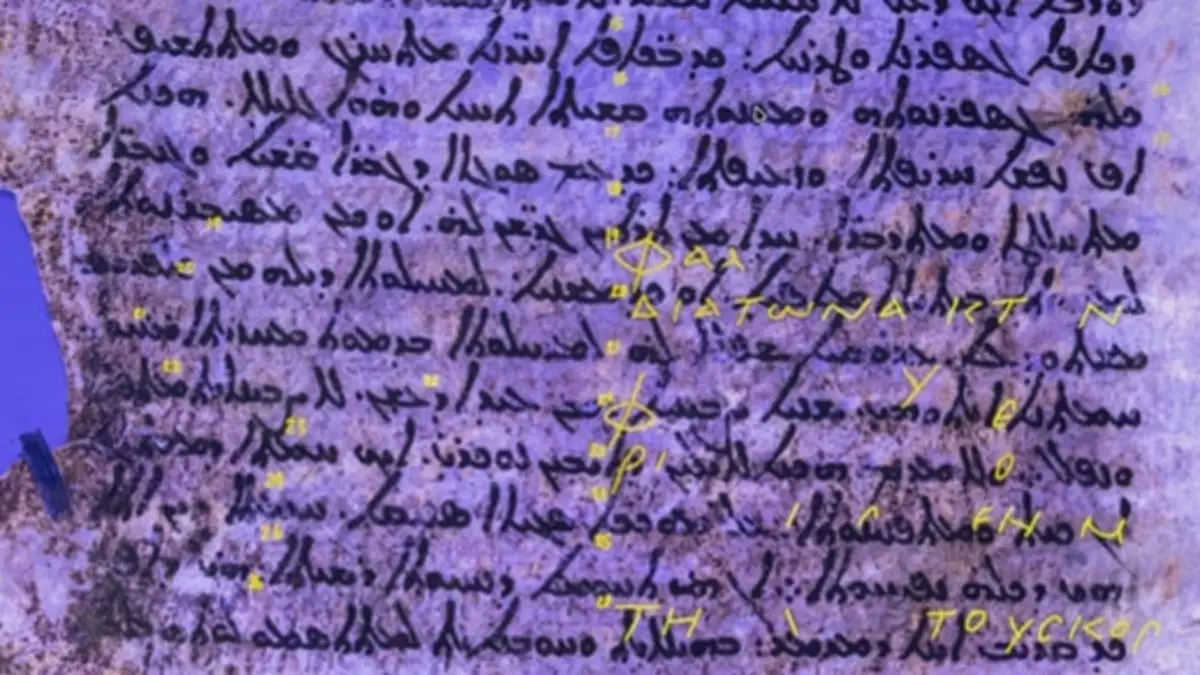
An international team of researchers has painstakingly reconstructed part of the oldest map of the night sky — a map that had been considered lost. X-ray scanning made the recovery possible.
The rediscovered map was created by the famous ancient Greek astronomer Hipparchus. He lived around 190–120 BCE, long before the invention of the telescope, the Daily Mail reported.
How this discovery began
In 2022, researchers analyzed the medieval monastery manuscript, the Codex Climaci Rescriptus, which dates to the sixth century. The codex was found at the Monastery of Saint Catherine in Egypt. Beneath the visible text, researchers discovered an ancient star map.
At the time, reconstructing the map was impossible because the available technology was inadequate. Now specialists at SLAC National Accelerator Laboratory in California have used a cutting-edge X-ray instrument to bring the ancient document back to life. The tool is a synchrotron — an extremely powerful particle accelerator.
“The goal is to recover as many coordinates as possible. That will help us answer key questions about the origins of science,” explained lead author Victor Gisemberg of the French National Center for Scientific Research.
The team is especially interested in why people in antiquity began practicing astronomy and how they managed to make such rapid progress. Dr. Gisemberg says the coordinates on the map are “incredibly precise for being determined with the naked eye.”

How did the star map end up underneath a monastery manuscript?
Because parchment was expensive in the Middle Ages, people often reused it by scraping off the ink. The team believes that is what happened to Hipparchus’s map.
The X-rays used to analyze the parchment in detail helped researchers distinguish different chemical compounds in the material without damaging it.
SLAC scientists are now carefully scanning 11 pages. The entire manuscript contains roughly 200 pages.
To protect the manuscript from environmental damage, the team placed its pages in special containers with controlled humidity. The lighting in the scanning room is automatically adjusted to prevent further fading of the ink.
“Step by step, the ancient Greek text of the astronomical manuscript is emerging,” said Dr. Gisemberg. “Being able to reconstruct the first map of the night sky is a major achievement for science.”
Who was Hipparchus?
The ancient Greek astronomer and mathematician Hipparchus lived and worked for most of his life on the island of Rhodes. He is considered one of the greatest astronomers of antiquity and is often called the father of scientific astronomy.

Hipparchus is known for creating one of the first star catalogs, recording the positions of about 850 stars. He classified the stars into six groups by brightness, discovered Earth’s precession, introduced geographic coordinates (latitude and longitude), and created one of the earliest trigonometric tables.
Hipparchus’s most important works have not survived. They were, however, known to scholars in antiquity, including Ptolemy, who relied on them in his work.
