
 Gaby
Gaby
Ancient Egyptians revered celestial bodies, but the Milky Way — our galaxy — hasn’t been fully explored in studies of Egyptian cosmology.
A new analysis suggests the barred spiral galaxy where our Solar System sits may have served several mythological roles for ancient Egyptians: a ladder to the underworld and a guide for migrating birds.
In a new study, astrophysicist Dr. Or Graur of the University of Portsmouth proposes that Egyptians identified the Milky Way with the sky goddess Nut. Nut is often shown as a star-studded woman arching over the Earth, shielding it from the waters of the abyss. In the ‘Book of Nut’ (also called ‘The Foundations of the Course of the Stars’), her main role is to give birth to the Sun each morning and swallow it again at night.
To carry out this task, Nut is often shown bending with her head to the west and her back to the east. But the Milky Way shifts position across the sky through the year—rising and setting differently in summer and sweeping north-south in winter. That raised doubts about equating Nut with the galaxy. Still, after reviewing burial papyri from Egyptian tombs, Dr. Graur found several depictions of Nut with her arms set at a 45-degree angle to her body.
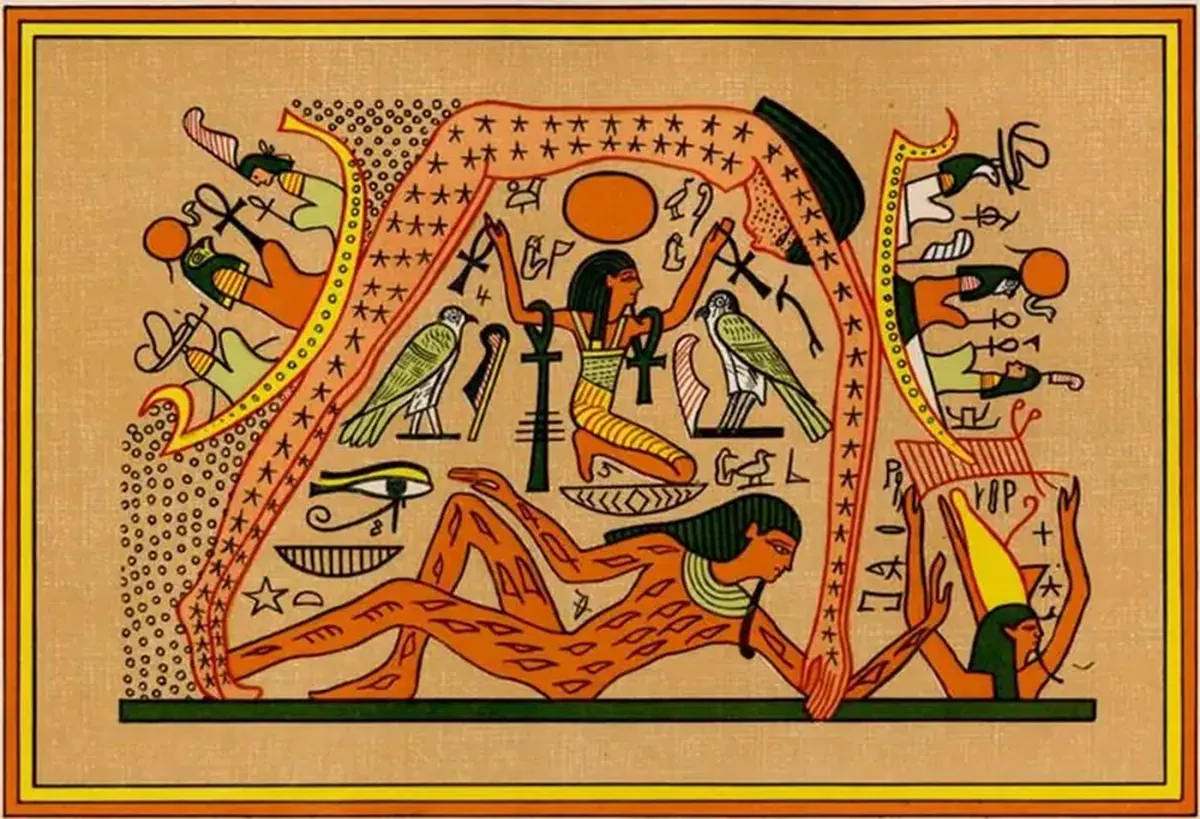
That pose would let the goddess align with the Milky Way’s changing directions through the year. So she could plausibly represent the galaxy. As Graur explained: ‘In winter, the Milky Way outlines Nut’s arms, while in the summer months, it outlines her torso (or spine).’
Searching for Evidence in Other Cultures
To find more evidence linking Nut to the Milky Way, Graur compared her role in Egyptian myth with similar ideas from other cultures. An Egyptian tomb text describes Nut as a ‘stairway’ that the souls of the dead climb to reach the afterlife — a theme echoed in some North American Indigenous mythologies that cast the Milky Way as a road for spirits.
Graur said, ‘Many Native American tribes view the Milky Way as a road that the spirits of the dead travel to the afterlife.’ He cited the Lakota name Wanaï Tachanaku, which means ‘road of spirits’ and refers to the path the tribe’s deceased follow to the heavens.

Similarly, the Yucatec Maya believed the dead traveled along the Milky Way at night. In that view, the dark band of the Great Rift in the Milky Way is seen as a pathway leading directly to the underworld.
Another passage in the ‘Book of Nut’ says that on the eve of each winter birds appear from the goddess’s northern side, migrating south from Europe to Africa. That passage alone doesn’t prove Nut is the Milky Way, but the link looks stronger when you consider Milky Way–bird migration associations in other Indigenous cultures.
Graur pointed out that the connection survives in modern languages: in Finnish, Estonian and several other Baltic languages the Milky Way is called a ‘bird path’ — for example, Linnunrata in Finnish and Paukščiu Takas in Lithuanian.
Graur’s findings shed new light on Nut’s possible connection to the Milky Way. The study was published in the Journal of Astronomical History and Heritage.
