
 Gaby
GabyResearchers at Queen Mary University of London found that bees can form a culture much like human culture. They teach one another how to solve complex puzzles — a behavior the team calls the “culture of kindness.” How did they show it?
In puzzle-box experiments, bees learned to tackle a difficult task by watching other bees, all for a sugar reward. The study shows bees can master complex tasks through social interaction, challenging the idea that only humans do this. Lars Chittka, professor of sensory and behavioral ecology at the university, said, “This challenges the traditional belief that only humans can socially acquire complex behaviors that go beyond individual learning.”
At first, individual bees were trained to solve a two-step puzzle. They had to press a blue lever to unlock a mechanism and then press a red lever to open a door and reach sugar water. The bees struggled to learn the sequence on their own, so the team trained them by rewarding completion of the first step before moving on to the second.
During training, the researchers introduced untrained observer bees that watched the trained demonstrators perform the two-step task. The observers quickly figured out how to do the actions in the correct order. But when no trained bee was present to show the steps, the newcomers were confused and couldn’t solve the puzzle by trial and error, as reported by the Daily Mail.
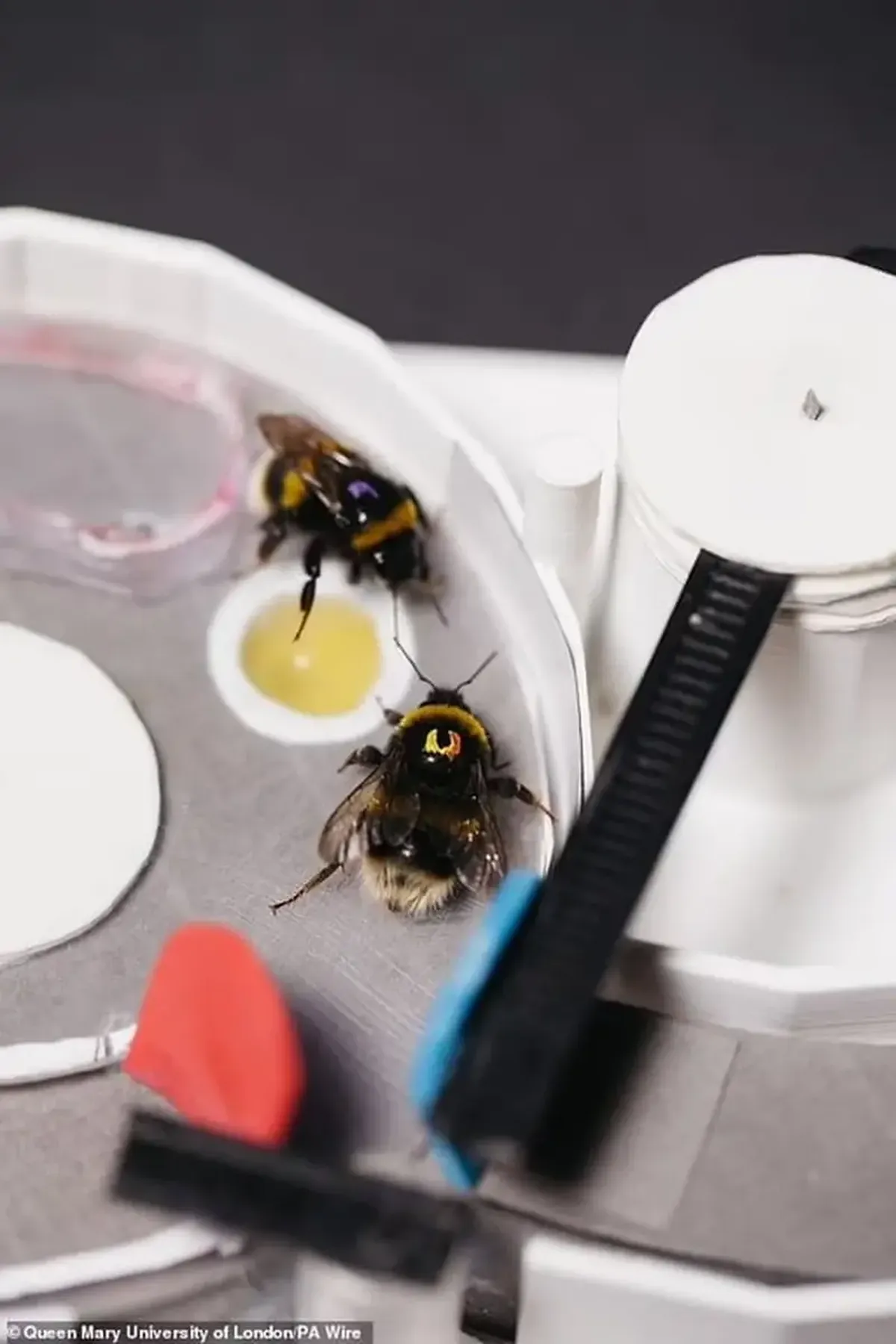
How did the team interpret these results? Lead author Dr. Alice Bridges said, “This task is extremely challenging for bees.” The researchers had to teach the demonstrator bees the full solution, which underscores the task’s difficulty. Although observers learned the sequence by watching, Dr. Bridges said that when observers tried the box without a demonstrator, they failed completely.
The team says the research opens new possibilities for understanding how cumulative culture develops. Cumulative culture is the gradual accumulation of knowledge and skills across generations, allowing ideas and practices to be refined through collective learning. In an interview with The Times, Professor Chittka asked readers to imagine throwing children onto a deserted island: if they’re lucky they might survive, but they would never learn to read or write. “That’s because learning from previous generations is essential,” he said. Cumulative knowledge acquisition has long been considered unique to humans, but the bees’ behavior suggests that conclusion may be wrong.
The findings were published in Nature. A separate study in Nature Human Behaviour found that chimpanzees can also pick up new skills by observing one another. In that work, Dutch and Belgian scientists taught a chimp to open a three-step puzzle box to get a tasty reward, then that individual passed the knowledge on to 14 relatives.
