
 Gaby
Gaby
Family dinners in the future will be smaller and much quieter. The average person will have more grandparents but fewer cousins. That’s the conclusion from researchers at the Max Planck Institute for Demographic Research in Germany.
By analyzing demographic trends, the team found that families are getting steadily smaller. In 1950, the average 65-year-old woman had 41 living relatives; by 2095 that number is expected to fall to just 25. Family structures will also change: grandparents, great-grandparents, and great-great-grandparents are likely to live longer, while fewer children will be born into each family.
What the researchers discovered
Scientists have long worried that declining birth rates and rising life expectancy could lead to an aging population. But until now, no one had examined how those trends would reshape family structure, says lead author Diego Alburess-Gutierrez.
He and his colleagues analyzed historical and projected data from the UN’s World Population Prospects report for 2022. To model how families might change, the team focused on a hypothetical average 65-year-old woman.
The analysis showed that her family size will steadily shrink worldwide over the next 70 years. That decline will be strongest in Latin America and the Caribbean: in those regions, the family of a 65-year-old woman is projected to drop from 56 living relatives in 1950 to just 18.3 by 2095—a 67 percent decrease.
Meanwhile, family sizes in Europe and North America, where birth rates are already very low, are expected to stay almost the same. The gap in family size between different regions is likely to narrow by the end of the century, the Daily Mail reported.
In 1950, the difference in average family size for a 65-year-old woman between Latin America and the Caribbean and Europe and North America was 31 relatives. By 2095, the researchers predict the largest gap between any two regions will be just 20 living relatives.
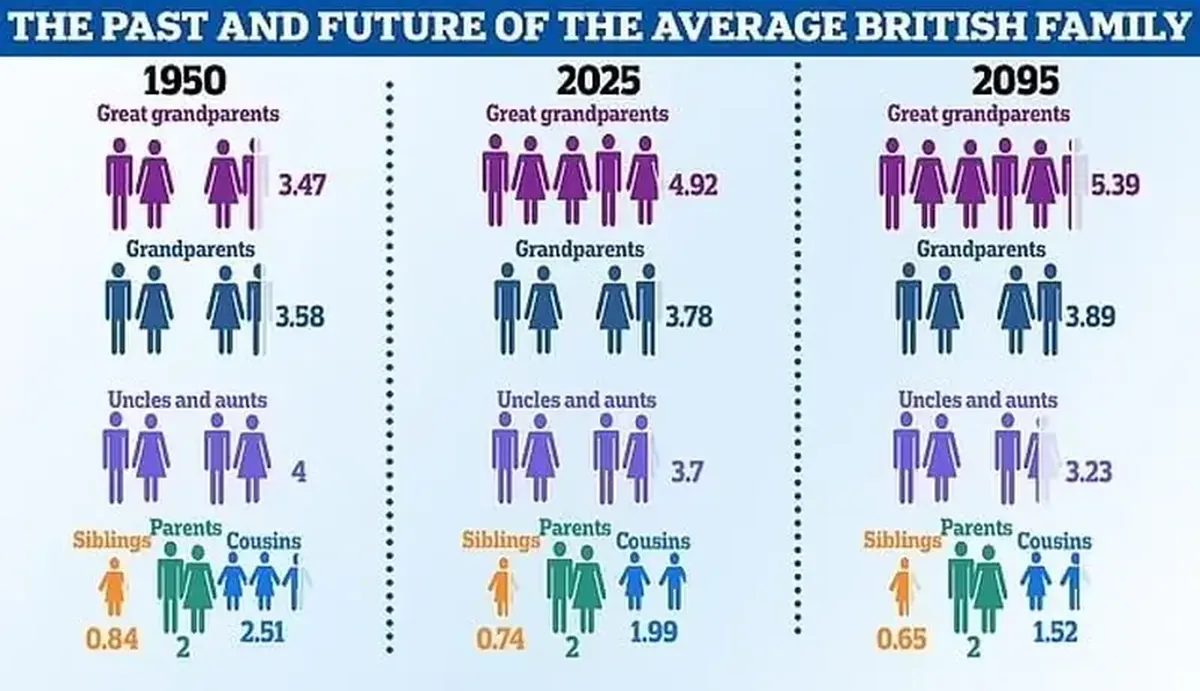
These trends are also evident at the country level
In 1950, the average Zimbabwean woman approaching 65 could expect to have 82 living relatives. By 2095, her counterpart is projected to have only 24.1 relatives. Meanwhile, the average 65-year-old woman in Italy, where families are among the smallest in the world, is expected to see her number of living relatives fall from 18 to 12.7.
But families will change not just in size; their makeup of relatives will shift, the study found. Future families will include far fewer cousins, nieces, nephews, and grandchildren, while the number of grandparents and great-grandparents is expected to rise sharply.
The shift comes from four forces: lower child mortality, longer life expectancy, declining birth rates, and delayed parenthood.
Lower child mortality tends to increase the number of siblings, cousins, and other relatives. But lower and later births push in the opposite direction and reduce overall family size.
Longer life expectancy raises the odds that people will live long enough to become grandparents and great-grandparents. At the same time, fewer and later births mean fewer people will actually have grandchildren.
The researchers warn these changes could complicate future health care: for a 65-year-old, the number of relatives available to provide care and support will be substantially lower in 2095.
“As the age gap between people and their relatives increases, families will not only be smaller but also older,” says Diego Alburess-Gutierrez.
The study’s findings were published in the journal PNAS.
