
 Gaby
Gaby
The Ig Nobel Prize is a parody award named after a caricature of Alfred Nobel on its medal—complete with an elongated nose, which earned it the nickname “shnobel.” The English name plays on the word “ignoble,” meaning dishonorable. The award, which celebrates absurd but thought‑provoking discoveries, was launched on September 14, 1991, by writers at the American satirical magazine Annals of Improbable Research. Its stated criterion is “for research that should not be repeated.” Candidates are selected for work that first makes people laugh and then makes them think.

Humor to the Rescue
Marc Abrahams, then editor and co‑founder of the Annals of Improbable Research, started the Ig Nobel Prize. He studied mathematics at Harvard and has served as the ceremony’s emcee. His magazine kept receiving submissions about odd, often dubious discoveries, and those contributions inspired the prize. Abrahams put it this way: “Scientific progress begins with curiosity and the search for answers to questions that others don’t care about. When serious research leads to funny results, a sense of humor saves us from despair. The Ig Nobel Prize is an attempt to draw attention to research efforts that go unrecognized in other ways.”

Marc Abrahams
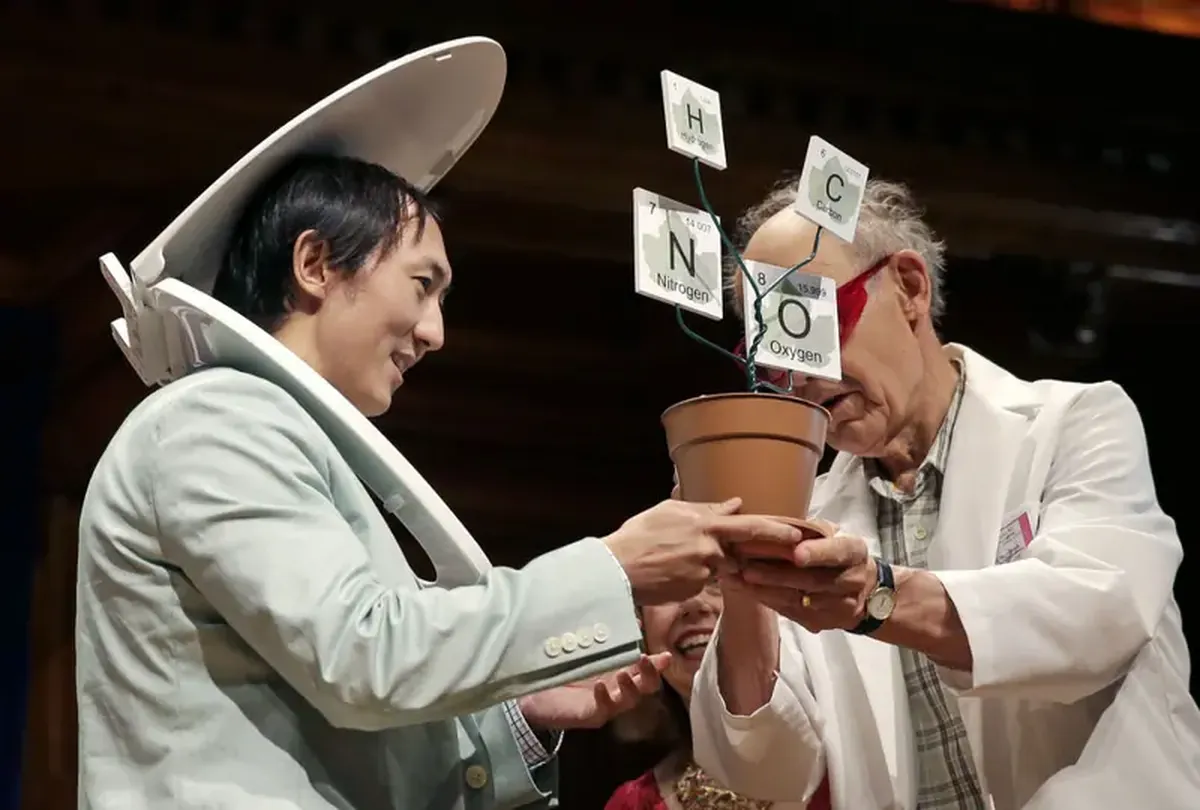
Each September, ten Ig Nobel Prizes are handed out for unusual, humorous research that sparks public interest in science, medicine, and technology. The prize itself is largely symbolic—officially worth 10 trillion Zimbabwean dollars or, jokingly, $10 U.S.—but the ceremony is theatrical: real Nobel laureates take part at Harvard University’s Sanders Theatre. Physicist Roy Glauber even served as the event’s “keeper of the broom.” In 2005 he couldn’t carry out that duty because he missed the ceremony after winning his own Nobel Prize that year.

Moment of Fame
Winners receive a statuette that looks like movable jaws on a pedestal, a foil medal, and a certificate signed by three Nobel laureates. The ceremony is broadcast live on television, radio, and the prize’s official website. Laureates get one minute at the microphone to explain their work; speakers who run on too long are playfully shushed offstage by a bored child in the audience. Afterward, winners can give fuller talks about their research in special lectures at the Massachusetts Institute of Technology.

Because the Ig Nobel can be read as criticism, organizers were once asked not to give the prize to British scientists, who already get a lot of joking attention. In 1995, Robert May, then the British government’s chief scientific adviser, warned that the American prize could harm Britain’s scientific reputation. Scientists themselves didn’t ask for special protection, though. In fact, some Ig Nobel winners have also been associated with mainstream scientific honors. One example: Bart Knols received an Ig Nobel in the “individual” category for finding that female malaria mosquitoes are equally attracted to the smells of cheese and human feet.
Deliberately Uninventive
During the COVID‑19 pandemic, several world leaders were singled out as Ig Nobel laureates for their “anti‑achievements,” including Boris Johnson, Donald Trump, Recep Tayyip Erdoğan, Jair Bolsonaro, Andrés Manuel López Obrador, Gurbanguly Berdimuhamedow, Vladimir Putin, and Alexander Lukashenko (who received the prize twice). The “Management” Ig Nobel went to five Chinese contract killers who hired each other for hits, each time lowering their fee until the contract was never carried out. But most Ig Nobels honor authors of real scientific papers: examples include studies showing that dogs tend to relieve themselves facing south, that the presence of people sexually arouses ostriches, that black holes could theoretically house Hell, and that falling asleep on “lying policemen” (speed bumps) can be used to diagnose acute appendicitis.

Past laureates have included two co‑authors who deliberately investigated the most painful spots of wasp stings on themselves, and a duo who used modern probability analysis to estimate the chance that the Moroccan Sultan Ismail the Bloodthirsty fathered 888 children. Other winners studied how constipation affects scorpion mating, the nature of boredom among teachers and students, optimal finger positioning for turning a doorknob, ritual enemas depicted on ancient Mayan pottery, how ducklings manage to swim in formation, and an algorithm describing how gossip mixes truth and fiction. Last year’s winners looked at what people feel when repeating the word “many” many times, whether the amount of hair in both nostrils is the same, and why some scientists enjoy licking stones.

What Researchers Studied
The Ig Nobel has honored a mathematical explanation for why success can be a result of luck rather than talent, research suggesting that officials’ excess weight correlates with higher bribe offers, experiments showing that a beard can protect the jaw from fractures, and methods for identifying a narcissistic personality by eyebrow features. Laureates have measured temperature differences in the genitals of clothed and unclothed postal workers, traced correlations between passionate kissing and income inequality, measured the amount of saliva in infants, and even built a machine to replace used diapers. Researchers have investigated which body parts are most pleasant to scratch, why some feces are cubic, and how riding roller coasters can help treat bronchial asthma or quickly expel kidney stones.

The Ig Nobel in the “Healthy Eating” category went to scientists from Zimbabwe, Tanzania, and Great Britain who studied the poor nutritional value of a diet based on cannibalism. Prizes in the “Reproduction” category have honored work on how synthetic underwear materials affect arousal and fertility and a quirky method for detecting nocturnal erections using postage stamps. Winners in “Biology” included researchers who found insects in which females have male reproductive organs and males have female organs. In the “World” category, past winners have included the inventor of karaoke (for promoting tolerance) and researchers who argued that plants have dignity and that coarse language can reduce pain.
P.S. Each ceremony traditionally ends with a wish for success next time—for those who didn’t win the Ig Nobel and especially for those who did. Soon we’ll find out who luck will smile on this year (or, more accurately, who luck will play a joke on).
