
 Carlos Solis
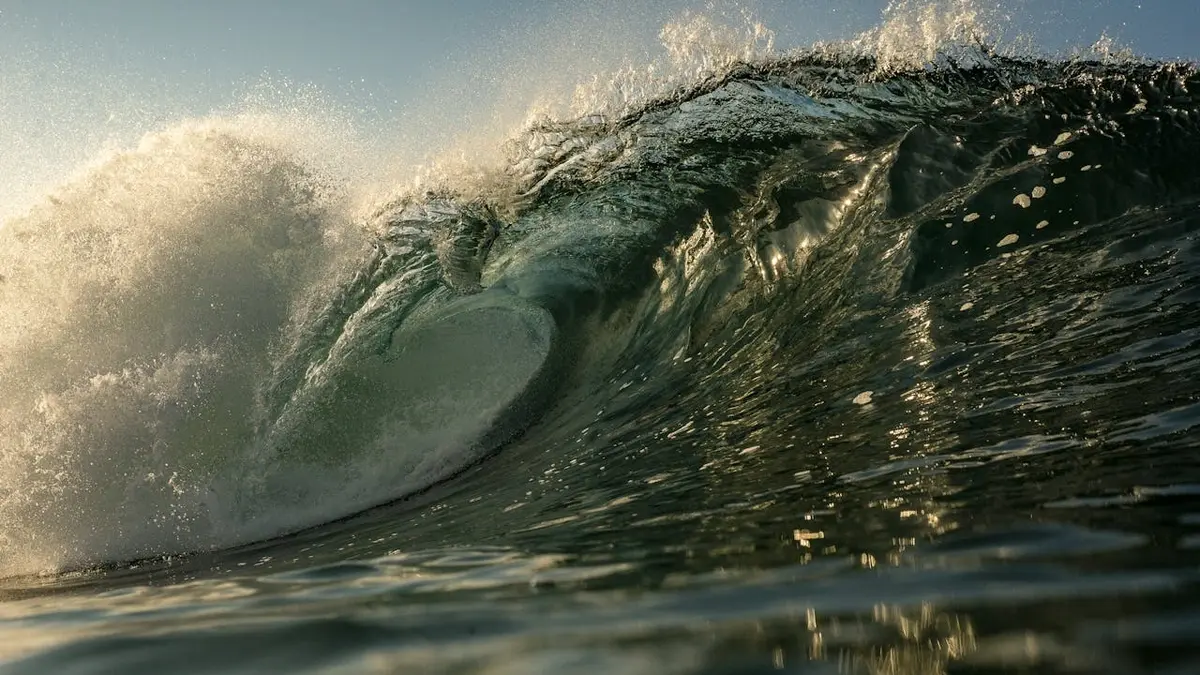 These isolated waves, towering at 20 meters (or more), suddenly appear in the open ocean. They exist for a brief moment, typically less than a minute, before vanishing. Due to their height and power, they pose a significant threat to vessels.
An international team led by Francesco Fedele at the Georgia Institute of Technology ran a unique study to learn what killer waves are and what causes them. Over 18 years, researchers analyzed high-frequency laser measurement data from the Ecofisk oil platform in the central North Sea. Ultimately, the team concluded that killer waves are not random. They follow the natural laws of the sea and are not mysterious — they’re quite straightforward.
How Was the Research Conducted?
The scientists examined roughly 27,500 half-hour recordings of sea state collected between 2003 and 2020. Each recording tracked how high the sea surface rose above the average sea level, including during major storms.
Under normal conditions, waves arise when wind blows across the sea surface. It’s similar to blowing on a cup of coffee and creating small ripples. Given enough time and space, those ripples can grow into much larger waves.
The team focused on why waves suddenly become anomalous and rise much higher than neighboring waves. One theory invokes modulation instability. When waves are confined in a narrow channel, modulation instability describes their behavior well. But the theory breaks down for the open ocean, where waves can propagate in many directions.
To grasp the difference, imagine a crowd leaving a stadium after a football match. If people must exit through a long, narrow corridor with high walls, they all move in the same direction, the flow bottlenecks, and some people get shoved forward. That catastrophic jam resembles a killer wave caused by limited space, as explained by Science Alert.
Researchers can generate killer waves in a confined laboratory channel, where the waves obey modulation instability. Without channel confinement, however, killer waves usually don’t follow that theory and don’t form the same way in open water.

What Is Constructive Interference?
Using statistical methods, the scientists searched the sea state data for patterns behind these rare events. The results showed that extreme waves are more likely to form not because of modulation instability but because of constructive interference.
Constructive interference happens when two or more waves line up and add together to form one larger wave. The effect is amplified by the natural asymmetry of sea waves: crests tend to be sharper and steeper than the troughs are flat.
Killer waves emerge when many smaller waves line up and their steeper crests overlap. Those overlapping crests can combine into a single massive wave that towers above the surrounding water for a brief moment.
These waves rise and fall in less than a minute, following a quasi-deterministic pattern in space and time. As a wave gains height and energy, it reaches a point of no return: the crest spills over, the wave breaks into foam, and excess energy dissipates.
What Does Quasi-Determinism of Waves Have to Do With It?
Killer waves are not unique to the ocean. The quasi-determinism of waves, a theory developed by oceanographer Paolo Boccotti, explains how extreme waves form both in the ocean and in other wave systems.
The team applied Boccotti’s theory to the North Sea recordings. The giant waves in those records carried a distinct signature of a group of waves, which helped explain how rogue waves emerge.
The researchers examined a storm on November 24, 2023, when a camera on the Ecofisk platform recorded a 17-meter killer wave. They used Boccotti’s theory and an artificial intelligence model to trace the origins of that extreme wave, which formed as many smaller waves repeatedly overlapped.
Understanding how killer waves form can help engineers design safer ships and offshore platforms and improve risk predictions.
The study’s findings were published in the journal Nature Scientific Reports.
Photo: pexels.com
