
 Carlos Solis
One of the most striking examples is an ancient relative of modern dragonflies, Meganisoptera—commonly called griffenflies. The insect, about half a meter long with a 70-centimeter wingspan, lived on our planet 300 million years ago.
For decades, scientists assumed that these giant predators of the Paleozoic sky owed their size to the high oxygen content of the atmosphere at the time. But a recent study by paleontologist Edward Snelling’s team at the University of Pretoria (South Africa) cast doubt on that idea. The researchers published their results in the journal Nature.
Why scientists blamed oxygen for giant prehistoric insects
In the 1990s, scientists thought that the higher oxygen demands of larger insects—and their bigger bodies—required a more oxygen-rich atmosphere.
That made sense because insects get oxygen through a tracheal system: a branched, tree-like network of respiratory tubes that end in tracheoles. Those tracheoles deliver oxygen to the flight muscle cells by diffusion.
Researchers argued that giant griffenflies couldn’t exist today because modern atmospheric oxygen levels are nearly half of what they were in the Paleozoic.
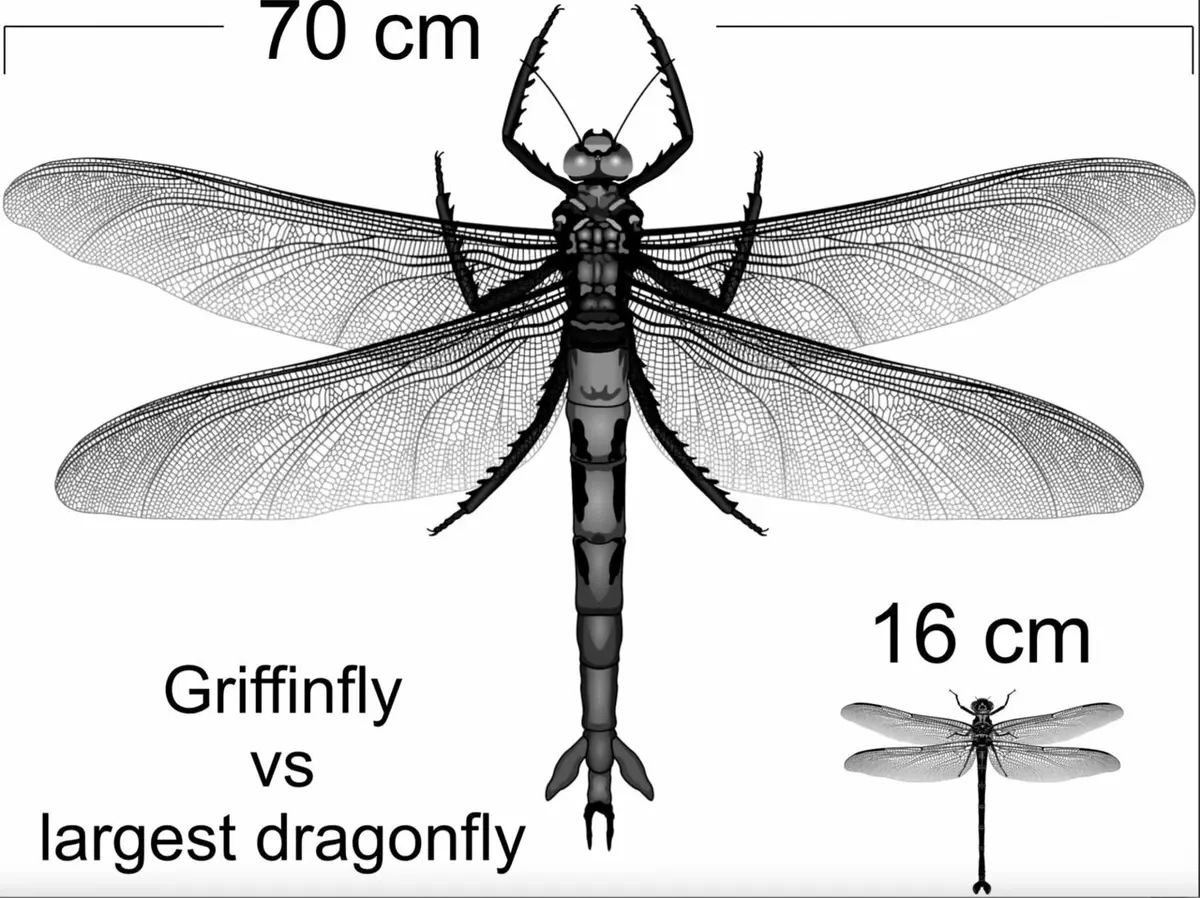
How Snelling’s team challenged the oxygen explanation
Dr. Snelling and his colleagues used high-resolution electron microscopy to assess how body size affects the number of tracheoles in insect flight muscles.
They found that tracheoles made up only about 1 percent—or even less—of those muscles. So the team concluded that flight muscles were not limited by atmospheric oxygen levels because tracheoles occupy very little space and many more could be added.
“For comparison, capillaries in the heart muscle of birds and mammals take up roughly ten times more space than tracheoles do in insect flight muscles, so evolution has enormous scope to invest more in tracheoles if oxygen transport really limits body size,” said Professor Roger Seymour, a co-author of the study.
So the theory that insects became smaller because of low atmospheric oxygen needs to be rethought. Paleontologists will have to look for other reasons why those prehistoric giant dragonflies are absent from Earth today.
One leading alternative is that insects were unable to compete with modern vertebrate aerial predators.
