
A team of Indian scientists has unveiled a study on the behavior of wild Adélie penguins that suggests the birds may have a degree of self-awareness. Researchers Prabir Ghosh Dasthidar, Azisuddin Khan, and Anindya Sinha published their findings on the bioRxiv preprint server. Previous work has found self-awareness in only a handful of mammals, birds, and fish, and testing self-awareness in animals is much harder than in humans. Scientists often use the mirror test: an animal sees itself in a mirror while researchers watch. Typically the animal is marked with a colored sticker; if the animal tries to remove the sticker, scientists infer it recognizes its reflection. Certain behaviors in the test indicate self-recognition: the subject notices something in the mirror that relates to itself and reacts.
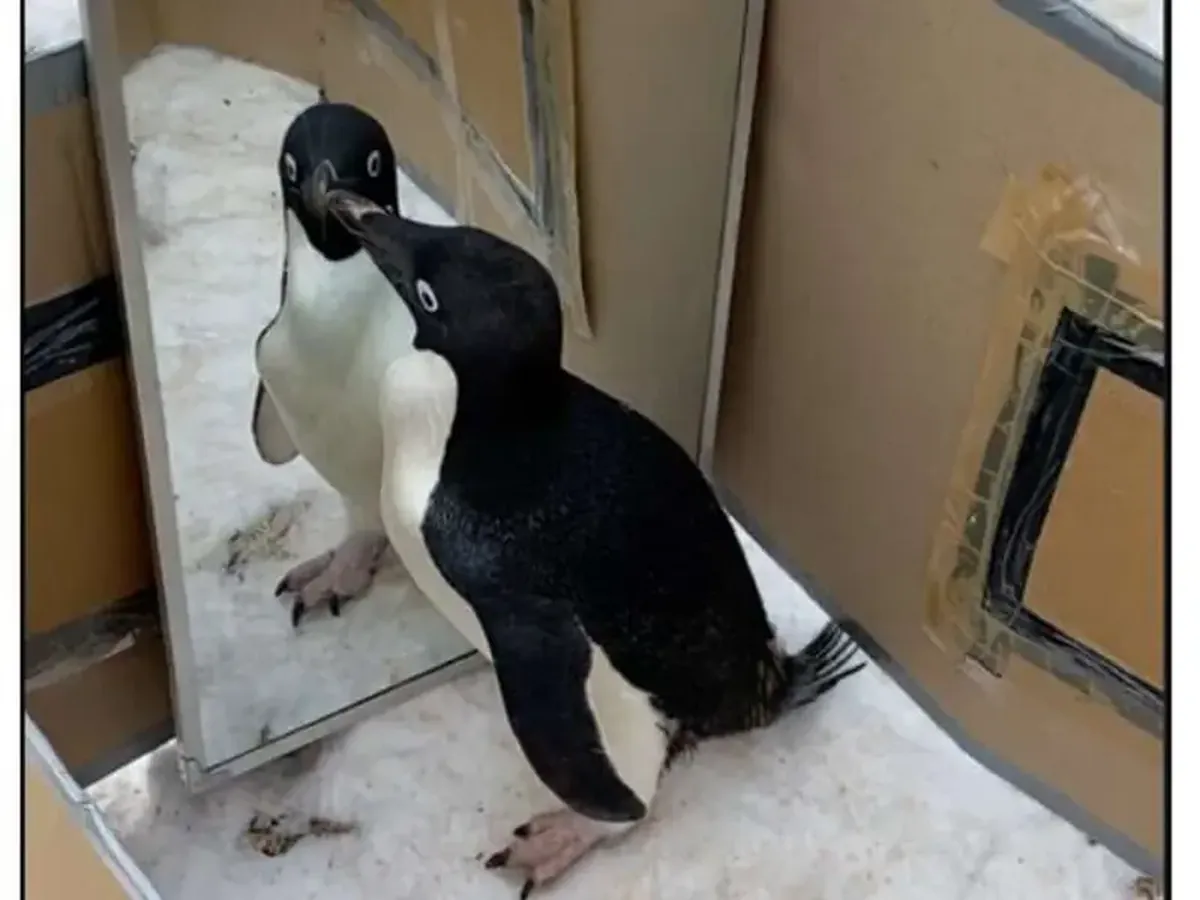
In their new study, the scientists asked whether wild Adélie penguins are self-aware. To find out, they traveled to Swinner Island in eastern Antarctica and watched how the birds responded to mirrors. In the first phase, the team placed several mirrors on the ground near the penguins and observed their reactions. In the second phase, they built a cardboard enclosure to guide birds toward the mirrors. In the third phase, the researchers placed small stickers depicting penguins on the mirror surfaces. In the fourth phase, the scientists outfitted birds that looked into the mirror with vests. During the first phase, the researchers did not observe strong emotional reactions. Many animals fail the mirror test and often treat their reflection as another animal. In the second phase, the penguins became more active. They appeared to inspect themselves and showed agitation when looking at mirrors with stickers, even trying to remove them. However, they showed no reaction to their reflections while wearing the vests. The researchers describe the results as ambiguous, but taken together the observations suggest the penguins display some signs of self-awareness. The team plans to continue the research.
The study included researchers from the Ministry of Earth Sciences of the Government of India, the Indian Institute of Technology Bombay, and the Indian National Institute of Advanced Studies. The Adélie penguin (Pygoscelis adeliae) lives along the Antarctic coast and on nearby islands. It is one of the southernmost and most common penguin species. The species is named for Adélie, the wife of French explorer Jules Dumont d’Urville. These flightless birds reach about 70 cm in length and weigh around 6 kg. They feed mainly on krill and fish. Polar explorers call them “adelies.” In 2018, satellites found the largest colony of Adélie penguins on the northern Antarctic Peninsula, totaling about 1.5 million birds.
