
 Gaby
Gaby
He’s often called the genius of an era that bridged medieval Europe and the modern Western world. Painting, sculpture, architecture, invention, anatomy, music, and literature all intertwined in the work of this most famous Renaissance figure—a man who leapt far into the future.
Biography and Interesting Facts About Leonardo da Vinci
The future genius was born on April 15, 1452, near Florence in the small town of Vinci. His father, Piero, a wealthy notary, never married the boy’s mother, who was a peasant. When Leonardo was three, his father officially acknowledged him and brought him into the household; Piero’s lawful wife had not had children.
Soon after, the young Leonardo began learning a range of crafts in the workshop of Andrea Verrocchio, where his father had placed him. There, he learned to paint, sculpt, tan leather, work with metals, and study various sciences. Verrocchio recognized Leonardo’s exceptional talent and, after his training, retained him in the workshop.
In 1482, the young man went to Milan to work for Duke Ludovico Sforza, who needed military defenses and devices to entertain his court. Leonardo excelled at those commissions and earned the duke’s favor. He spent many years working there. During this period he produced paintings, sculptures, and numerous anatomical studies, and he sketched machines meant to travel on land, swim underwater, and fly.

The house where Leonardo lived as a child
Eventually he returned to Florence and later spent time at the court of Cesare Borgia, serving there for seven years while Borgia pursued war machines for his campaigns.
In later years Leonardo lived in Milan again. By then he had already painted the world-renowned “Mona Lisa.” After a six-year stay in Milan he moved to Rome, where he continued to paint, write scientific treatises, and develop various devices.
Three years before his death, Leonardo moved to France, accompanied by his talented student Francesco Melzi.
The great Florentine died on May 2, 1519, at age 67. Historians believe he likely suffered a stroke: in his final years da Vinci was partially paralyzed and relied on his student Francesco for care.
According to his will, Leonardo was buried in the Church of Saint-Florentin. During the Huguenot Wars the church and grave were destroyed, and five centuries later scholars are still trying to identify his remains.

The Death of Leonardo da Vinci. Joseph-Théodore Rhigom after Jean-Auguste-Dominique Ingres, (circa 1825)
Scholars from many fields study each of his works. Many people think Leonardo embedded a kind of graphic code in his paintings. The mystery of the Mona Lisa’s smile has puzzled observers for centuries. To date, about 570 pages of his notebooks have been digitized. Books and films continue to explore his life and work, and his sayings still resonate today.
Short Interesting Facts About Da Vinci’s Life
- He did not have a surname – “da Vinci” simply means “from Vinci”;
- Leonardo had little formal education – he taught himself Latin and only began studying mathematics after the age of 30;
- He painted very few works – despite his fame, only 17 paintings are definitively attributed to him today;
- His first painting was created at the age of 15;
- His anatomical drawings still have scientific value;
- During his lifetime, da Vinci kept many notebooks, one of which is now owned by Bill Gates;
- The artist was ambidextrous, using both his left and right hands skillfully;
- All entries in his notebooks were written in mirror script, from right to left.
Leonardo da Vinci: Timeless Paintings
Leonardo began practicing as an artist at about age 20. After joining the artists’ guild in Florence, he ran his own studio by 1476. At that time he didn’t focus solely on painting, and some works were lost. Those that survived are regarded as masterpieces. Many myths surround his art, and some people believe his paintings contain a graphic code that has puzzled art historians for generations.
The power of the Florentine’s creativity can be seen in Dmitry Merezhkovsky’s book “The Resurrected Gods: Leonardo da Vinci,” published in a religious magazine in 1900. The most famous paintings from his legacy include:
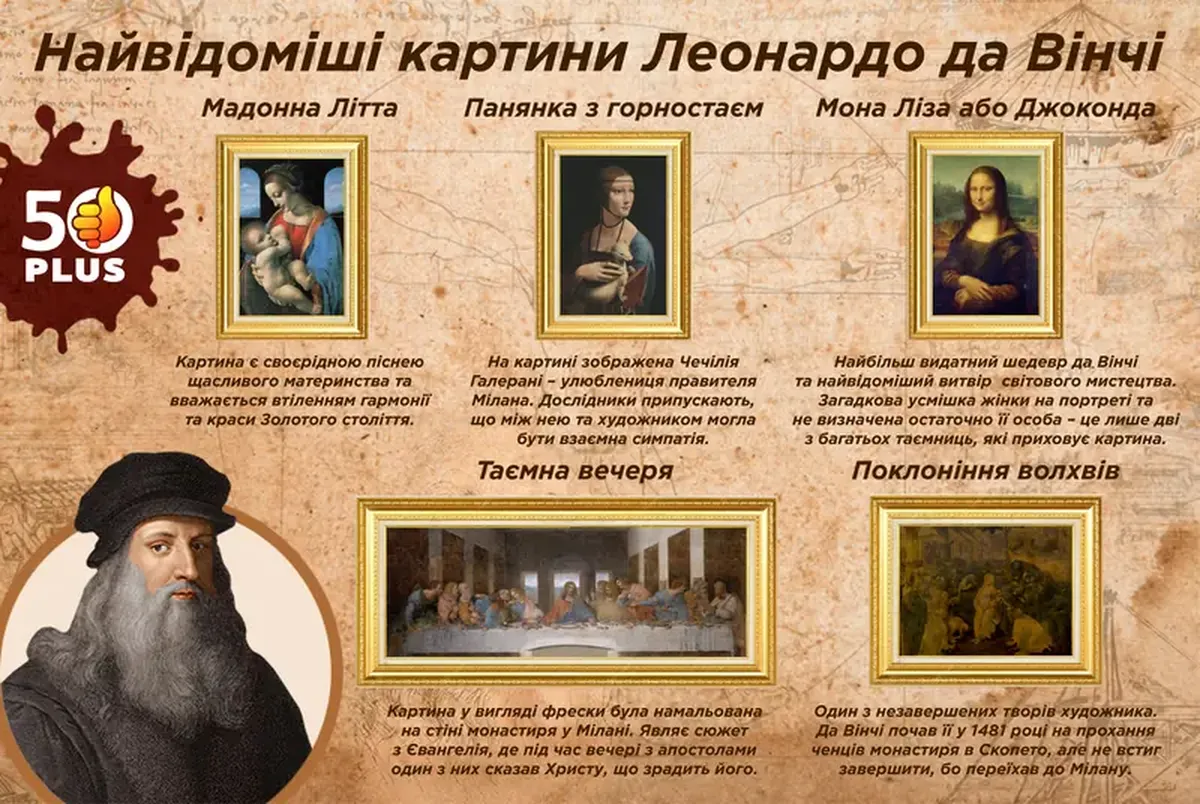
- The Virgin Mary – Leonardo refused to follow the canonical depictions of Mary. His “Madonna Benois” and “Madonna Litta” celebrate joyful motherhood and include details that reveal aspects of daily life for women of the period.
- “Lady with an Ermine” – an extraordinarily beautiful portrait created at the Milanese court, depicting Cecilia Gallerani, the duke’s favorite. Researchers point to complex symbolism in the painting and suggest there may have been mutual affection between the sitter and the artist.
- “The Last Supper” – a fresco on a monastery wall in Milan showing the Gospel scene in which Jesus announces that one of the apostles will betray him. The painting has undergone numerous restorations.
- “The Adoration of the Magi” – an unfinished work begun in 1481 at the request of a monastery in Scopeto. Leonardo left it incomplete when he moved to Milan.
- “Mona Lisa” – also known as “La Gioconda,” this portrait’s smile is considered one of the great mysteries of the Renaissance. The sitter’s identity attracted many theories, and researchers concluded in 2005 that the portrait depicts Lisa Gherardini, the wife of a Florentine merchant. Today this and other portraits by Leonardo hang in the Louvre behind bulletproof glass.
Other renowned works span different periods of his career: “The Annunciation” from his early years and the late-period “Saint John the Baptist” are well known. The painting “Salvator Mundi” was lost for a long time.
The Man Behind the Genius: The Theme of Proportions
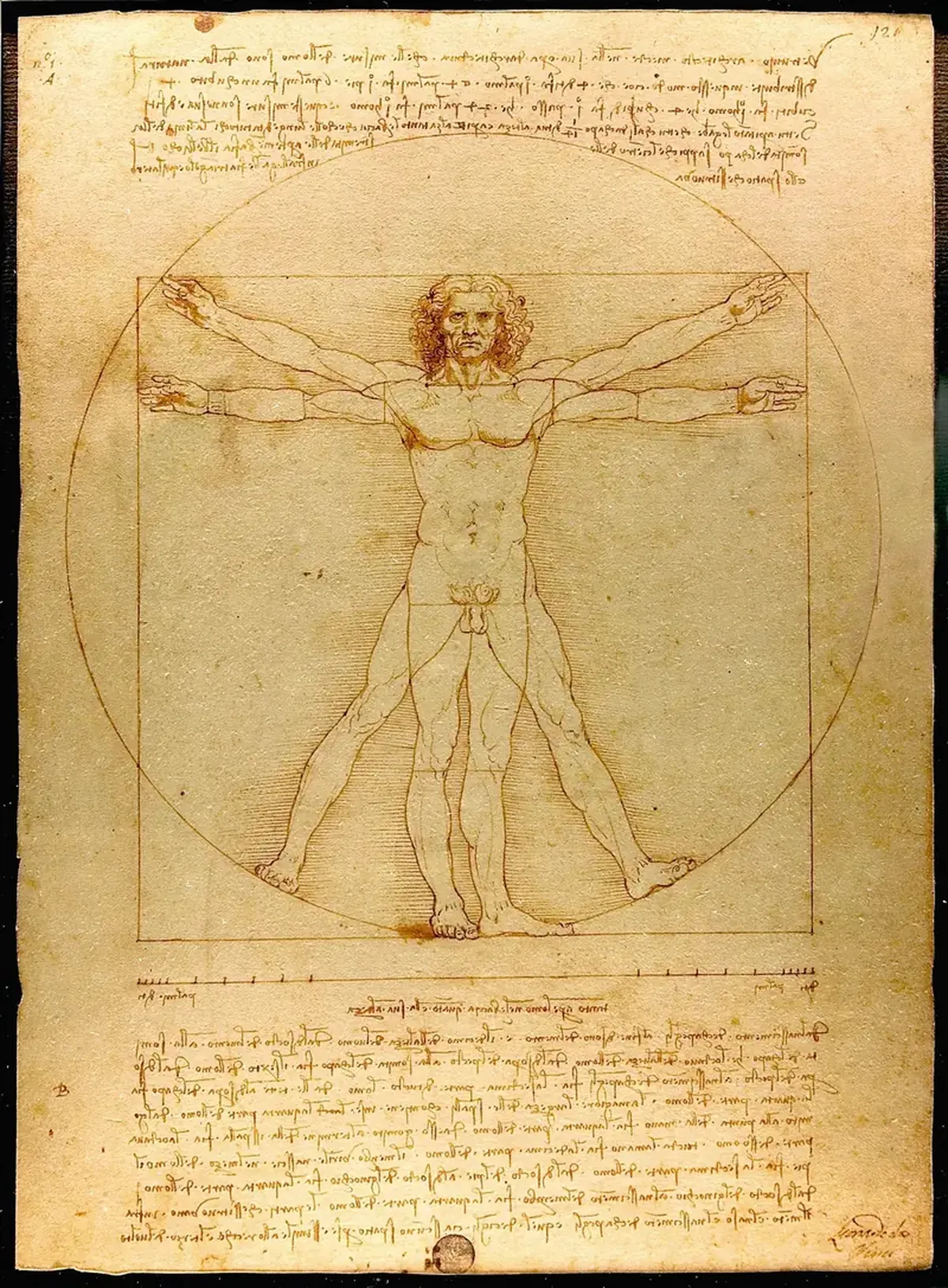
Original drawings by da Vinci, rendered by hand in ink and pencil, have also survived. The most famous is the “Vitruvian Man,” an illustration linked to the writings of the Roman architect Vitruvius. It shows a man positioned inside a circle and a square.
It is one of the most recognized studies of mathematical proportions in human anatomy. Leonardo explored the relationship between the whole and its parts, seeking a harmonious balance in proportion.
At the same time, the drawing is a masterpiece of art and is often used as a universal symbol of human anatomical symmetry and the broader order of the universe.
Inventions of Leonardo da Vinci
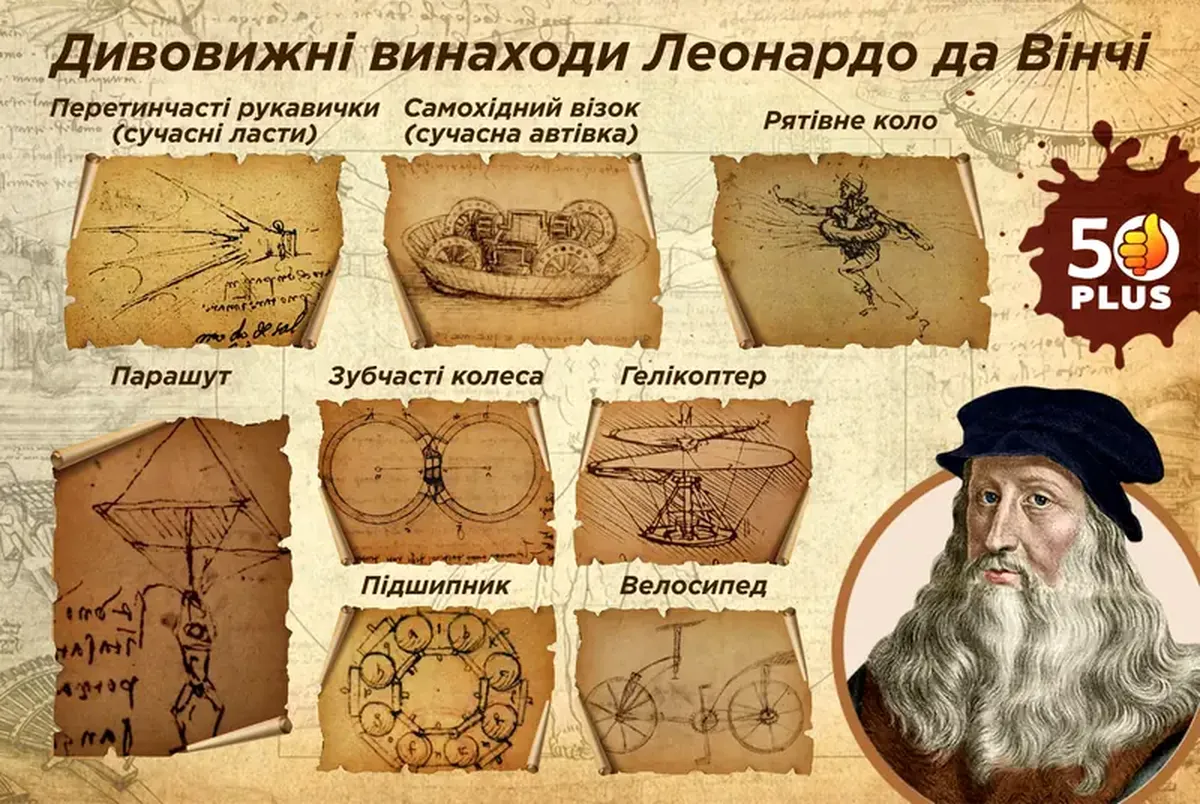
Art was only one arena where Leonardo made a lasting mark. He was also an engineer, experimenter, and inventor. His scientific legacy is remarkably broad, as the following facts show:
- He designed plans for a metallurgical furnace and a rolling mill;
- He sketched concepts for a submarine, a multi-barrel gun, a parachute, a helicopter, and a bicycle;
- His flying-machine ideas were based on observations of bird flight;
- He offered early scientific explanations for why the Moon shines and why the sky appears blue.
His drawings of an early two-lens telescope display surprising precision. He was also sought after as a military engineer: designs for portable bridges, wheel-lock mechanisms for pistols, and catapults come from his notebooks, and he envisioned an armored vehicle that resembles an early tank.
He worked on urban planning and land-reclamation projects as well. He proposed canal and drainage works, and some later engineers referenced his ideas.
Leonardo sketched a diving suit and created a mechanical lion in the early 16th century as a theatrical automaton to present as a gift. His achievements inspired later innovators: an advanced surgical system was named after him, and the so-called da Vinci surgical robot is now used in hospitals around the world.
Sculptures of Leonardo da Vinci
Alongside painting and science, Leonardo studied sculpture with his first teacher. He created numerous statues for Duke Ludovico Sforza’s park in his youth, but none of those large works survived. The only piece confidently linked to him is a small wax model of a horse and rider.
That statuette included a figure of a Renaissance warrior and measured about 30.5 cm in height and length. Judging by its size and the animal’s pose, it likely was intended as part of a larger composition. Leonardo did not live to see that idea cast in metal, and after his death the model disappeared. The original resurfaced and became publicly known only in the 19th century.
Leonardo was very much a son of his time who far outpaced it. His ideas and inventions foreshadowed later advances, and that legacy remains one of the clearest proofs of his genius.
