
 Gaby
Gaby
Mozart was a virtuoso pianist who performed for roughly 30 years but died at 35. By the age of 20 he had already become one of the most celebrated composers in Europe, acclaimed across virtually every musical genre of his day. Imagine how much more he might have added to the world’s music if he’d spent his short life composing instead of constantly hunting for patrons.
“A Miracle from God”
Of seven children in his family, only two survived. The birth of a son on January 27, 1756, nearly cost his mother her life, and the newborn was so frail he was baptized on the second day. His father gave the baby names that meant “beloved of God”—Theophilus in Greek and Amadeus in Latin—one honoring his grandfather, the other marking his baptism.
The son of a violinist and composer in the court chapel of the Archbishopric of Salzburg, Wolfgang Amadeus Mozart (1756–1791) was indeed regarded as prodigiously gifted. Left-handed and precocious, he learned to read and write music before he could distinguish letters. He had such keen hearing that trumpets sometimes caused him physical discomfort. By age three he could play the clavier and harpsichord; at four he taught himself the violin by watching his older sister’s exercises and played his part flawlessly in the family string trio. By five he performed on keyboard and strings with professional skill, and by six he was touring Europe with his sister, playing for nobility and royalty.

Father teaching young Wolfgang to play the piano. Artist: Ebenezer Crawford (19th century)
This extraordinary talent cost him a normal childhood: his early years were consumed by a grueling concert schedule, long performances, and constant meetings with potential patrons. During an extensive tour he contracted scarlet fever, then smallpox—which left unsightly scars on his pale face—and later fell ill with typhoid fever after his sister. Doctors later suggested that the strain of touring worsened his naturally frail health and may have turned acute infections into chronic problems, hastening his early death.
Music Without Borders
Leopold Mozart even took a three-year leave from his job with the archbishop to accompany his son and daughter, but the tours stretched on for years. The archbishop eventually fired Leopold, saying, “Let him go; I no longer need him.”
Their first major tour visited Vienna (where, decades later, Ludwig van Beethoven would die; Mozart reportedly said in 1787, “Everyone will talk about this young man!”), Munich, Linz, Pressburg (Bratislava), Paris, London, The Hague, Lyon, Geneva, and Brno. Leopold’s plan was to introduce influential people to his virtuoso son to promote him as a composer.
The boy astonished audiences with feats no one had seen before: playing music backward from memory, performing with the keys covered and his eyes closed, playing while turned away from the instrument, and even lying on the bench while he played.
At 13, after hearing Gregorio Allegri’s Miserere in the Sistine Chapel, Mozart reproduced the Vatican’s closely guarded version from memory. With phenomenal hearing, an extraordinary memory, and dazzling improvisational skill, he was a “world star” from childhood. By 14 he was the youngest member of the Bologna Philharmonic Academy and a knight of the Order of the Golden Spur.
Half of his symphonies were written between the ages of 8 and 19. Yet he had no formal schooling in the usual sense: his father taught him nearly everything. Besides musical notation, Mozart picked up many languages—German, English, Italian, Spanish, French, Polish, Bohemian (Czech), Dutch, Russian, Turkish, and even Ancient Greek, Latin, and Biblical Hebrew. That facility made travel and work outside his homeland easier: he spent about half his life—14 of 35 years—outside Austria.
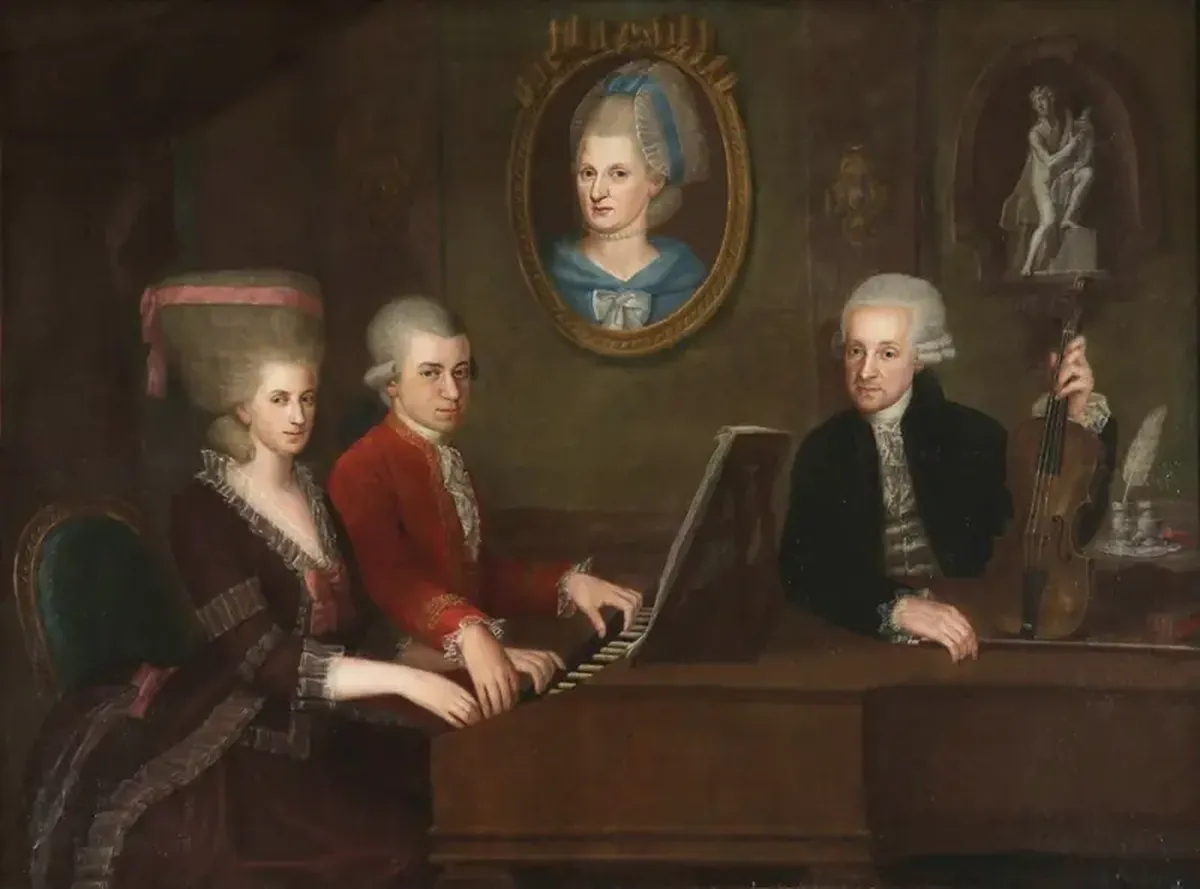
The Mozart family. On the wall – a portrait of the mother. Artist: Johann Nepomuk della Croce, 1780.
Horse, Bowling, Minuet
Unlike his sister, who stopped performing after she married, Wolfgang Amadeus continued to play and conduct. At the height of his fame he had no shortage of students and fees. Income from published works and concert subscriptions let him rent expensive housing and keep staff—a maid, a cook, and a hairdresser. He owned a luxurious piano, a billiard table, and his own carriage. His pets included a horse, a dog, a starling, and a canary.
He liked horseback rides in the park, played bowling, danced the minuet well, and sang confidently. He once wanted to marry an opera singer—the daughter of a double bassist with whom he lodged—but she married someone else, and Mozart instead married her younger sister.
In his marriage to Constanze Weber, daughter of a theater double bassist, six children were born in eight years but four infants died, including those named after Mozart’s parents. Leopold Mozart disapproved of the marriage and never gave his consent. The two surviving sons, Karl Thomas and Franz Xaver, became musicians but never married and did not continue the Mozart line. Mozart paid for his elder son’s schooling in Perchtoldsdorf, while his younger son was raised by Constanze alone; she remarried only 18 years later.

Wolfgang and Constanze. 19th-century postcard.
In his efforts to get his music staged, Mozart wrote individual arias for colleagues’ operas and eventually won an imperial commission of his own. The Marriage of Figaro was not warmly received by some in Vienna, but Prague embraced it. After that triumph the emperor offered him a post as imperial musician—vacant after his predecessor’s death—to write masquerade and dance music for 800 florins a year. It was the last real bit of good news in his career.

The theater in Prague, where the world premieres of the operas “Don Giovanni” and “La Clemenza di Tito” took place.
From Major to Minor
Beginning in 1787 the number of his public “academies” declined, and by the next year they had disappeared for lack of subscribers. His finances began to suffer, partly because Vienna rejected his opera Don Giovanni. Two moves to cheaper housing, including to the suburbs, signaled growing trouble. The situation worsened when a newborn daughter died and Constanze fell ill; doctors prescribed a stay at a spa for her recovery. Constanze would live to 80 and eventually be buried beside Mozart’s father—who, during his lifetime, never reconciled with his daughter-in-law.
Mozart sent bitter pleas for help to a wealthy friend and fellow Mason. In the summer of 1788, in just a year and a half, he wrote three of his greatest symphonies—the 39th, 40th, and 41st—but they brought him little money because timely performances could not be arranged. By the end of that year he was arranging other composers’ works for home performances at the request of his patron Baron van Swieten. Mozart was buried in a common grave without a marked name, which made it impossible to locate his remains seven years after the burial.
After Emperor Joseph II died in 1790, Mozart applied to the new monarch Leopold II for the post of second Kapellmeister (deputy to Antonio Salieri), emphasizing his experience with sacred music, but he received no reply. Later he asked for an unpaid assistant post to the gravely ill Kapellmeister of St. Stephen’s Cathedral, hoping eventually to take the position, but the ailing Kapellmeister outlived him.
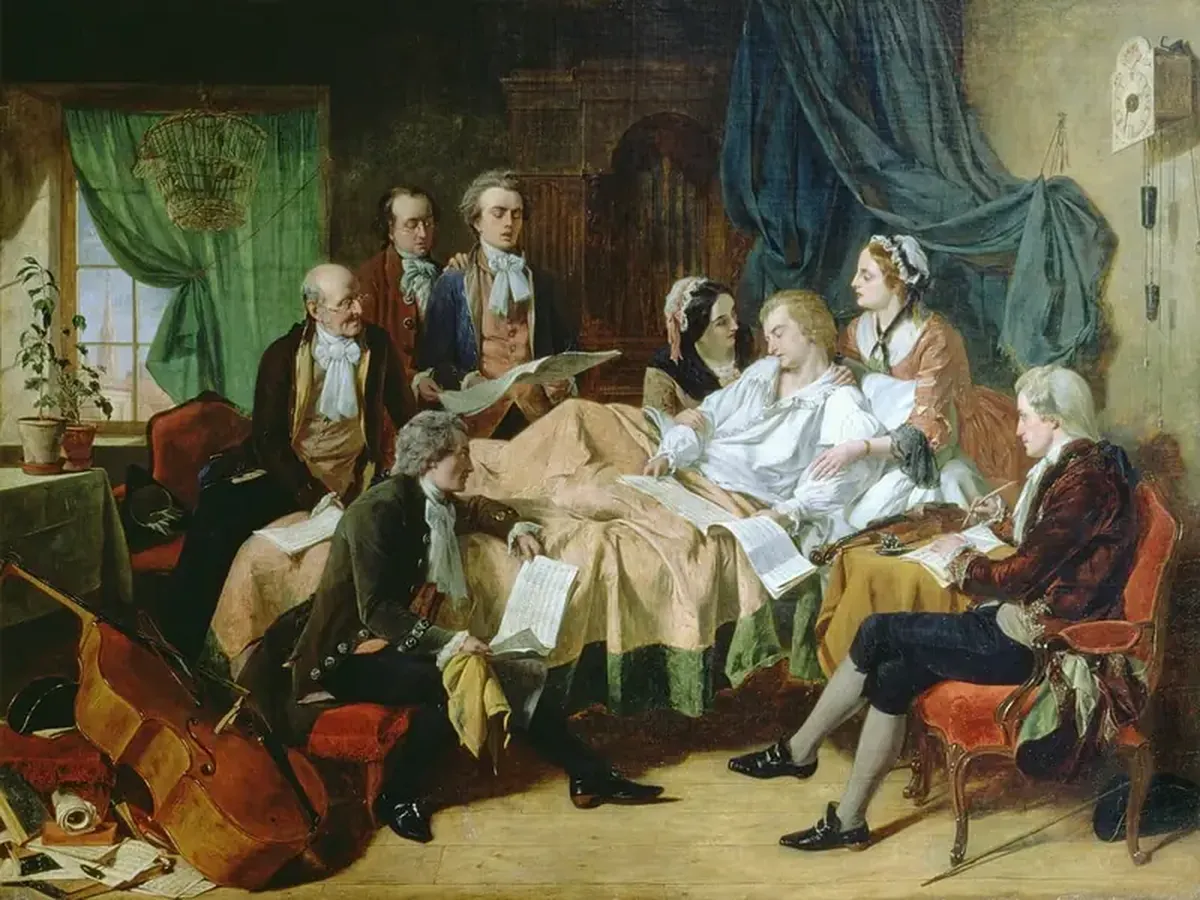
“The Last Hours of Mozart,” painting by H. N. O’Neil, 1860s.
By the end of his life Austria’s celebrated composer had only two students left. Mozart wasn’t invited to perform for King Ferdinand or at Leopold II’s coronation, which he found humiliating. In the fall he toured Frankfurt am Main and on the way back performed in Mainz, Mannheim, and Munich. During this time Constanze was moving their household to a new address; she soon found herself alone with their two sons and her late husband’s debts. On December 5, 1791, Wolfgang Amadeus Mozart died.
