
 Gaby
Gaby
A biography of the remarkable sculptor, painter, architect, thinker, and poet was published during his lifetime—an unprecedented move in Western European art. Alongside his masterpieces, documentary evidence of his 89-year life and creativity survives: sketches, contracts, contemporary reviews, and both personal and professional letters. Yet even five centuries later, the titan of the High Renaissance (1475–1564) remains an enigma.
The Phenomenon of Michelangelo
Debates continue not only about his immortal works but also about the personality of their creator. The artist, famous for some of the most recognizable masterpieces on the planet, earned contemporary renown for the uncanny realism with which he depicted the human body: beyond technical mastery, his genius brought spiritual intensity to his art. Everything touched by his chisel, brush, or pen shows the imprint of his thought and humanistic worldview. Goethe wrote, “With his all-encompassing vision, Michelangelo surpassed nature itself.” Giorgio Vasari and Ascanio Condivi described his talent as seeming to be “sent to Earth by the Almighty as a model of perfection in the visual arts; combined with his poetic gift, he appeared more like a celestial creator than a terrestrial one.”

A fragment of the fresco “The Flood,” located on the ceiling of the Sistine Chapel
The colossal power of his works makes it hard to believe they could have been made by an ordinary mortal. It is difficult to picture a physically frail, solitary creator—afflicted by hand arthritis and other ailments—producing multi-ton sculptures and gigantic frescoes. In sonnets he confessed that his “body is made of rags,” and he even referenced his ailments in his refined poetry. Deteriorating health and recurring anguish became the price Michelangelo paid for his creative obsession. Despite earning substantial sums (he began receiving tomb commissions from high nobility at a young age), the perfectionist and workaholic lived in solitude and practiced ascetic habits. In his reflections he said he “lived the life of a poor man: with minimal food, wine, and sleep.”
By Himself
Isolation and estrangement were necessary for the artist to focus his creative energy. That solitary intensity links him, in a conceptual sense, with loners like Copernicus, Galileo, Kant, and Newton; some biographers compare that drive to the Greek autos, meaning “self” or “by oneself.”
Because of his personal modesty, the master avoided official self-portraits and hid his likeness inside other subjects. The most famous secret self-portrait is the face of Saint Bartholomew in the fresco “The Last Judgment” (1541) in the Sistine Chapel. Michelangelo also inserted himself among the crowd in “The Crucifixion of Saint Peter.”
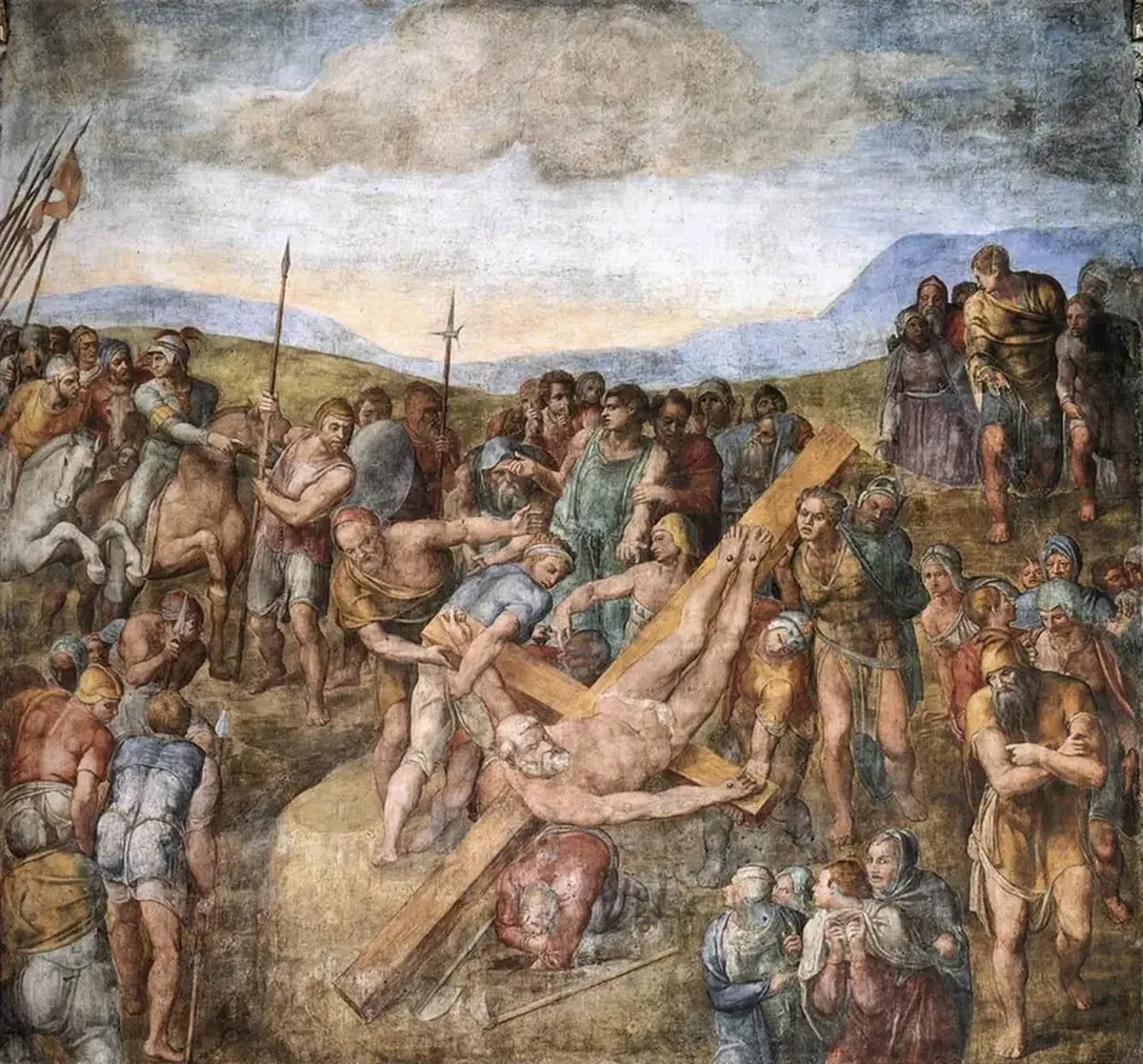
“The Crucifixion of Saint Peter,” 1546-1550
Some art historians believe that his works contain more than hidden self-portraits; they argue the images also encode people close to him. For example, in the sculptural composition “Florentine Pietà,” which Michelangelo envisioned as his personal tombstone, he appears to have given his face to the figure of Nicodemus. Art historians have also read hidden meanings into figures in “The Meeting of Jesus Christ with Saint Veronica on the Way to Golgotha,” the painting in the altar of the Buonarroti family next to the sculptor’s tomb complex by Giorgio Vasari. One figure is identified as Michelangelo—unmasked in the guise of Nicodemus by curly hair, a distinctive beard, and a broken nose—while the neighboring figure is his fellow artist Giovanni de’ Jacopo (1494–1540), nicknamed Rosso Fiorentino. Vasari’s biography of his teacher also noted the close relationship between the master and the “Red Florentine.”

“Florentine Pietà,” 1547-1555
Only once did the supposed “woman-hater” appear in a friendly exchange with a member of the opposite sex: his poignant verse correspondence with the poet Marchioness Vittoria Colonna survives. Most likely those feelings were platonic—the lyrical author was about 60 while his muse was around 40. Michelangelo lived nearly 89 years and never established a family. His brief will consisted of a single line: “The soul to God, the body to the earth, the property to relatives.”
A Blue-Blooded Stonecutter
Born on the Tuscan estate of Caprese, he came from a diminished noble family that traced its roots toward near-imperial lineage. Although no documents prove a blood relation to Margravine Matilda of Canossa on his father’s side, Michelangelo himself never doubted his aristocratic heritage. Florentine annals record his ancestors from the 13th century holding municipal positions. His grandfather, Leonardo Buonarroti Simoni, for example, served as a magistrate and was listed among the Buonomini—”the best names,” an honor reserved for only twelve Florentines. Still, the family’s fortunes declined after failed real estate dealings, and his grandfather ended up in public service out of necessity.

Sculpture by Cesare Zocchi. “Young Michelangelo Carving the Head of a Faun”
Michelangelo’s father, Lodovico Buonarroti, did not accumulate wealth: the modest income from the rural estate barely supported the family, so Lodovico entrusted his second son to a wet nurse. The boy did not remember his mother—Francesca died giving birth to their fifth child. He was six at the time and was not told about her death. Growing up around stonecutters, he learned to carve hard stone and model clay before he even learned to read.
That environment helped shape his difficult character and a stubborn unwillingness to cooperate, submit, or compromise. His complex nature bred enmities and prepared him for conflicts with jealous rivals and slanderers.
Angels and Demons
At the same time, Michelangelo earned the nickname Terribile. Named after the archangel Michael, he was far from angelic. His caustic wit produced sharp jabs at fellow craftsmen. As a youth studying sculpture in the household of Lorenzo de’ Medici, a quarrel with a fellow student left him with a broken nose and a crooked septum that altered his appearance.
He is credited with aphoristic comments about others’ work. On seeing a painting called “The Mourning of Christ,” he reportedly quipped that “the true mourning is the sight of all this.” About another colleague he remarked, “The best thing an artist can achieve is his own self-portrait,” a barb aimed at an image that depicted a bull.

“The Drunkenness of Noah” — a fresco on the ceiling of the Sistine Chapel, 1508-1510
He made no exceptions even for patrons. “It’s better to deal with the unclean forces than with this terrible man,” Pope Leo X reportedly said of working with Michelangelo. While painting the Sistine Chapel ceiling, the Pope criticized the artist’s pace. When the pontiff returned to check the work and hinted at deadlines, the enraged master—who barred viewers from the chapel until he finished—rebelled and, the story goes, threw paint-smeared brushes in the face of the high-ranking client. After threats to replace him, the Pope relented and waited for the project to be completed behind closed doors. Over four years (1508–1512), one of the wonders of the world came into being: an incredibly complex work unmatched anywhere.

The ceiling fresco of the Sistine Chapel (circa 1508 – 1512)
Michelangelo’s Greatest Fresco
Michelangelo did not choose to decorate the Sistine Chapel voluntarily. The magnificent vault in Rome was commissioned by the warlike Pope Julius II, with whom the artist had a complicated relationship. The artist lived through thirteen popes and, from 1505, worked on commissions for nine of them, beginning with Julius II and ending with Pius IV. His Vatican tasks ranged from designing papal furniture to the exhaustive decoration of the Sistine ceiling. Five million visitors a year stand beneath that vault and find it hard to believe the work was created reluctantly.
The painted program moves from the Creation to the Flood and involves more than three hundred figures. Each section of the huge ceiling was assembled from individual painted panels, often joined by proportions close to the golden ratio. Michelangelo kept the overall idea in his mind and provided no preparatory sketches for client approval.
The most famous part of the ceiling, completed around 1511, is the near-touch of God’s and man’s hands—”The Creation of Adam”—which has become the most reproduced religious image in history.
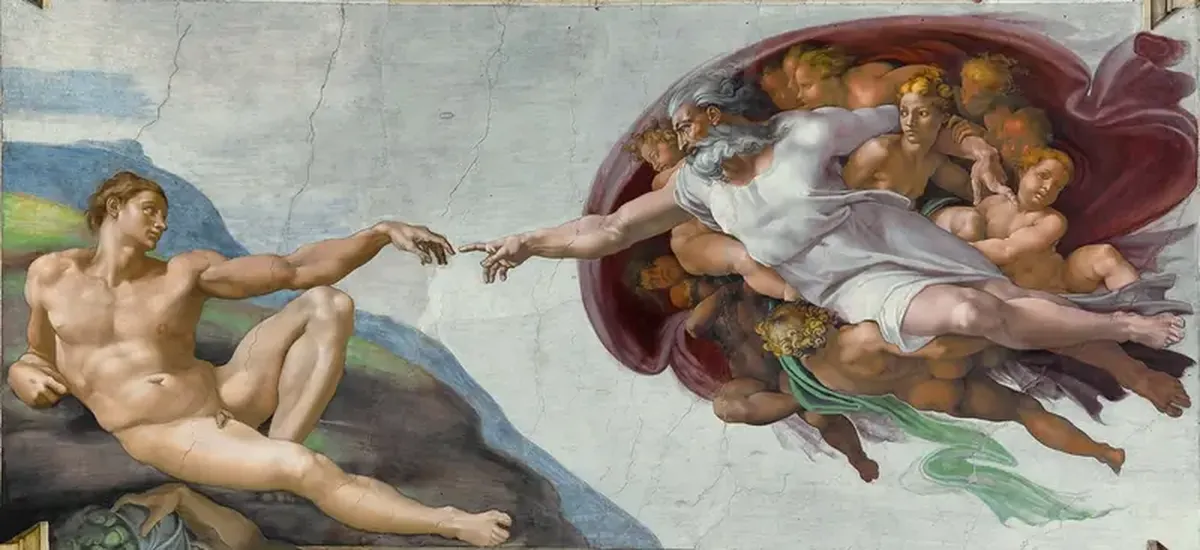
“The Creation of Adam,” 1511-1512
The Sistine ceiling became a monumental celebration of humanity. Despite the grandeur of its scriptural figures, the energetic painting gives the impression of having been executed in a single breath. Overwhelmed by the masterpiece, Goethe wrote, “One cannot conceive of the power of one man without seeing the Sistine Chapel.”
Did Michelangelo Undervalue Painting?
From 1537 to 1541, the master returned to the Chapel scaffolding. After 25 years away, he came back as artist, sculptor, and architect of the Vatican Palace to fulfill Pope Paul III’s commission for a grand fresco, “The Last Judgment.” The reaction to this bold interpretation of the Bible nearly brought accusations of immorality and heresy. The altar wall of the principal Christian sanctuary filled with naked bodies, some with exposed genitals. That provocative imagery sparked a dispute with Cardinal Carrafa, though the Pope defended Michelangelo. After the Council of Trent condemned the work, the painter was obliged to cover the indecent parts.

“The Last Judgment,” 1537-1541
Michelangelo’s panel paintings are rare. The tondo (a circular image) “Doni Madonna,” in its original frame, is considered the only surviving work by the artist in that format (since 1635 it has been in the Uffizi Gallery in Florence). His earliest known narrative experiment was the youthful “The Torment of Saint Anthony,” a work executed when he was about 12 or 13 after copying a German engraving. He entered the Ghirlandaio workshop in 1488 to learn the basics of painting. Michelangelo studied drawing from pencil copies for only a year but showed a sculptural vision of form from the start. It is no surprise that he soon focused on sculpture, which became his principal calling.

“Doni Madonna,” circa 1504
The artist called sculpture “the light of painting,” contrasting the two arts as one might contrast “the Sun and the Moon.” In a public disagreement with Leonardo da Vinci—who regarded painting as a science and a foundation for other arts—Michelangelo dismissed painting as a more feminine pastime or child’s play. Sculpture remained his true passion, with architecture a close second.
Sacred Sculptures of Michelangelo
The unparalleled master of chisel and stone produced 57 statues, of which 10 have not survived. He followed the rule, “A good statue should not be damaged even by rolling down a hill.” When asked how he captured the details of the human body so accurately in solid rock, Michelangelo replied that he simply cut away everything unnecessary from the marble block.
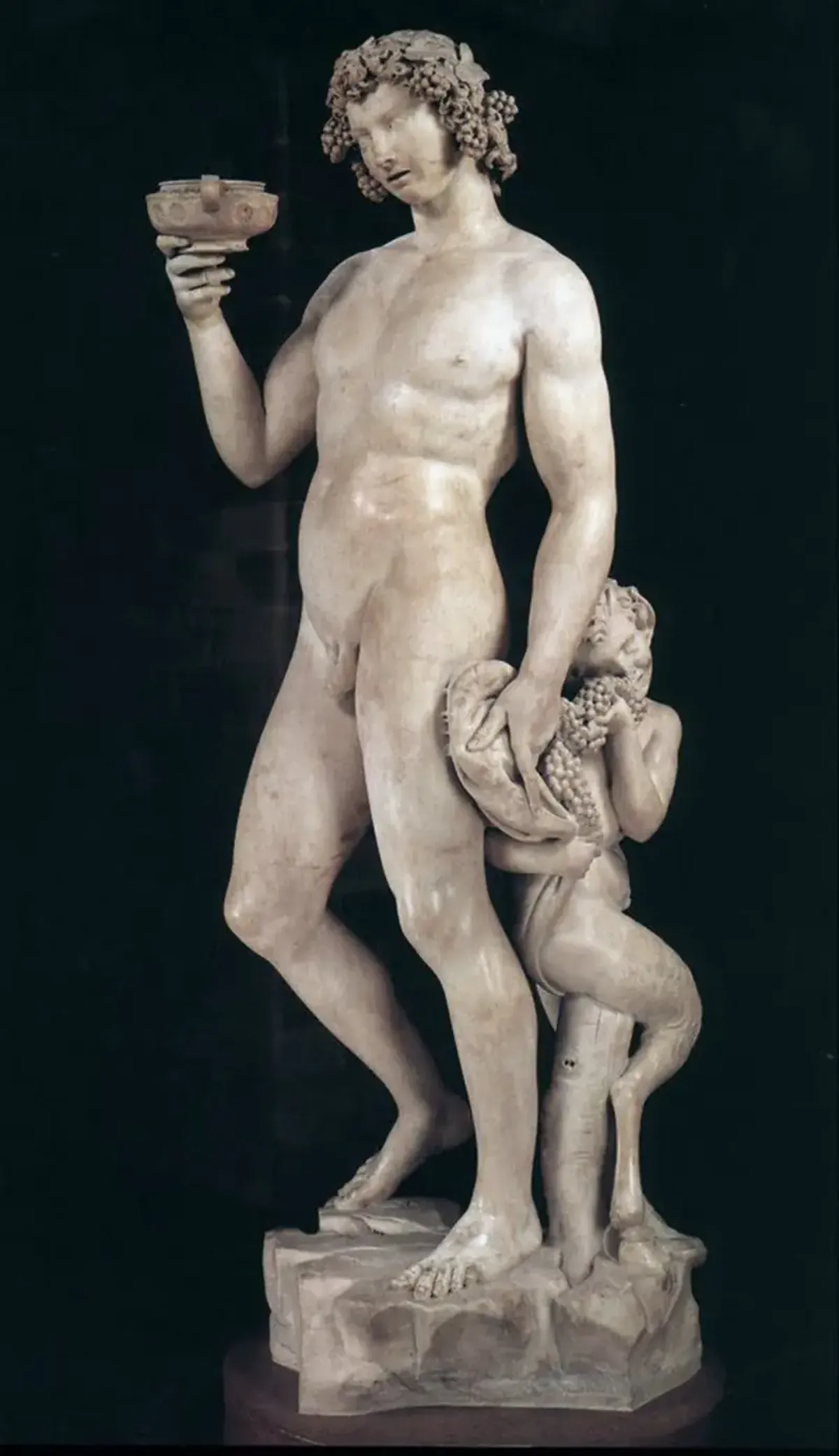
“Bacchus,” 1497
His greatest sculptures—”David,” the “Pietà,” and “Bacchus”—were informed by early anatomical study. With the abbot of Santo Spirito’s permission in the 1490s, he studied human anatomy at the monastery morgue. In gratitude he gave the local church a crucifix carved with anatomical precision.
At the start of his career, Michelangelo was even accused of fraud: he carved a statue of “Cupid” in an antique style so convincingly that a client sold it as an ancient relic. After the deception was revealed, the money was returned to the buyer, but the impressed Roman cardinal kept Michelangelo in Rome for further work.

“Madonna at the Steps” (1490-1492)
In early reliefs like “The Battle of the Centaurs” and “Madonna at the Steps” (1490–1492), the sculptor’s emerging style is already apparent: monumentality, plastic expressiveness, dramatic character, and reverence for the perfection of human form.
The marble “Pietà” for St. Peter’s was carved when Michelangelo was about 24. It is the only work in which he signed his name.

“Pietà” or “The Mourning of Christ,” 1498-1499
The five-meter “David” took him about three years to complete. Usually exacting about his materials, he nevertheless accepted a rejected block of marble that bore traces of two previous carvers who had abandoned it. Despite voids and cracks in the stone, he carved what many consider his supreme masterpiece—what biographer Giorgio Vasari said “took glory from all the statues that existed before.”

“David,” 1501-1504
Talent Saved His Life
In 1527, when Florence overthrew the Medici and set up a republican government, the court artist who had worked for Pope Clement VII sided with the republicans and was appointed head of the city’s defensive works. His fortifications helped keep papal forces from quickly reclaiming the city during a ten-month siege by imperial troops. When Michelangelo was briefly taken captive, he had to prove he was an artist and not a spy. His skill saved him: blindfolded, he reportedly drew two flawless one-meter circles simultaneously with both hands, and the head of the city’s defense then appointed him architect of the bastions. When the old regime returned, Michelangelo might have been executed as a traitor, but Clement VII forgave him and rehired him.
Among his architectural achievements are the Medici Chapel complex in Florence, the design for the Capitoline Hill ensemble, the Laurentian Library staircase, and work on the dome of St. Peter’s Cathedral in Rome. Michelangelo continued work on St. Peter’s until his death. As chief architect of the Catholic sanctuary he even offered to oversee construction free of charge, out of love for God.
