
 Gaby
Gaby
For centuries, believers and travelers visiting the Sistine Chapel have marveled at the frescoes of Michelangelo Buonarroti (1475-1564), a master of the High Renaissance. Among these works is the fresco “The Great Flood” (1508-1512), which depicts scenes from the Book of Genesis. In this masterpiece, you can see people who are about to be engulfed by water.
However, one of the roughly 300 figures portrayed by the artist was destined to die before the flood. This was revealed by an international team of scientists.
Researchers from Italy, Germany, France, Austria, and the United Kingdom, specializing in art history, medicine, and genetics, joined forces to diagnose the illness of a semi-nude woman in the fresco.
After a detailed examination of the woman’s breasts in the second bay of the ceiling, the scientists concluded that this woman had late-stage breast cancer. They believe Michelangelo knew the signs of the disease and depicted them intentionally.
What You Need to Know About the Discovery
From 1508 to 1512, Pope Julius II commissioned Michelangelo to paint the Vatican chapel with scenes from the Old Testament. At that time, Michelangelo, who was just over 30, was already an experienced artist. Bringing his years of sculptural expertise to this monumental task, he demonstrated an extraordinary level of detail in his work.
Given this, it’s hard to imagine he accidentally distorted the woman’s breasts in the fresco. To the average viewer, this woman is merely one of the exhausted figures seeking refuge from the waters meant to cleanse the world of sin. For art historians, the blue of her scarf signals that she’s married, while her finger pointing to the ground hints at her inevitable demise.
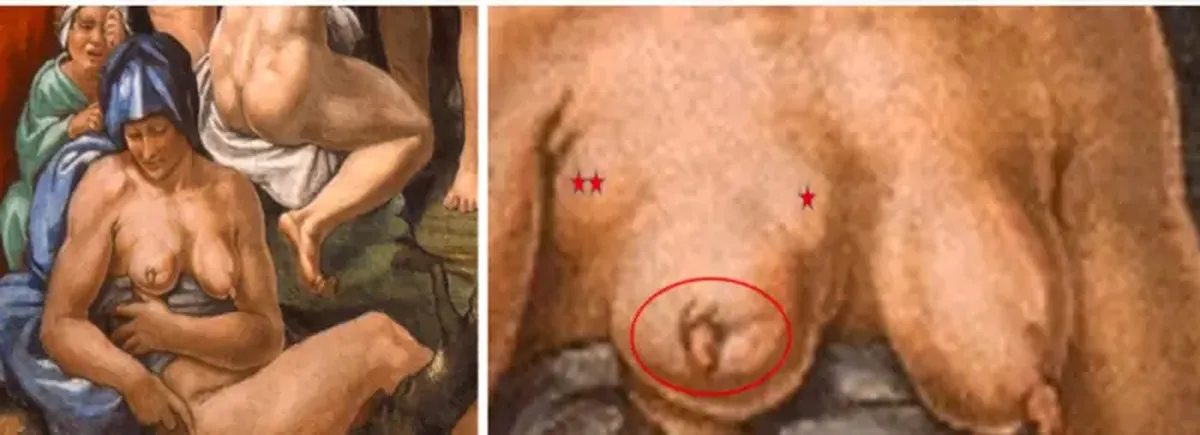
Medical experts focused their attention on the noticeable swelling of the woman’s breasts. According to the researchers, if this image were in a medical chart, there would be no doubt that the patient had breast cancer.
By comparing those details with the physical characteristics of many other figures in the fresco, the team concluded that this narrative element is not coincidental. Michelangelo had a considerable understanding of disease and death. From his teenage years, he took part in human dissections, gaining insight into how the body works. The researchers do not believe that the artist copied the pathology from a model suffering from cancer. Rather, he likely became familiar with the manifestations of the disease during dissections.
Over the centuries, the ceiling of the Sistine Chapel has undergone numerous restorations. One of the largest took place at the end of the 20th century. By comparing old photographs of the frescoes with the restored versions, scientists confirmed that the original shape and shading of the woman’s breasts had not changed.
This isn’t the only time Michelangelo depicted illness. Shortly thereafter, he created an allegorical figure of Night for the tomb of Giuliano de’ Medici, with a similar breast deformity. Oncologists drew attention to that detail in 2000, as reported by Science Alert.
So why did the artist depict a woman with a terminal illness in the Sistine Chapel? Experts say the probable breast cancer connects to themes of life’s transience and functions as a symbol of punishment.
So this embodiment of sin, shown as a deadly disease, went unnoticed in the Sistine Chapel for many years. The study shows Michelangelo’s deep anatomical knowledge continues to astonish. The results were published in the journal The Breast.
