
 Carlos Solis
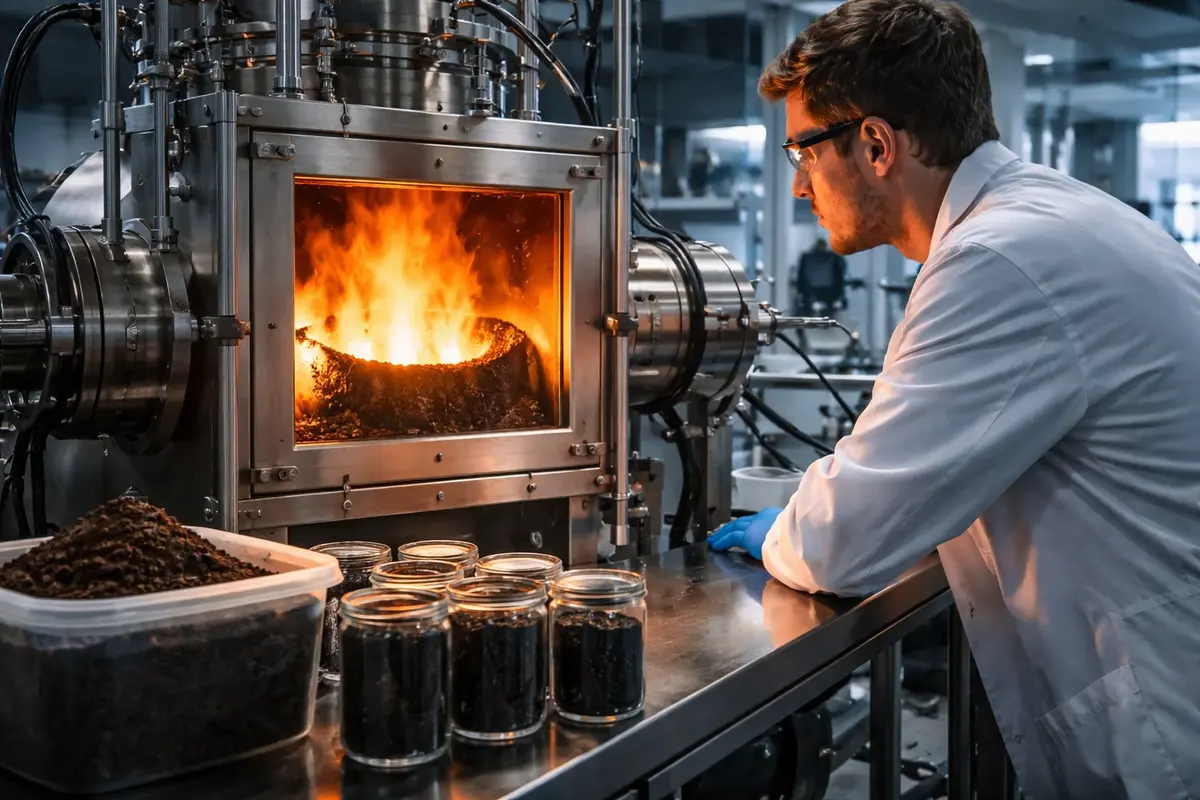
A research team at the Korea Institute of Geoscience and Mineral Resources (KIGAM), working with GodTech, developed a way to convert wet coffee grounds into high-quality biochar in just 90 seconds.
How Wet Coffee Grounds Turn Into Fuel
The new technique, called Flame Plasma Pyrolysis, or FPP, works without pre-drying. Instead of electric plasma devices, the system creates a plasma flame about 800–900°C using liquefied petroleum gas (LPG) and compressed air.
Under intense heat, the water in the grounds (about 55% moisture) quickly turns to steam. Pressure rises inside the particles, causing micro-explosions that rupture the structure, form a porous network, and speed up carbonization. Here, moisture acts as a catalyst rather than slowing the conversion.
FPP produces almost no smoke and only a small amount of bio-oil, unlike many conventional pyrolysis methods.
How Good the Fuel Is
The optimal processing time was 90 seconds. During conversion, the coffee grounds lost 83.3% of their mass, and the biochar’s heat content reached 29.0 megajoules per kilogram. That’s about 33% higher than untreated coffee grounds and comparable to anthracite.
Fixed carbon nearly tripled, rising from 15.6% to 46.2%. Sulfur was completely removed, so burning this fuel won’t produce sulfur oxides (SOx). That reduces the risk of air pollution, acid rain, and equipment corrosion, and lowers the need for extra emissions filters.
The resulting product is promising for making activated carbon and industrial adsorbents. But extending the treatment beyond 90 seconds worsens fuel quality because excessive heating destroys the carbon structure.
Where This Technology Could Be Used
The team believes the approach could work not only for coffee grounds but also for other wet organic wastes: food scraps, sewage sludge, and agricultural residues. The compact design of the unit makes it suitable for decentralized, small-scale waste-to-energy operations near where the waste is generated, cutting transport and processing costs.
“This technology opens a new paradigm in which waste stops being a problem and becomes a valuable energy resource,” said lead author Tejun Pak. The research team plans to adapt the method to different types of high-moisture organic waste and optimize the process for industrial deployment.
This article draws on reporting from ZME Science.
