
 Gaby
GabyIn the scientific community, discussions about when placental mammals, which include humans, dogs, and bats, first appeared have been ongoing for a long time. Recent analysis of fossils has led to a stunning discovery.
New evidence suggests human ancestors lived during the time of the dinosaurs. The overlap between prehistoric giants and early mammals was brief, but researchers now say it did happen.
Dinosaurs went extinct while human ancestors evolved
Some scientists have long argued that placental mammals existed during the age of dinosaurs, before the asteroid impact that wiped out roughly 75% of species on Earth.
After that catastrophe, nonavian dinosaurs went extinct while the ancestors of humans survived and later evolved. A group of paleontologists now has supporting evidence: an in-depth analysis of fossils indicates our ancestors coexisted with dinosaurs for a short period before those reptiles disappeared.
Until now, fossils of placental mammals had only been found in rocks less than 66 million years old, the Daily Mail reported. Because of this, many scientists thought placental mammals evolved after the mass extinction caused by the asteroid impact.
In the Earth’s crust around the world, there is a characteristic layer of sediment rich in iridium — a metal that is rare on Earth but more common in asteroids and comets. That layer is a key piece of evidence for the asteroid-impact hypothesis that explains the dinosaurs’ extinction. Fossil remains also show a sharp drop in biodiversity above that layer.

The event wiped out most nonavian dinosaurs, leaving only birds, and it spared some smaller animals like lizards and frogs. However, molecular data have long suggested an older age for placental mammals, which include the ancestors of humans.
A team of paleobiologists used statistical analysis of fossils to test whether human ancestors could have existed before the mass extinction. The study found that primates — the group that includes humans — along with other placental groups such as rabbits, dogs, and cats, emerged shortly before the catastrophe. In other words, the fossil record is consistent with human ancestors living during the Cretaceous and coexisting for a time with nonflying dinosaurs.
Researchers think placental mammals were able to survive the asteroid impact. The mass extinction removed competition from dinosaurs, allowing early mammals to diversify and evolve more rapidly.
Lead researcher Emily Carlisle says her team collected thousands of fossils of placental mammals. In their study they observed patterns of emergence and extinction across different groups.
Small ancestors could survive
Carlisle says the fossil patterns let researchers estimate when human ancestors first appeared, although they still can’t say exactly what those animals looked like. The first placental mammals were very small.
For example, one early primate ancestor was similar in size to a modern mole. It’s therefore likely that many of the human ancestors living alongside dinosaurs were tiny creatures.
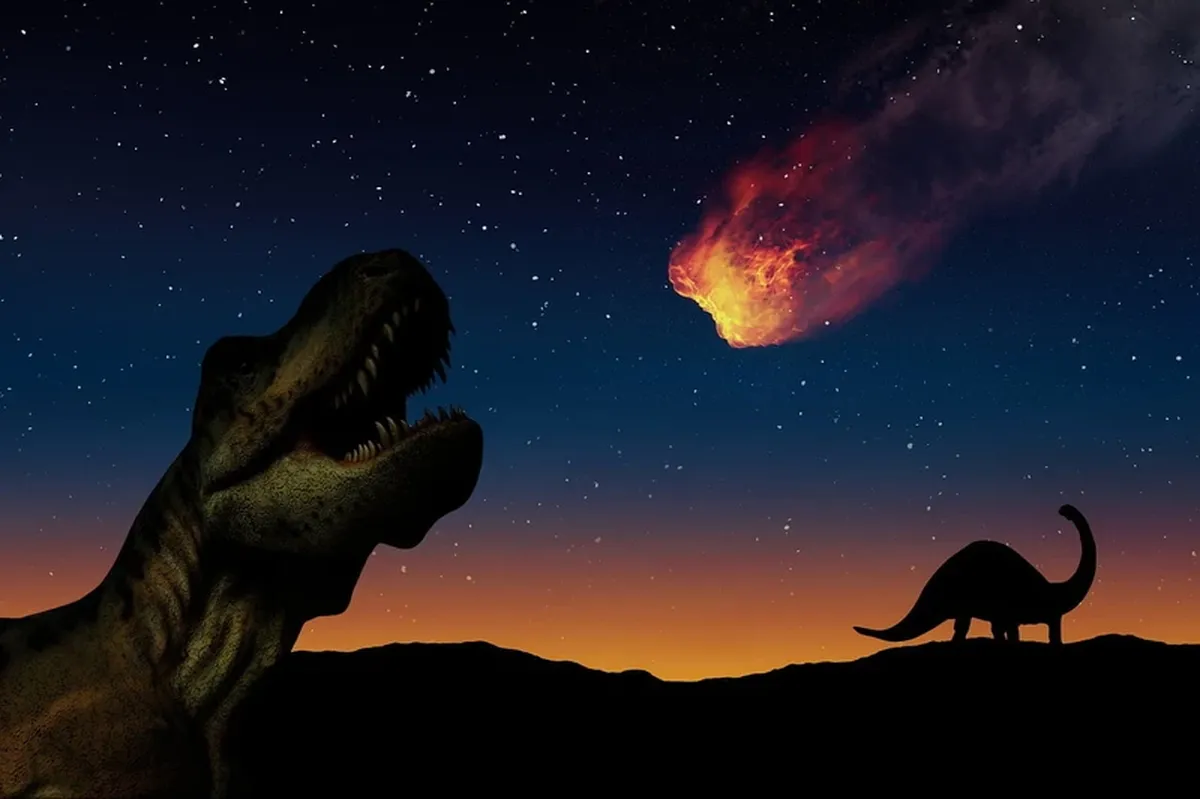
The recovery of life after the asteroid impact took millions of years. The animals that survived the catastrophe laid the foundation for modern global biodiversity.
Because the ancestors of placental mammals (including human ancestors) were small, they could hide and survive on limited food in the harsh conditions that followed the impact. That survival allowed them to persist and evolve after the disappearance of the giant dinosaurs.
If the asteroid had not struck Earth, the planet — and the course of evolution that led to humans — might look very different. The extinction of the dinosaurs opened ecological opportunities that let primitive mammals diversify, including the line that led to humans.
