
 Gaby
Gaby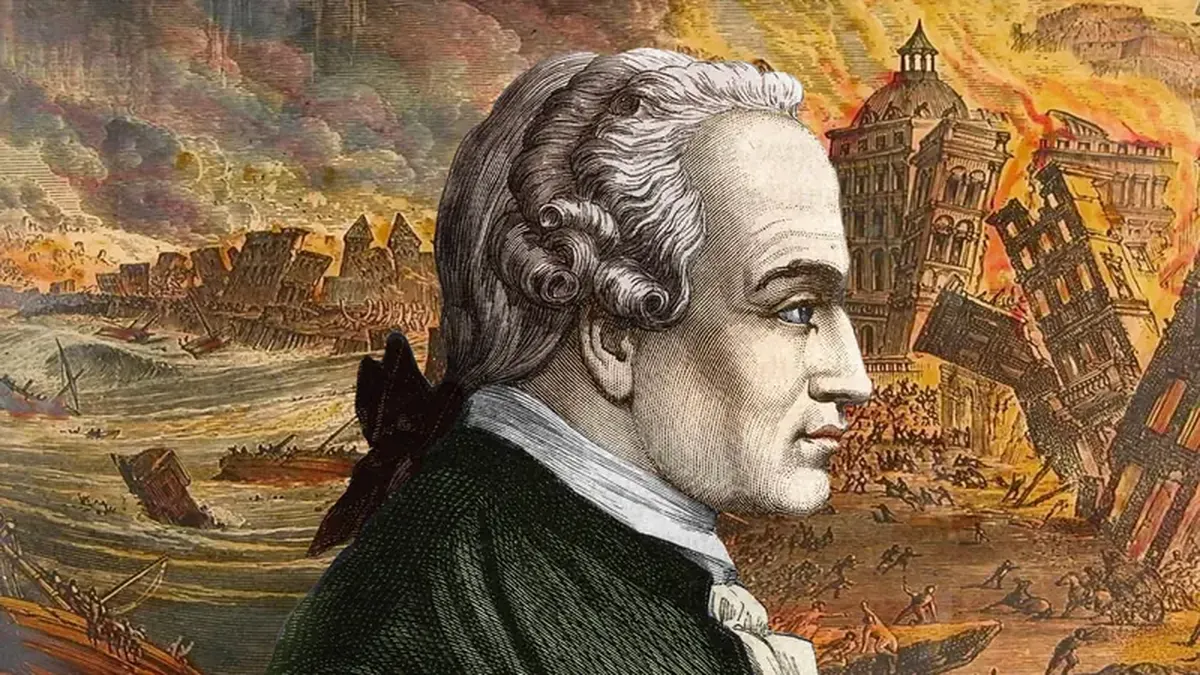
Three hundred years ago a German philosopher was born who tackled life’s biggest questions: What can I know? What should I do? What can I hope for? What is a human being? He explored faith, knowledge, and morality and offered a new way to understand the nature of things—a foundation that still matters three centuries later.
Moral Biography
Immanuel Kant was born into a family of harness makers; his father and maternal grandfather made their living crafting horse gear. He was born on April 22, 1724, to a workshop owner on the outskirts of Königsberg and was registered at birth under his father’s trade. His biblical name, meaning “God is with us” in Hebrew, reflected the family’s piety. He inherited the status of a guild craftsman from his father, Georg Kant. A harness maker’s son did not seem destined for much, but Kant’s thirst for knowledge changed that. Even after he became a respected scholar, this “commoner” never won royal favor. For the twice-elected rector of the University of Königsberg, court approval mattered far less than other concerns.
“My parents, of the artisan class, were models of decency and respectability,” the thinker recalled. “Having left neither inheritance nor debts, they provided me with the best moral upbringing, for which I am very grateful.” His mother, Frau Regina, died at 40 when he was 14; she was a devout woman who, he wrote, planted in him the “first seed of goodness.” Kant achieved success through his own efforts. His principles are captured in memorable lines: “One must live primarily for work”; “It is a person’s duty to uphold their own dignity”; “Two things fill the soul with wonder and reverence: the starry sky above me and the moral law within me.”
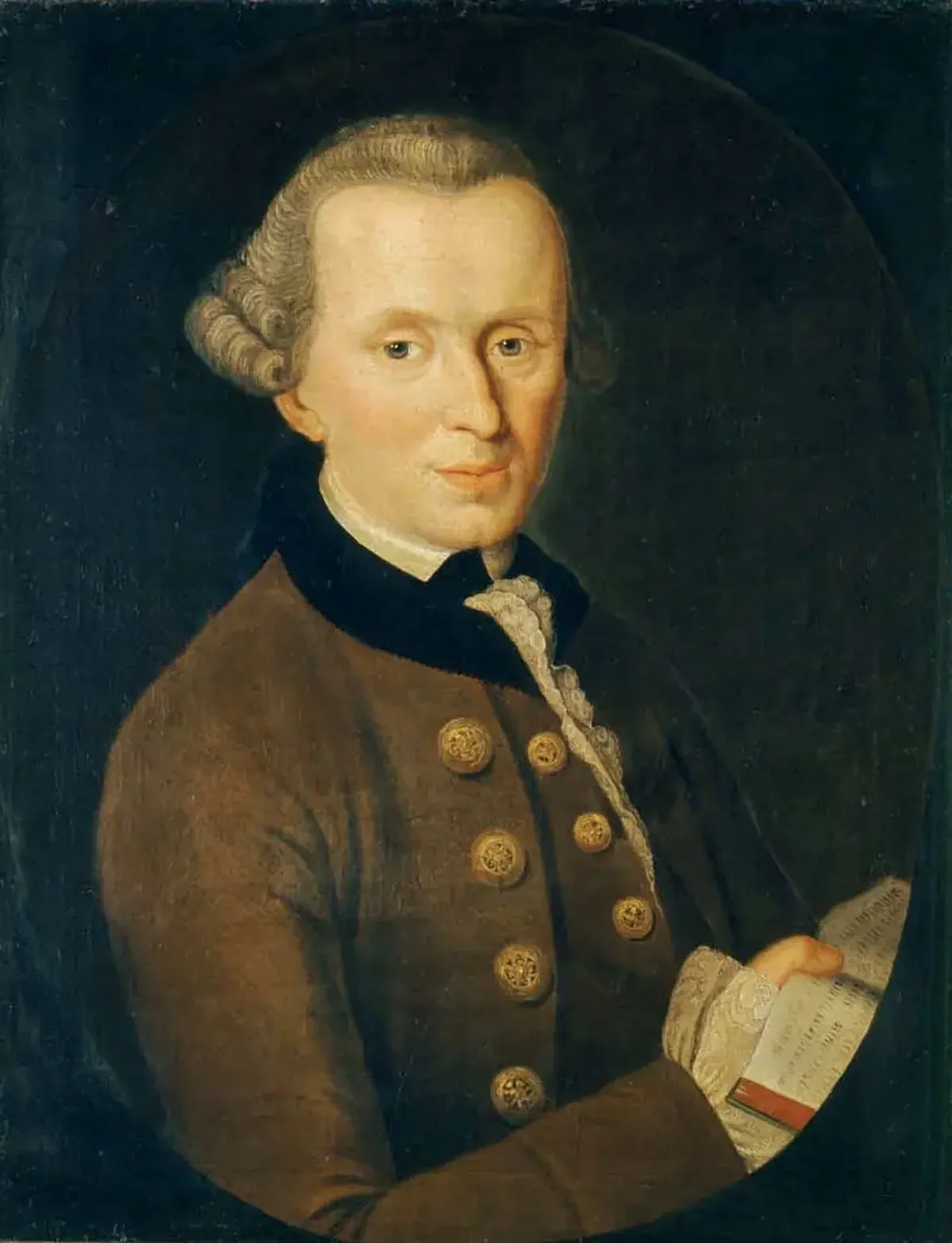
Kant in a painting by Johann Gottlieb Becker (1768)
The “Prussian Hermit”
After graduating from the Latin School, Kant continued his education at the theological faculty of the University of Königsberg, where he developed an interest in the natural sciences, mathematics, and philosophy. When his father died, the family faced financial hardship, and Kant earned a living tutoring, playing billiards, and even working as a card player. For nine years he worked as a private tutor and then spent 15 years as an assistant librarian at the Königsberg palace library while waiting for a professorship. Despite his modesty, he did not avoid recording aspects of his life. He began lecturing on logic and metaphysics at his alma mater in 1755 after defending three dissertations in two years.
The first dissertation let him teach at the university, the second earned him the title of Privatdozent, and the third gave him the right to become an extraordinary professor—a position he finally secured at 46. He continued working in the library for another two years. In 1786, when he was entrusted with the rectorship, he was already 62, and two years later he was re-elected for a second term. Kant’s teaching motto was to “teach not knowledge, but reflection.” He never traveled beyond his small homeland, which earned him the nickname “Prussian hermit” from contemporaries. Without changing his residence, he became a subject of two empires: when the Baltic city changed hands, the German thinker was a Russian subject from 1757 to 1762.
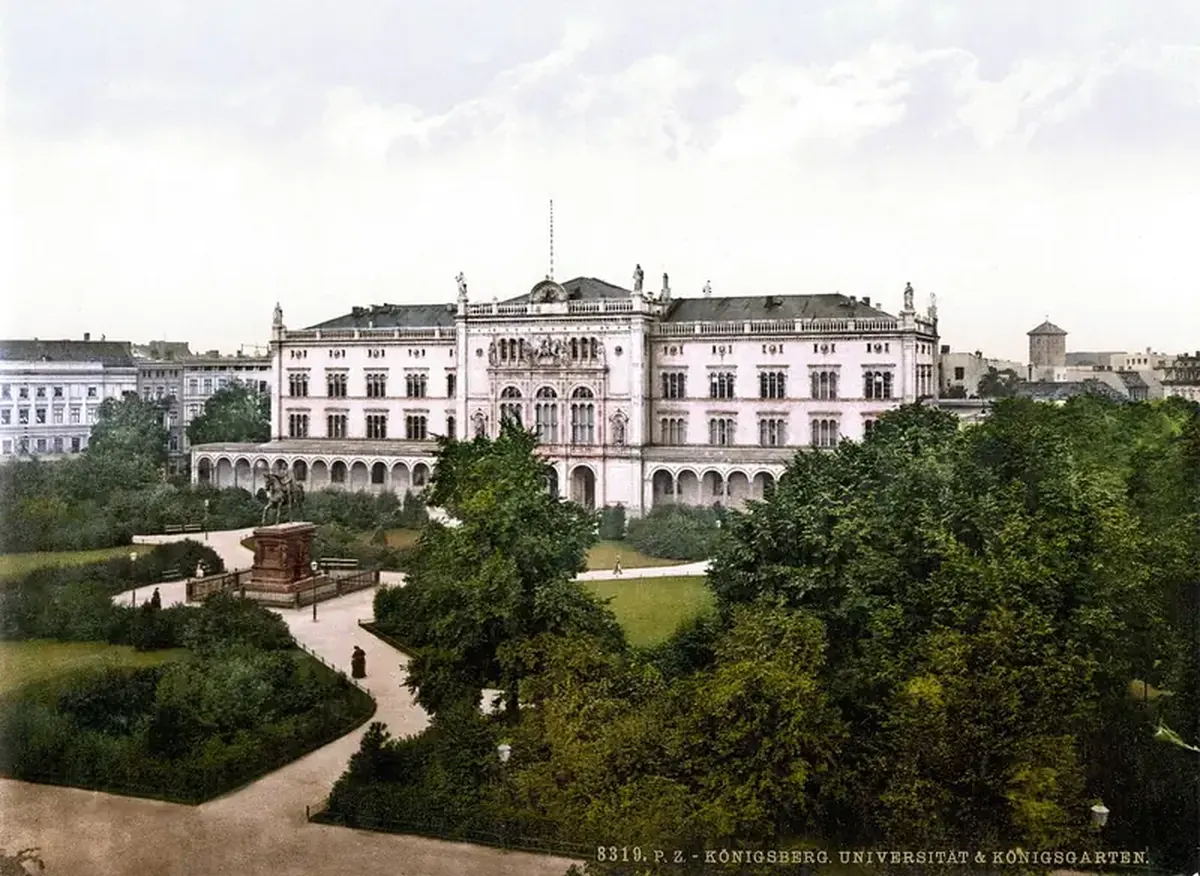
An image of the University of Königsberg on a 19th-century postcard
Interesting Facts
Immanuel Kant was known as a stickler for detail, an ascetic, a pedant, and a literalist. He disliked toothless interlocutors and untidy students. Violations of rules and traditions disturbed his mental comfort and could provoke a serious health reaction (a conflict with an arrogant servant once escalated to such an outcome). Kant called beer “food of poor taste” and preferred wine. A lifelong bachelor, he never married or had children, though he did allow himself to admire female beauty. After losing sight in one eye in old age, he would sit next to an attractive young woman at dinner parties and ask her to position herself to his right. He insisted that the number of dining companions be “no fewer than the number of Graces and no more than the number of Muses.” His ritualized habits and strict schedule were attempts to manage his health rather than rely on what he called “ineffectual doctors.”
Kant showed tendencies toward hypochondria and melancholy that shaped his personality. Though he usually ate with others, he always took solitary walks along his established “philosophical route,” fearing that cold air entering his lungs during conversation might make him ill. From childhood he worried over ailments he read about in medical texts. Some scholars have even suggested that the author of “Dare to use your own reason” may have suffered from schizophrenia. Those concerns did not prevent him from living to old age: he died on February 12, 1804, at nearly 80. The town’s farewell to their illustrious compatriot, who left his relatives 20,000 guilders, lasted two weeks.
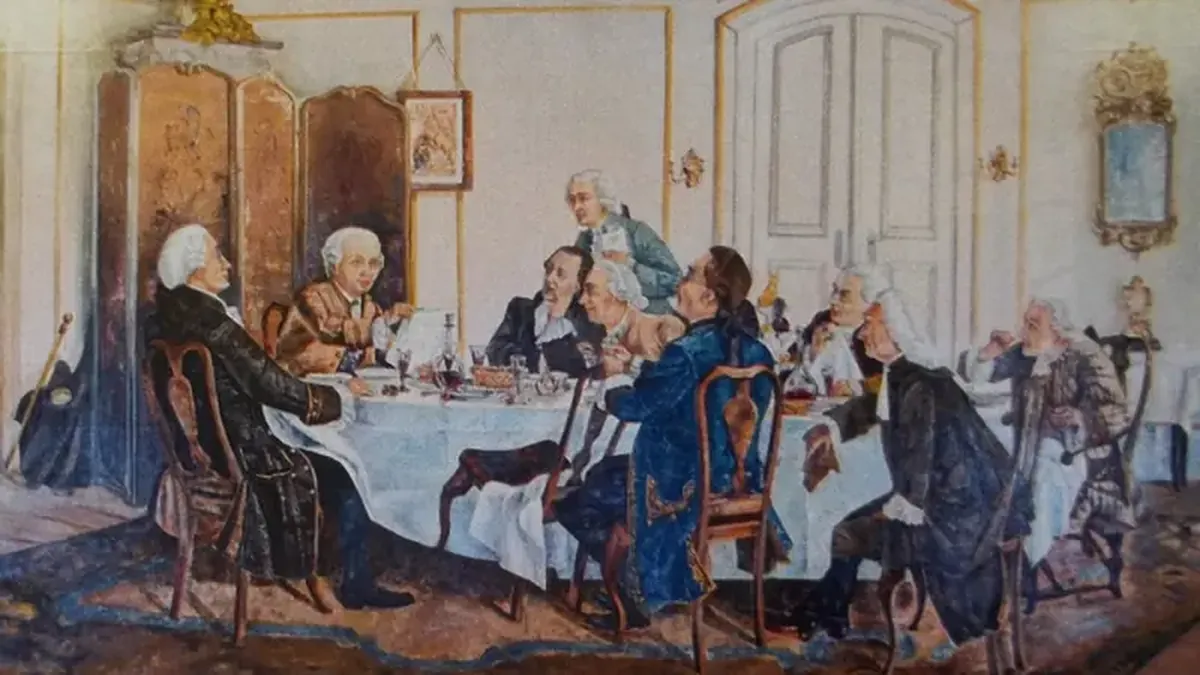
The painting “Kant Among Friends,” by Émile Derstling
Worldview Revolution
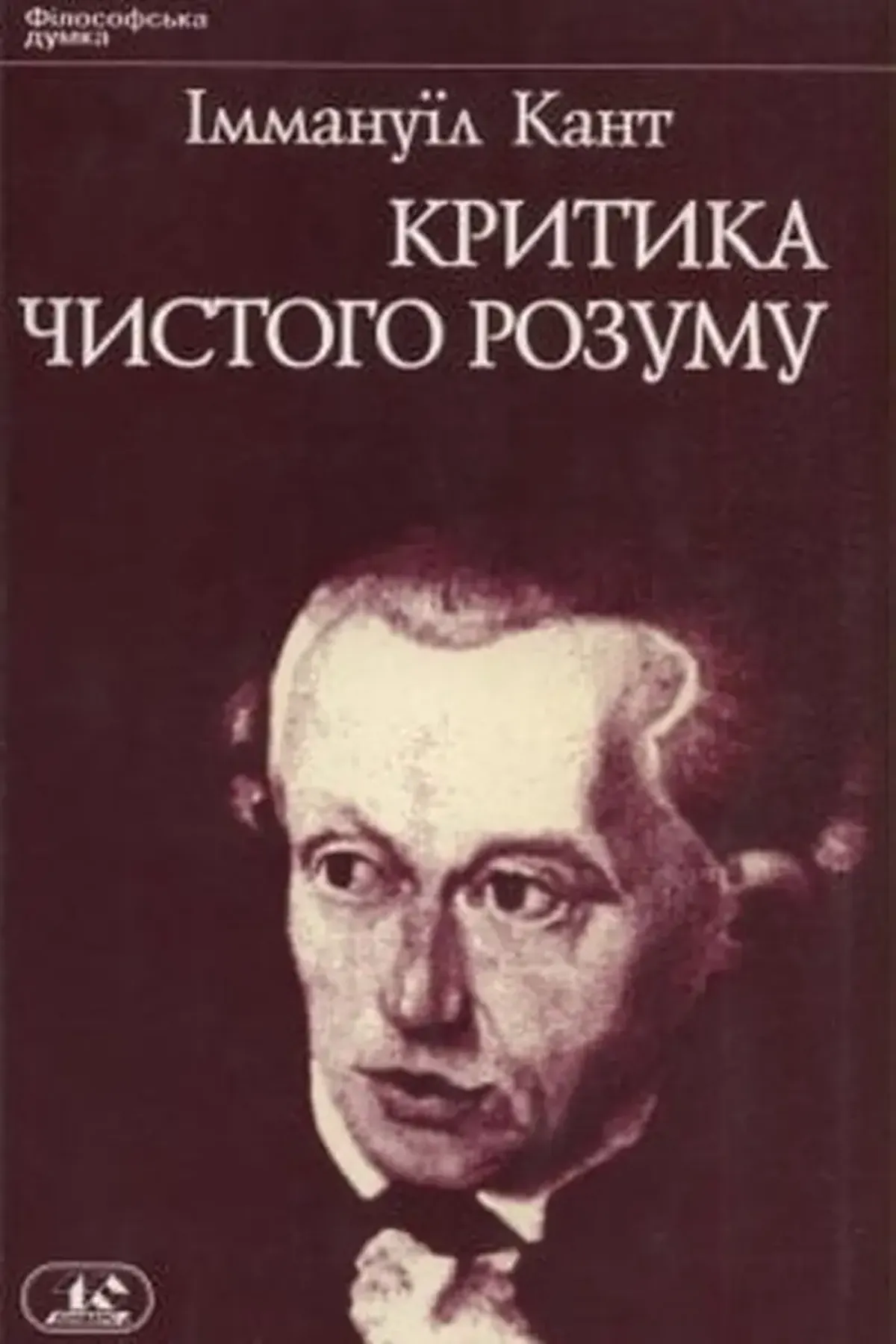
Any mental-health diagnosis would underscore a paradox: the idealism of this Enlightenment thinker helped spark one of the greatest intellectual transformations in human history. Kant’s contribution to the theory of knowledge and metaphysics is often compared to a paradigm shift in how we understand the universe. In the history of ideas, Immanuel Kant’s “Critique of Pure Reason” stands alongside Nicolaus Copernicus’s “Revolutions of the Celestial Spheres.” For the intellectual development of humanity, the works of the founder of classical German idealism and the creator of the heliocentric model are milestones of equal importance.
To summarize Kant’s philosophy: he regarded reason as the source of morality and framed his doctrine as a synthesis of rational and sensory knowledge. His main contributions lie in epistemology (from the Greek episteme, “knowledge,” and logos, “study”). Kant examined knowledge as a scientific category, building a system that explored the origins, limits, and laws of human cognition. His work falls into two periods—pre-critical and critical—during which he moved from natural science and natural philosophy toward questions of freedom and morality. Over his life he also engaged with history, law, astronomy, and religion, along with ethics, aesthetics, and political theory; his writings have led some to view him as both a theologian and an agnostic.
Perpetual Peace
Kant’s quotes show how themes of war, freedom, and rights intersect: “The highest moral good cannot be achieved through the moral improvement of an individual—it requires a system of people united as a whole.” “The greatest evils of cultured nations are not the consequences of destructive wars, but the constant preparations for them—such a future robs states of the fruits of civilization and the resources that could serve their development.” “While freedom is being severely attacked in many places, and the increasing demands on citizens are justified by security considerations, people must have the right to openly express disagreement with state regulations that they perceive as unjust toward society.” “The freedom of the printed word is the only sacred safeguard of the rights of the people.”
Kant believed injustice was the root cause of military conflicts. The author of the imperative “Do not do to others what you would not want done to yourself” taught moral improvement and opposed the “right of the strong” in international relations. In his later years, after earlier writings that embraced scientific racism drew contemporary criticism, he spoke against European colonialism and rejected racial hierarchies. The man who called space and time “forms of intuition” and “objects of experience” imagined the culmination of world history in “perpetual peace,” achieved through an equal union of nations and universal democracy. “Of course, perpetual peace as the ultimate goal of international law is a utopian idea,” he reflected, “but the political principles that would allow us to bring it closer are entirely feasible.”
