
 Gaby
Gaby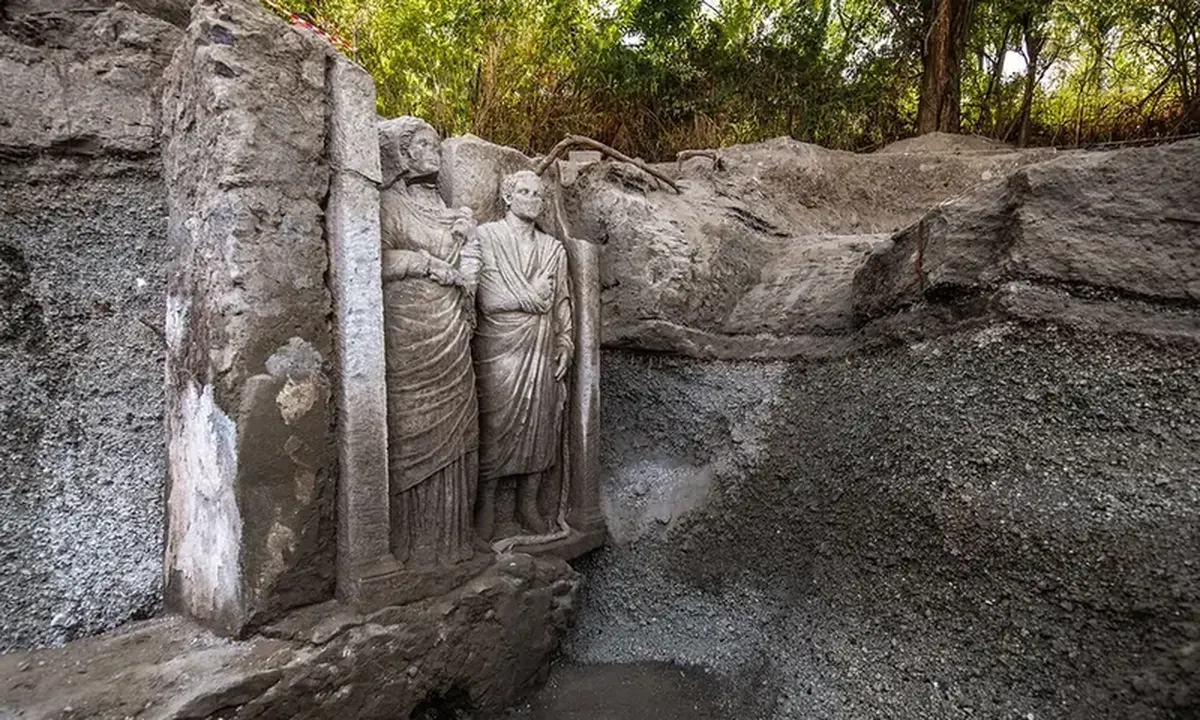
During excavations of the large Port Sarno necropolis in ancient Pompeii, archaeologists uncovered two nearly life-size tomb statues of a man and a woman.
These funerary sculptures date to the late Roman Republic and once adorned a tomb with several burial niches. The statues are set into a wide wall of the necropolis, next to one of Pompeii’s main city gates.
The discovery raises questions, especially about the woman’s identity. Researchers suspect she was an important local woman—possibly a priestess of Ceres, the Roman goddess of agriculture, fertility, and motherhood. The carved jewelry and accessories—earrings, rings, and bracelets—suggest high status. She also wears a lunula, a crescent-shaped pendant at the center of her necklace. The woman is shown wearing a tunic and a long cloak; the man is depicted in a toga, The Guardian reports.
Gabriel Zuchtriegel, director of the Archaeological Park of Pompeii, said, ‘She appears to have been a very important woman from the local elite. It can be assumed she might have been a priestess of Ceres, holding plants and something resembling a papyrus scroll.’
She likely holds laurel leaves in her hands, which were used to purify and bless religious sites.
In ancient Roman society most women were homemakers, so the role of priestess was one of the highest positions a woman could hold, granting power comparable to that of a male priest.
Another mystery is the relationship between the two figures. Were they a married couple? Experts don’t know. Zuchtriegel says these paired burial sculptures don’t always show spouses. ‘Sometimes you can see two men, and sometimes three. This could have been her husband, but it could also have been a son. There’s no inscription, so we can only speculate,’ he added.
Near the male statue, archaeologists found a well-preserved root from an ancient tree that grew on top of the tomb. ‘It was quite unexpected to find it there,’ Zuchtriegel said.
Both sculptures are undergoing restoration and will be displayed in an upcoming exhibition in Pompeii.
The excavations at the Port Sarno necropolis are a joint project of the Archaeological Park of Pompeii and the European University of Valencia. In 2021, mummified remains of a former slave who rose through the social ranks were discovered here.
Pompeii was destroyed by the eruption of Mount Vesuvius in 79 AD.
