
 Carlos Solis
 Experts think the enormous fish probably died in a predator attack. The sawfish, which is guitar-shaped, hasn’t been seen in this region since the 1990s. Locals believed the species was extinct. But to the surprise of residents and scientists alike, a guitar-shaped sawfish recently washed ashore, undercutting the idea that it had disappeared.
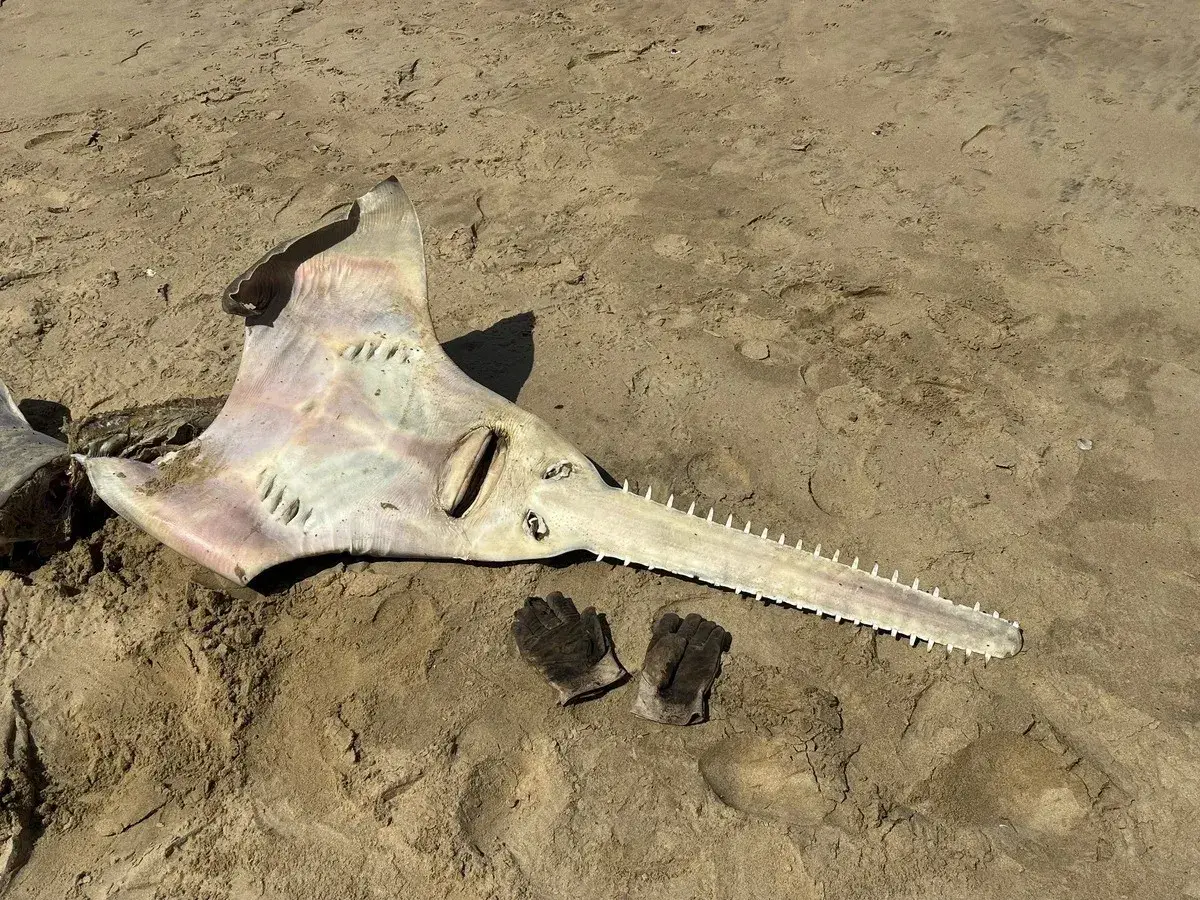
The body of the sawfish, measuring 2.93 meters long, was discovered at the mouth of the Birha River in South Africa’s Eastern Cape Province by local resident Mike Vincent. He stumbled on the specimen and sent a photo of his find to Kevin Cole, a British naturalist at the East London Museum.
“It was surreal to see this shark-like ray with a long, saw-like snout. I just sat next to it for a while, pondering what was happening,” Cole told IFLScience.
About the Discovery
Scientists joke that the sawfish is something between a fish and a chainsaw. While its body resembles a shark’s, it belongs to the ray family.
It’s hard to miss its distinctive feature: a long, flat snout lined with sharp teeth. The fish uses this “tool” to hunt and to dig into the ocean floor.
It’s unclear how the sawfish died, but it may have been attacked by a predator. Alternatively, scavengers may have fed on it after it died.
“Judging by the wound, it was probably a predator. No land creature could have eviscerated this fish like that. Some researchers believe an orca might have been involved. Unfortunately, no DNA samples were taken from the carcass, so researchers will have to rely solely on photographs,” Cole noted.

Various species of sawfish have historically lived in tropical and subtropical waters around the world, sometimes moving from salty coastal waters into freshwater lakes.
Because these fish are globally endangered, many feared the worst. However, after this discovery, Cole received several reports of a similar fish found nearby — on Kaiser Beach. That suggests there may be more of the species in the area than previously thought.
“Amateur fishermen and beachgoers will now be more vigilant for potential wash-ups of such fish, helping to revive research on this species,” Cole said.
