
 Carlos Solis
Even though more effective spies appeared in the 20th century, the femme fatale archetype has been immortalized in countless films, series, musicals, and novels. Mata Hari, the woman used by two intelligence agencies during World War I, was executed by firing squad at 41. Behind the tragic fate of this favorite of the European elite were a difficult childhood, a troubled marriage, dramatic motherhood, and a struggle to understand the role history had placed on her shoulders.
Mata Hari – Who Was She?
The real name of the performer of “adult dances,” similar to modern-day striptease, was Margaretha Gertruida Zelle. She was born in the Netherlands on August 7, 1876. The only daughter of Adam Zelle and Antje van der Meulen, she grew up with three brothers. Her father, Adam Zelle, earned income from successful investments in oil extraction. The family was well-off for a time, so the children lacked nothing, and Margaretha attended elite schools until she was 13. Everything changed after her father’s bankruptcy in 1889. Soon after, her parents divorced, and her mother died of tuberculosis two years later.
In 1891, her father sent his 17-year-old daughter to another city to live with her godfather in Sneek. Continuing her education in Leiden, young Margaretha planned to become a kindergarten teacher. Her godfather withdrew her from school after she flirted inappropriately with the director’s daughter. A few months later, Margaretha left her guardian and fled to The Hague to live with her uncle. At 18, she married 39-year-old Captain Rudolf MacLeod, a Dutchman of Scottish descent whom she had met through a personal ad. After registering their marriage, the couple moved to the Dutch East Indies.

Margaretha with her husband, Captain Rudolf MacLeod
What Does Mata Hari Mean?
On the island of Java in Indonesia, Margaretha gave birth to two children: a son, Norman-John, in 1897, and a daughter, Jeanne-Louise, in 1898. The family was far from happy. Rudolf, who struggled with alcoholism, often took out his frustrations on his young wife because of disappointments in his life and career. The much older man repeatedly cheated on her, flaunted his mistresses, and kept several women. Disillusioned with her marriage, Margaretha left her husband for another Dutch officer and tried to earn her own income. She joined a dance troupe, began studying Indonesian culture, and immersed herself in local dance traditions.
In 1897, Margaretha adopted the stage name Mata Hari, which translates from Malay as “eye of the day” and means “sun.” She found solace in Eastern dance after family quarrels (her husband persuaded her to return, but his aggressive behavior did not change) and the tragic death of her two-year-old son. The child may have been poisoned by a vengeful maid after Rudolf had a conflict with the maid’s husband. Another theory suggests the child’s death resulted from complications of syphilis, a disease the parents may have transmitted to their children. Their daughter also died of syphilis at age 21; Rudolf took custody of her after their divorce in 1903.
The Capital of Erotica
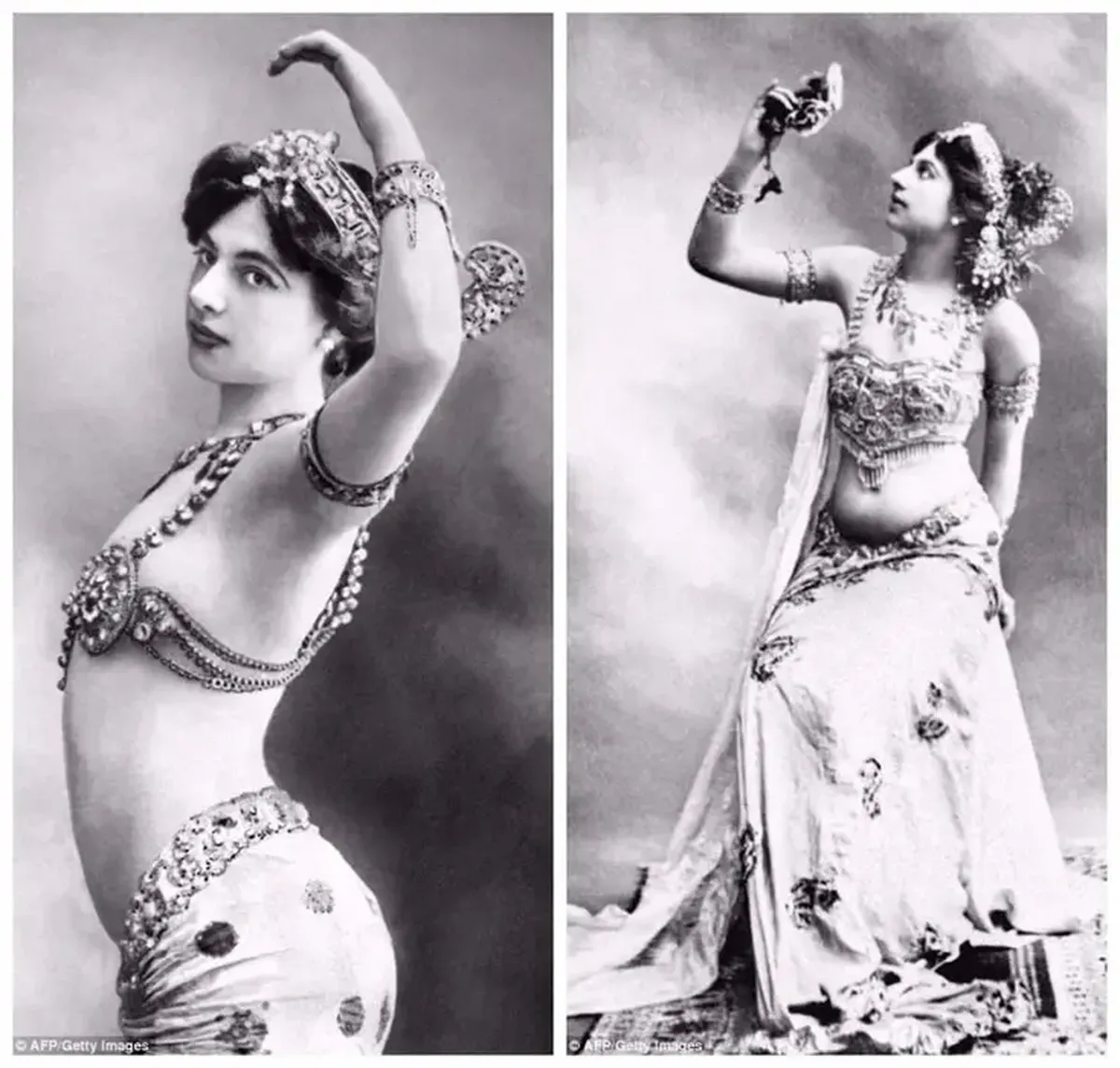
After returning to the Netherlands, Margaretha MacLeod-Zelle found herself in poverty and decided to go to Paris, where she could earn a living with her artistic skills and captivating stories. Initially, the striking Dutchwoman performed in a circus as an exotic rider under the name “Lady Grisha MacLeod,” claiming her unusual horse could only be ridden by her. By 1905 she had enchanted French audiences as a dancer in an “Eastern style” at a time when Europeans were fascinated by the East. Her exotic stage name on posters attracted both fans of Eastern dance and men seeking entertainment.
Thus began Mata Hari’s stage career. In Paris, and later in other European capitals, her performances mixed ballet and eroticism and became popular. Her shows featured spectacles unfamiliar to Western audiences: the dancer would be nearly naked by the end of a performance. Claiming to perform sacred Eastern dances she had learned in childhood, Mata Hari undressed for money, saying it was “pleasing to Shiva.” She added mystique to her act by presenting herself as a student of a Buddhist monastery or as an Eastern princess, at times even claiming royal connections.
Between Erotica and Politics
Her experiences of male cruelty, violence, poverty, and harassment in the dance world pushed Margaretha toward becoming a courtesan. Her charming persona attracted high-ranking officials, politicians, and influential figures in France, Germany, and other countries where she performed. Margaretha squandered her easy earnings on gambling: she became an avid card player and was constantly in debt. Those connections and vulnerabilities made her attractive to intelligence services, and she likely became a German spy long before the war began.
The exact circumstances of her recruitment remain unclear. Since the Netherlands was neutral during World War I, Dutch citizen Margaretha Zelle could travel between France and her homeland. Those trips had to avoid German-occupied Belgium and instead go through Spain (where Germany maintained an active residency at the time) and Great Britain. Allied counterintelligence noticed these movements. In 1916, French intelligence began to suspect Mata Hari of spying for Germany.

Mata Hari with her Russian lover Maslov
Double Agent
When she learned French counterintelligence had compromising information on her, the courtesan approached the agency and offered her services as a French spy. During conversations with French agents, Mata Hari carelessly mentioned the name of her lover, a man the French identified as a German recruiter. The French sent her on a fact-finding mission to Madrid and confirmed their suspicion that she was a German double agent. Intercepted radio messages from a German agent in Spain indicated the Germans were told that the French-recruited agent H-21 had arrived in Madrid and was returning to Paris.
An analysis of events raises the possibility that the German residency deliberately disclosed the radio interception in order to eliminate the double agent and hand her over to the French. A photograph of Mata Hari taken on February 13, 1917, coincided with her arrest soon after she arrived in Paris. The Dutch national Margaretha Zelle was charged with espionage. Prosecutors accused her of passing wartime information to the enemy that led to the deaths of several divisions. Materials from the closed court session on July 24, 1917, remained sealed for a century until 2017. That court handed down a death sentence.

Prison photographs of Mata Hari before her execution
How Did Mata Hari Die?
While in custody, her lawyer tried to clear her of the charges. He filed appeals and sent requests for clemency to the president, all without success. When all options were exhausted, the defense attorney suggested the prisoner claim pregnancy to delay execution; Margaretha rejected the proposal. Surviving prison photos taken before her execution show a woman who held herself with dignity, as if she had already accepted that life no longer held meaning for her. When guards came for her in the morning and ordered her to dress, she was outraged that she would not even be fed before her death. Breakfast was delivered to her cell at the same time as the coffin.
The execution took place on October 15, 1917, at the military range in Vincennes and ended with a final shot to the head. Mata Hari’s body was handed over to the anatomical theater. Her embalmed head was kept at the Paris Museum of Anatomy, but it was reported missing in 2000. The loss was attributed to the chaos of the museum’s relocation in 1954. Documents from 1918 say other parts of Mata Hari’s body were also in the museum’s possession, but the ultimate fate and whereabouts of her remains are unknown.
Afterword to a Life
Margaretha Gertruida Zelle’s life continues to intrigue historians. Some researchers argue her death sentence was motivated by the threat she posed of exposing ties between spies and members of the French military and political elite. Other experts say the damage Mata Hari caused has been exaggerated; it’s unlikely the information she provided had major value for either side. As Colonel Orest Pinto of British and Dutch counterintelligence put it, “If the expansive courtesan had not gained the martyr’s halo from her execution, no one would have known her name.”
Ultimately, the name Mata Hari has become almost synonymous with the femme fatale. For more than a century, her image has inspired writers (including a book about Mata Hari by Paulo Coelho) and filmmakers such as Curtis Harrington, Nicholas Moore, Antonio Adamo, and Quentin Tarantino. The first film titled “Mata Hari” appeared three years after her death, in 1920. After Asta Nielsen’s portrayal, Greta Garbo played the legendary spy in a 1931 melodrama that presented a romanticized, fictional interpretation of her life.

Greta Garbo as Mata Hari
Wars End with Peace
If you study books or films about Mata Hari, you’ll find many elements of her image that explain why intelligence agencies sometimes recruited agents who used sexual relationships—and not only women. The 1967 parody film “Casino Royale” presents Mata Hari as James Bond’s one true love and the mother of his daughter, Matty Bond.
The story of the beautiful spy has even inspired erotic and pornographic films. One erotic drama starred Sylvia Kristel, famous for “Emmanuelle,” and the plot revolves around a love triangle between the heroine and two officer friends—a Frenchman and a German—who become adversaries during World War I. The creators of the film “Mata Hari” depicted the spy as a pawn cynically sacrificed by intelligence agencies that, the film suggests, knew of her innocence. Its finale shows former enemies reconciling after the war, a reminder that wars sometimes end with peace after they have buried innocent victims.
Photos from open sources
