
 Carlos Solis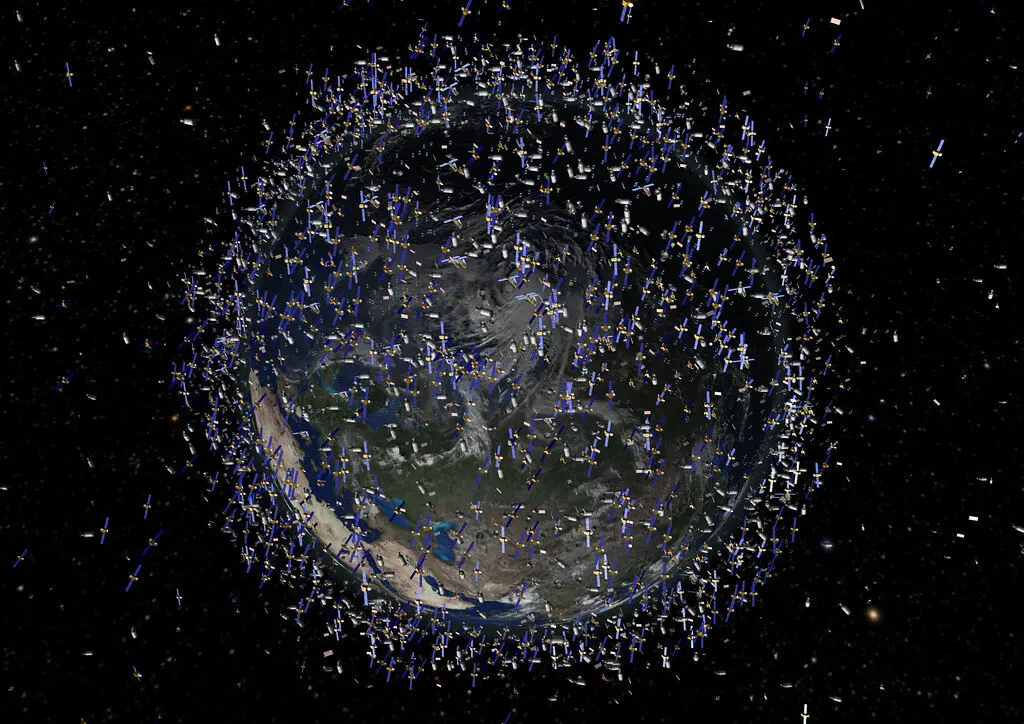
A new red-alert report from Accu, an engineering-components company, draws on data from the U.S. Space Surveillance Network and the Space-Track database. By Accu’s estimate, at least 12,550 trackable objects in orbit are “uncontrolled and unassigned.” That figure represents about 47% of the 33,269 known objects in orbit, which include roughly 17,690 satellites. Many of those satellites are no longer operational, and about 2,400 of the objects are spent rocket stages, so the actual amount of debris is likely higher.
Accu calculates that for every ten satellites in orbit there are seven pieces of debris. Three players account for most of that debris: China generated about 34% of it, the United States about 31%, and CIS countries about 31%.
Why space junk is dangerous
Space debris travels around Earth at extremely high speeds — roughly 17,400 miles per hour (about 28,000 km/h). Even the smallest fragment can severely damage a spacecraft or ruin a mission. In 2016, for example, a particle no larger than a few thousandths of a millimeter struck one of the four multi-pane windows of the Cupola observation module on the ISS and left a crater about a quarter-inch (approximately 6.4 mm) across.
Most abandoned objects slowly fall into lower orbits under Earth’s gravity and burn up on atmospheric entry, but that process can take years. Even if metals such as aluminum, copper, or lithium vaporize and never reach Earth’s surface, their particles remain in the upper atmosphere. More research is needed to understand the full impact of those particles, but evidence already links them to damage to the ozone layer.

What’s being done — and what’s still missing
Accu points out that there are no large-scale programs for systematic space-debris removal right now. Investments and initiatives to limit or mitigate the problem are growing, but they don’t yet cover the full scale of the threat.
- The European Space Agency (ESA) is leading projects such as ClearSpace-1 — the first mission aimed at actively collecting debris.
- Several private companies are also trying their hand at solutions: engineers are testing robotic manipulators, drag sails to increase atmospheric resistance, and even harpoons as possible tools for capturing and removing debris from orbit.
Accu estimates the total mass of space debris above Earth at about 15,550 tonnes — roughly the weight of 40 large passenger jets — and that mass is increasing. The report stresses the urgent need for international coordination and large-scale efforts rather than quick fixes. Without that coordination, space research and development will become much harder.
Based on material from Popular Science
Photo: Openverse
