
 Carlos Solis
Excavations organized by the University of Vigo returned to Castro de Hortas this spring. The campaign ran from late April to early May 2026 and was the second excavation at the Castro de Hortas site — an Iron Age hillfort.
Castro de Hortas stands out among Galician sites because it’s located on an island. In ancient times, that kind of location could have had huge strategic value: cliffs, sea routes, and sheltered waters made the place both hard to reach and strategically important.
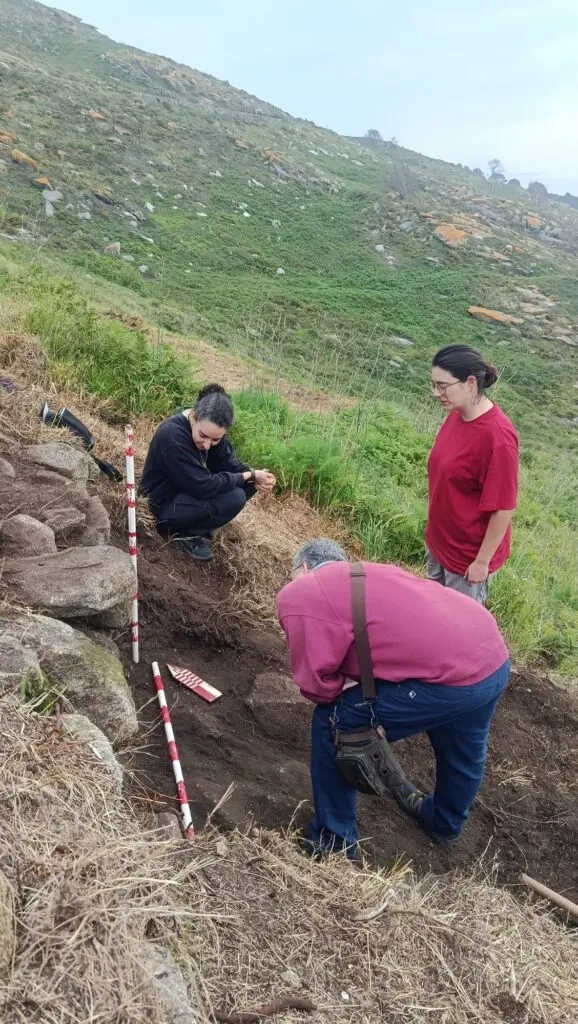
The team opened two trenches on the slope of the hill. The first trench widened an area excavated in 2025, where walls and a floor had already been recorded. The new campaign revealed additional buildings and confirmed two later occupation layers: one dates to late antiquity (roughly the 5th–6th centuries CE), and the other to the early Middle Ages (roughly the 9th–10th centuries CE).
This sequence of layers shows that the site is more than a simple Iron Age settlement: Castro de Hortas was likely occupied across a long span of time.
The Forgotten Diet That Reveals Island Life
The most striking discovery came from the second trench. Where a change in soil level had been interpreted as possible remains of a defensive wall, archaeologists uncovered a large midden, consisting of food waste from the hill’s inhabitants.
The team took numerous samples from the trench that specialists at the University of León will study. The analyses should help reconstruct the diet of the inhabitants of Castro de Hortas during the castro period and reveal how they used the sea and the surrounding land. The team also found a large amount of pottery that will be analyzed at the GEAAT laboratory on the Ourense campus.
Crucially, these waste layers lay outside a large house from the castro period, providing strong evidence of a significant settlement on the island before Roman influence.
The new excavations add depth to this landscape. Official heritage records had already indicated island use in prehistoric times, and the As Hortas area on the slope of Monte Faro was considered an important ancient campsite. Previously discovered shell middens hinted at a diet tied to shellfish and fish; the 2026 campaign gives that picture a much firmer archaeological basis.
For Galicia, the discovery means more than another dot on the archaeological map: it confirms that the Cíes Islands were not just a maritime landmark or a place with later monastic and medieval traces. An actual Iron Age settlement existed there, and its remains still survive under the soil.
Based on reporting from Arkeonews.
