
 Carlos Solis
 The weight of his achievements grew heavier after a severe, incurable disease distorted his body and took his speech — but it never defeated the brilliant mind that made him a legend.
Stephen Hawking’s key discoveries
Ranked 25th on the BBC list of the “100 Greatest Britons,” he was credited with developing theories about the origin of the universe and with popularizing the idea that advanced aliens might hide their existence to avoid more powerful civilizations. But Hawking’s main field was the physics of black holes. He showed that these “cosmic voids” emit energy as thermal radiation, gradually lose mass, and can “evaporate” — a process now known as Hawking radiation.
Working with Roger Penrose, Stephen Hawking extended the concept of a singularity (a state of infinite values where ordinary mathematical and physical laws break down), describing points of infinite density at the center of black holes and at the moment of the Big Bang. Together with James Hartle he worked on the “wave function of the universe” and used mathematical tools to study the history of the cosmos. Hawking also investigated the disappearance of information swallowed by black holes and proposed ways that information might be preserved.
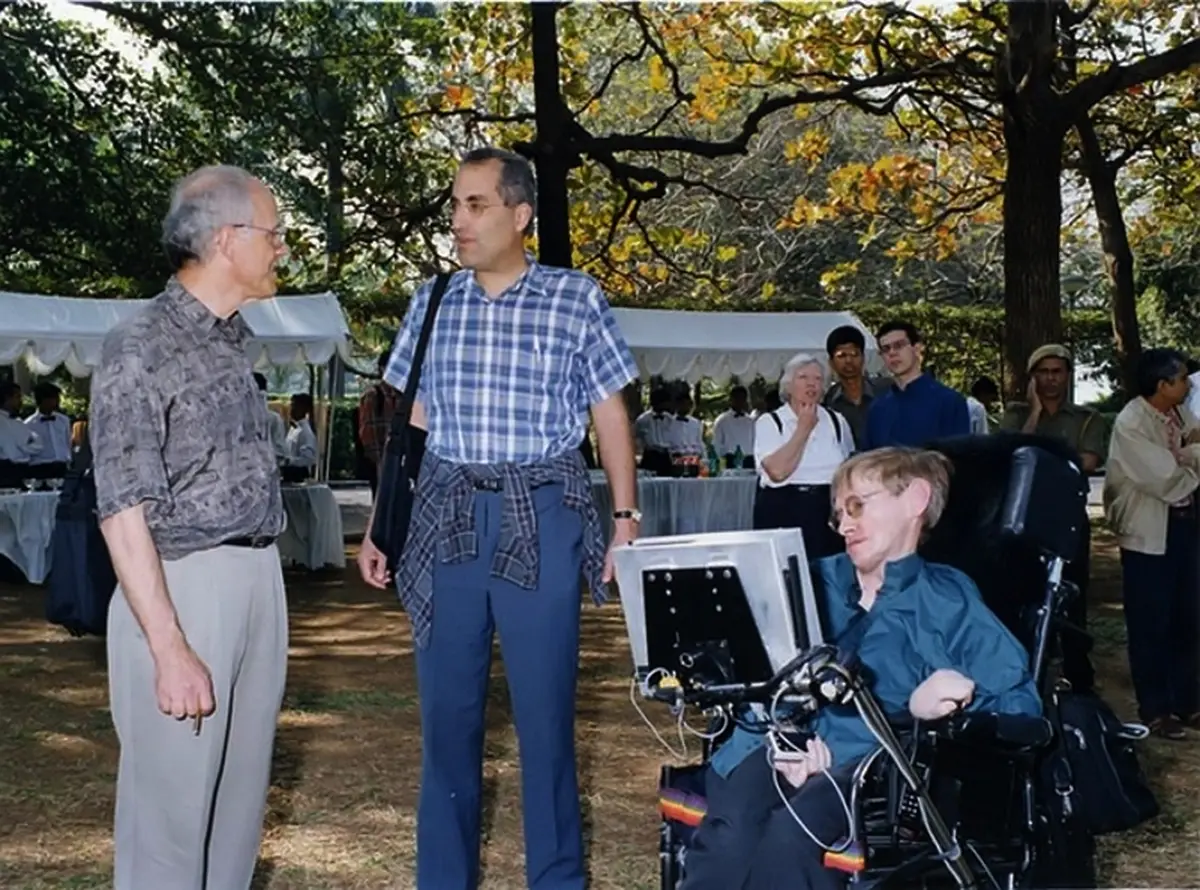
Stephen Hawking with string theorists David Gross and Edward Witten at a January 2001 string conference
Why his ideas mattered
Hawking’s biggest scientific contribution was to quantum cosmology: he applied the principles of quantum mechanics and thermodynamics to black holes and helped lay the groundwork for quantum gravity. That gave researchers a way to approach the boundary where our usual models break down and processes become unpredictable. Without quantum gravity, you can’t reliably predict what happens at those extremes. Cosmological singularities share features with the runaway prospect of unchecked technological growth.
When technology surpasses the human mind, it can trigger explosive, uncontrolled technological development. Biotechnologies and human–machine integration will transform civilization. Hawking’s theoretical work helped imagine some hypothetical consequences of those shifts. His research pursued deeply important directions, anticipated later advances, and spurred new studies. Hawking’s focus on foundational physics cemented his place in the history of the physical sciences.
Between Oxford and Cambridge
The English theoretical physicist was born in Oxford and died in Cambridge, and living and working in Britain’s major university centers was decisive for his scientific career. He graduated from Oxford at 20, and for three decades (1979–2009) he held the prestigious Lucasian Professorship of Mathematics and served as a distinguished professor at the University of Cambridge.
As director of research at Cambridge’s Centre for Theoretical Cosmology, Hawking was a member of the Royal Society, the Pontifical Academy of Sciences, and other scholarly bodies. The United States recognized his contribution to science with its highest civilian award, the Presidential Medal of Freedom. Hawking’s popular books — including A Brief History of Time, The Universe in a Nutshell, and The Grand Design — explain complex ideas in accessible language and became bestsellers.

Cosmic coincidences
Hawking was born on January 8, 1942 — exactly 300 years after the death of the great physicist, mathematician, and astronomer Galileo Galilei. That was the first “cosmic hint” about where the future cosmologist might find his calling. Another notable predecessor on his chosen path was the creator of classical physics and mathematical analysis, Isaac Newton, who, by a strange twist of fate, was born the year Galileo died: January 4, 1643.
Hawking literally and figuratively followed in that scientific predecessor’s footsteps. Cambridge linked scientists of different eras: both Hawking and Newton held the Lucasian Professorship of Mathematics, an extraordinary academic chair founded in 1663 by Cambridge alumnus and benefactor Henry Lucas and funded by his bequest. Hawking received his education at his hometown university, Oxford.
A family that worshiped learning
Hawking’s parents both studied at prestigious Oxford. His father, Frank Hawking, studied medicine and researched tropical diseases, while his mother, Isabelle Walker, worked as a secretary at a medical research institute and studied philosophy, politics, and economics. Hawking’s mother came from a family of doctors in Glasgow, and his prosperous great-grandfather lived in Yorkshire. After losing the family’s money in a failed farm investment during an agricultural crisis, Hawking’s great-grandmother opened a private school at home.
A culture of education dominated the Hawking household for generations. When Frank Hawking became head of the parasitology department at the National Institute for Medical Research in 1950 and moved the family to St Albans in Hertfordshire, locals found the new neighbors extremely intelligent but eccentric: they drove a converted taxi, read books silently at lunch, let their large house fall into disrepair, and seemed unconcerned.
In search of the fundamental
When the family head traveled to Africa for work, the family could spend four months on holiday in Mallorca, staying with friends. Stephen admired his always-busy father and tried to model himself on him. “Because my father was a scientist, doing science seemed natural to me,” Hawking explained. “But I was not attracted to medicine and biology; I wanted to work on something fundamental and I found the precision I needed in physics.”
When he was 21, doctors diagnosed him with a hopeless illness and expected he had only a few years to live. Despite that prognosis, Hawking lived to age 76, astonishing the medical community. After being diagnosed with amyotrophic lateral sclerosis (ALS), a motor neuron disease, he married twice, became a father, had grandchildren, and left over 50 years of productive work and a substantial intellectual legacy.

Stephen Hawking marrying Jane Wilde
A journey into infinity
“Although a cloud loomed over my future, after the shock of the diagnosis I began to get more enjoyment out of life,” the theoretical physicist said about how his outlook changed. He didn’t postpone living: he proposed to the woman he’d known since university and arrived to register the marriage in 1965 leaning on a cane. Jane Wilde, Hawking’s young wife, could hardly have known exactly what the future would bring.
Jane later wrote an autobiographical book, Travelling to Infinity: My Life with Stephen, and that book became the basis for the British feature film The Theory of Everything. A documentary series, The Universe of Stephen Hawking, also appeared. Those films show that Hawking completed his doctoral work thanks to daily medical care and his wife’s devotion, which helped him continue sharing his ideas.
How they first met
Jane described her first impression of the Oxford student this way: “On the other side of the street walked an ungainly young man with his head down and his face hidden under a rebellious mop of dark hair. Lost in his thoughts, he noticed no one and paid no attention to our group of schoolgirls on the other side of the road. For sleepy St Albans he was a nonconformist, an eccentric phenomenon.” Jane was won over by his independence and his sense of humor.
“Listening to this unusual man was very interesting and pleasant,” Jane recalled. “He would gasp with laughter at his own jokes, many of which were about himself.” Two years after their marriage, in 1967, the couple’s son Robert was born; three years later their daughter Lucy was born (Lucy would become a writer); and in 1979 their son Timothy was born. Caring for Hawking’s children added to Jane’s burdens, and later problems became nearly unbearable for her.

How Stephen Hawking communicated
Until 1974 Hawking could manage much of his care himself: he could get out of bed and feed himself, but after that he required professional assistance. In 1985 he developed pneumonia, which led to a tracheotomy operation and the loss of his voice. From that point on Hawking used a wheelchair, relied on round-the-clock help from a team of devoted assistants, and had to relearn how to communicate with others.
At first Hawking communicated with his wife using letters on a board: Jane would sweep through the alphabet and when she reached the letter he wanted, the speech-impaired man lifted an eyebrow. Later engineers created a computer program that let him select words on a screen using a special switch controlled by a finger or a cheek muscle. A speech synthesizer spoke the selected words — the artificial voice made public speaking and continued scientific work possible.
A marriage put to the test
In her book Travelling to Infinity Jane described how she saved her husband’s life by refusing doctors’ advice to switch off the ventilator when complications from pneumonia arose. She answered the doctor’s question about ending life support with firmness: “Stephen must live!” At the time Hawking already had several million dollars that his wife would have inherited if he had died, but she was not thinking about that. However, beginning in 1990 the couple, after 26 years together, started living apart.
Exhausted, Jane began an affair with a family friend, Jonathan Jones, who helped her cope with daily problems. Five years later Stephen and Jane divorced. Immediately in 1995 Hawking married his caregiver Elaine Mason, who left her husband and two children for him (ironically, Jane had originally hired Elaine). That second marriage lasted 11 years. Hawking later described those years as “passionate and stormy”; his body bore marks that suggested he had been assaulted.

Weightlessness and gravity
Hawking treated life philosophically, and many of his aphorisms stuck: “From the point of view of the cosmos our problems are tiny,” “Where there is life there is hope,” “To achieve something, don’t give up,” and “The universe would be meaningless if it were not the home of our dear ones.” In 2007 Hawking flew in zero gravity and returned to Earth very happy. He also took pleasure in repairing relationships with his first wife, his children, and his three grandchildren.

Stephen Hawking flying in a Zero Gravity aircraft
Of course, scientific work brought Hawking great joy. He spent his final years in Cambridge, working at the university until the end of his life. The genius who defied death for 50 years died at age 76. The date of his death carried a symbolic weight similar to his birth: he died at his Cambridge home on the night of March 14, 2018 — International Pi Day and the birthday of Nobel laureate Albert Einstein, who also studied gravity.
The universe’s design
Why didn’t Stephen Hawking receive a Nobel Prize despite his enormous contribution to physics? The reason is that many of his key ideas, hypotheses, and predictions could not be experimentally verified. Confirming revolutionary theoretical physics hypotheses often requires major technological breakthroughs that come later. A recognition of Hawking’s achievements was the burial of his ashes near Isaac Newton’s grave in Westminster Abbey in London.
Hawking’s children completed his final book by adding answers they found in his archives to questions that concerned him and humanity. An avowed atheist, Hawking wrote: “Everyone is free to believe what they want, but most likely God does not exist. Nobody created the universe and nobody directs our fate. Physical science leads me to the confident belief that there is no heaven and that the afterlife is a fairy story for people afraid of the dark. We have this one life to appreciate the grand design of the universe, and for that I am hugely grateful.”
